Abuses, Unanswered Questions, and US-Ecuador Security Cooperation
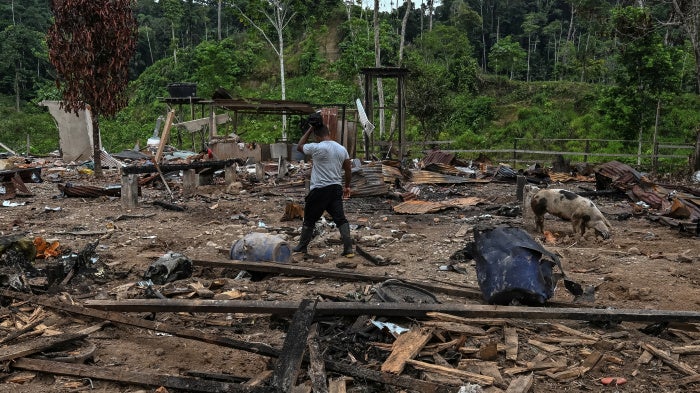
The 94-page report, "A Dangerous Partnership: Abuses, Unanswered Questions, and US-Ecuador Security Cooperation," documents serious human rights violations in a rural community on the Colombia-Ecuador border, as well as attacks on and the disappearance of fishermen at sea near the Galápagos Islands. Each incident either clearly implicates the US-Ecuador security partnership or surfaces questions about responsibility. Ecuadorian forces tortured and arbitrarily detained four farm workers, and later burned and struck a dairy farm, during what the United States called a “partnered operation.” And drones of unknown origin attacked two fishing vessels, injuring several crew members. A third vessel remains missing.
Afghanistan has been the scene of some of the most serious human rights violations on record. About one half of the country's prewar population is either in emigration, or internally displaced, or dead. Most of the biolations documented in three previous Helsinki/Asia Watch reports continued in 1987, despite the fact that prospects for peace in 1988 seem brighter than ever before.
This 33-page report by Americas Watch and the National Coalition for Haitian Refugees finds that, far from encouraging political pluralism, the Haitian goverment is stiffling opposotion political parties; shutting down the independent press; attempting to silence the Church; and terrorizing members of the inteligentsia who have attempted to speak out about Haiti's critical economic and social prob
This 25 page report by the National Coalition for Haitian Refugees, Americas Watch, and the Lawyers Committee for International Human Rights examines human rights conditions in 1984, a year when respect for human rights continued to be poor, and in some respects deteriorated significantly.
The Committee to Protect Journalists and the the Americas Watch mission to Haiti from August 12-15,1984 to investigate a recent crackdown on the press.
A Report on Human Rights in Haiti Based on a Mission of Inquiry
This 17- page report by the Americas Watch and the Lawyers Committee for International Human Rights finds that the circumstances in which the February 12, 1984 elections were held in Haiti involved, in the words of US Secretary of State George Shultz, a denial of "all the preliminary aspects that make an election really mean something."
This 24 page report by the Lawyers Committee for International Human Rights, Americas Watch Committee, and the International League for Human Rights examines the situation of people who support human rights in Haiti, and in particular a series of detentions in May 1983.
A Fund for Free Expression Report by Meron Benvenisti
In its pre-publication review of Palestinian newspapers and magazines, Israel’s military censor blocks the publication not only of supposed national security secrets or material likely to incite violence. Rather, the censor’s primary concern, as shown through a study of banned materials, is to eradicate expression that could foster Palestinian nationalist feelings; suggests Palestinians are a nation with a national heritage; denies Israel’s legitimacy; or imputes behavior to Israeli officials that suggests illegitimacy. Palestinian editors must submit for review all material meant for publication, including photos, advertisements, and crossword puzzles. The censor’s list of banned books included some 1,600 titles, at the time this report was prepared.