Abuses, Unanswered Questions, and US-Ecuador Security Cooperation
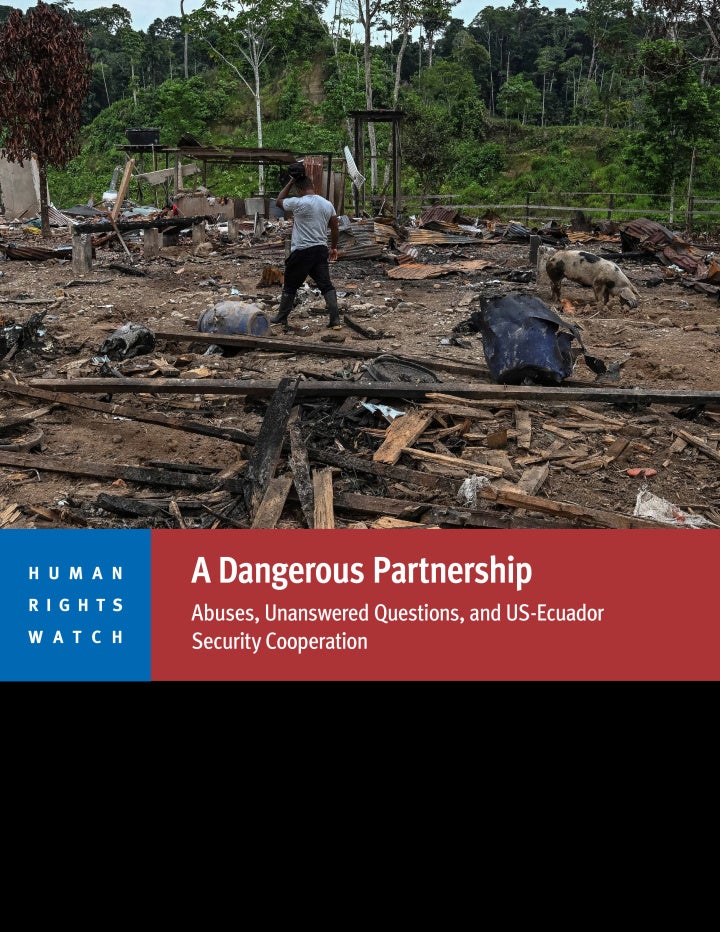
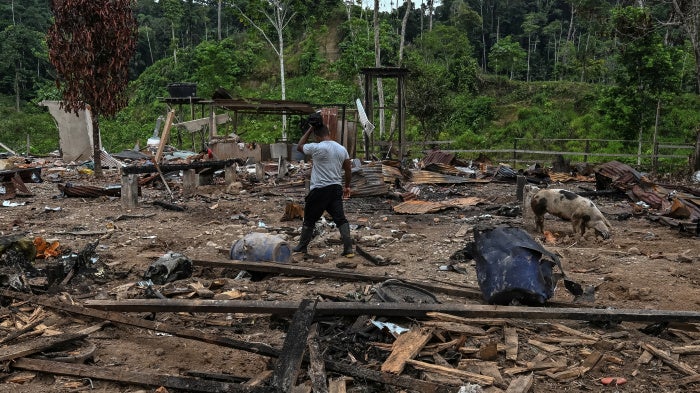
The 94-page report, "A Dangerous Partnership: Abuses, Unanswered Questions, and US-Ecuador Security Cooperation," documents serious human rights violations in a rural community on the Colombia-Ecuador border, as well as attacks on and the disappearance of fishermen at sea near the Galápagos Islands. Each incident either clearly implicates the US-Ecuador security partnership or surfaces questions about responsibility. Ecuadorian forces tortured and arbitrarily detained four farm workers, and later burned and struck a dairy farm, during what the United States called a “partnered operation.” And drones of unknown origin attacked two fishing vessels, injuring several crew members. A third vessel remains missing.
Violence between separatist Sikh militants and government forces in Punjab has escalated to unprecedented levels, claiming thousands of civilian lives. Since 1984, the security forces have adopted increasingly brutal methods to stem the militant movement, resulting in widespread human rights violations.
This comprehensive assessment of the current human rights situation in Kenya goes well beyond those aspects that are ordinarily the focus of international attention: the efforts of Nairobi-based journalists, lawyers, clergy and political figures to promote the rule of law and an open, accountable system of government. This book also details the arbitrary, punitive and cruel measures by the government of President Daniel arap Moi against rural and urban squatter communities; the miserable conditions of confinement in detention facilities and prisons for those charged with common crimes as well as for those held for political offenses; the violence with which Kenya annexed 14,000 square kilometers of disputed territory on the border between Kenya, Sudan and Ethiopia in 1988; the brutality of the implementation of emergency powers in the North Eastern Province; and the discriminatory "screening" of ethnic Somalis and the ill- treatment of refugees from Kenya's war-torn neighbors.
When Patricio Aylwin became President of Chile, on March 11, 1990, he had promised to resolve the human rights legacy of over sixteen years of military dictatorship, through a process of exposing the truth about past abuses and seeking justice. President Aylwin's efforts have been hampered by the Constitution of 1980 that defines a form of government that falls short of full democracy.
Aceh, the "special region" of Indonesia on the northern tip of Sumatra, continues to be the target of an intensive counterinsurgency campaign waged by the Indonesian army against guerrillas of the Aceh Merdeka or Free Aceh movement.
Administration's `Alien Terrorist Removal' Plan Puts U. S. in Company of Repressive Regimes
The Bush Administration has proposed legislation in Congress that would authorize secret proceedings for the deportation of foreign nationals accused of terrorism. If enacted, this proposal would depart from two centuries of history and law in the U.S.
The Medicolegal System and Human Rights in Guatemala
Since the overthrow of a reformist democratic government in 1954, Guatemala has been known for astounding military violence inflicted on a defenseless civilian population. A new civilian government elected in 1986 first raised and then dashed hopes for an end to the torture, murder and disappearances carried out with impunity by the security forces.
Civilian Casualties During the Air Campaign and Violations of the Laws of War
This report applies the rules of war governing international armed conflicts to examine civilian casualties and damage to civilian objects from bomb and missile attacks carried out by the allied forces against Iraq during Operation Desert Storm, and from missile attacks by Iraq against Israel, Saudi Arabia, Bahrain and Qatar.
Despite the political changes that have occurred in Bulgaria since Todor Zhivkov's resignation in November 1989, Gypsies continue to be the targets of discrimination, as they have been throughout the country's history. The disparate treatment they receive is reflected in housing, education and the work place.
Indonesian authorities are about to bring at least two young men to trial on charges of insulting public officials for having distributed a calendar that caricatured government leaders.
Since the partition of India in 1947, Kashmir, with a predominantly Muslim population, has been the site of militant unrest and a cause for war with Pakistan.
Killings, Detentions, Forcible Conscription and Obstruction of Relief
Ethiopia is in the midst of a massive political upheaval. Government forces have been defeated in recent rebel offensives, endangering the survival of the government of President Mengistu Haile Mariam.
The violent events of February 17, 1991, and their aftermath suggest that egregious violations continue to be committed with impunity by agents of the Guatemalan state and that human rights activists, who risk their lives to protect others, continue to be severely persecuted.
On April 8, 1991, Arswendo Atmowiloto, a young newspaper editor in Jakarta was sentenced to five years in prison. His arrest, trial and conviction on charges of insulting a religion raise questions about the relationship between freedom of expression, religious sensitivity, and political manipulation in an overwhelmingly Muslim society.
The ouster of General Manuel Noriega in December 1989 and the installation of the democratically-elected coalition government of President Guillermo Endara brought high hopes in Panama that a long period of disrespect for law and the civil rights of the Panamanian people had come to an end.