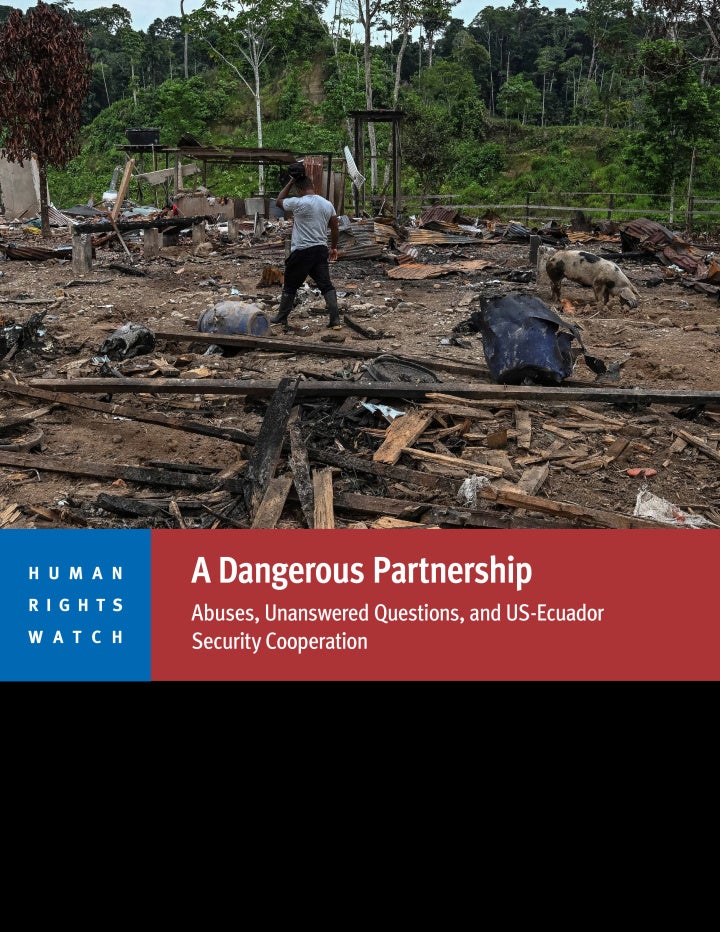
Abuses, Unanswered Questions, and US-Ecuador Security Cooperation
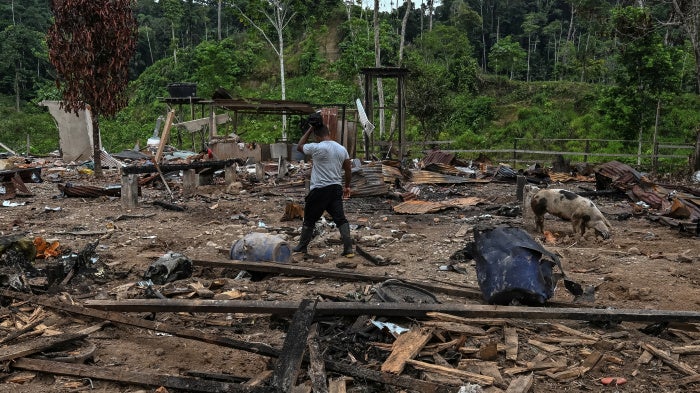
The 94-page report, "A Dangerous Partnership: Abuses, Unanswered Questions, and US-Ecuador Security Cooperation," documents serious human rights violations in a rural community on the Colombia-Ecuador border, as well as attacks on and the disappearance of fishermen at sea near the Galápagos Islands. Each incident either clearly implicates the US-Ecuador security partnership or surfaces questions about responsibility. Ecuadorian forces tortured and arbitrarily detained four farm workers, and later burned and struck a dairy farm, during what the United States called a “partnered operation.” And drones of unknown origin attacked two fishing vessels, injuring several crew members. A third vessel remains missing.
Human Rights Violations by the Government of Zviad Gamsakhurdia
Helsinki Watch has sent two fact-finding missions to Georgia in recent months that have documented severe violations of human rights on the part of the Gamsakhurdia government, including violations of freedom of speech and the press, violations of the right to free assembly, the imprisonment of political opponents, some of whom have not used or incited others to violence, the torture and mistreatm
The trial of nine Salvadoran army soldiers and officers accused in the November 1989 murders of six Jesuit priests, their housekeeper and her daughter took place in San Salvador on September 26-28, 1991, in front of a host of international observers including Americas Watch.
On November 12, 1991 in Dili, the capital of East Timor, anywhere from 75 to 200 people are estimated to have been killed when Indonesian troops opened fire on a demonstration. The demonstrators were calling for the independence of East Timor, the former Portuguese colony of some 700,000 people on the eastern half of the island of Timor, off the north Australian coast.
A decade ago, on December 4, 1981, the South African government declared that the Ciskei, an arbitrarily defined area in the south east of the country, had joined three other "national states" in receiving "independence." No other state recognizes the independence of Ciskei or of the other homelands.
The Cairo-based Arab Women's Solidarity Association (AWSA) was ordered dissolved by an administrative decree dated June 15, 1991. The action was taken pursuant to the 1964 Law of Associations which regulates private voluntary organizations in Egypt. AWSA actively promotes women's rights in Egypt and the Arab world. The founder and president of AWSA, Dr.
A Personal Statement by Dr Mohamed Mostafa Mandour
Dr. Mohamed Mandour, an Egyptian medical doctor and psychiatrist, was administratively detained by the Egyptian security authorities for sixteen days in February 1991. He was brought from his home after midnight to State Security Intelligence headquarters at Lazoughly, Cairo. He was held there for ten days, from the early morning hours of February 8 until the morning of February 17.
While torture by the police in Argentina is viewed as a serious problem by its citizens, and efforts have been made to curb its use, it is still widespread.
The government of Jean-Bertrand Aristide compiled a record on human rights which showed much promise but which was also marked by certain troubling practices.
The United States imprisons more than a million of its citizens at any given time, a larger number than anyother country. After visits to more than twenty institutions in the U.S. and Puerto Rico, including state, INS, and federal prisons as well as jails, Human Rights Watch concludes that the most troubling aspect of the human rights situation in U.S.
Human Rights Violations Since the November Cease-fire
On November 28, 1990, Liberia's warring factions signed a cease-fire agreement, theoretically ending 11 months of fighting that had ravaged the country.
Human Rights Since the Assassination of Archbishop Romero
The most comprehensive account now available on human rights violations in El Salvador, A Decade of Terror documents the civil war between an armed insurgency and the military-backed government, and explains how it has led to a decade of ferocious political violence that has cost thousands of civilian lives.
Heads of state of Commonwealth nations meet this month in Harare, Zimbabwe. Their gathering is an important opportunity to take tangible steps to recognize the importance of human rights in the member states and to commit the Commonwealth to an initiative that would significantly enhance its role in combatting human rights abuses.
Human rights abuses are persistent and chronic in Northern Ireland, affecting Protestants and Catholics alike, and are committed by both security forces and paramilitary groups in violation of international standards.
The Brazilian government is failing to prosecute violence against women in the home fully and fairly. Despite ever-increasing domestic violence (particularly wife-murder, battery and rap) impunity and discriminatory treatment in favor of the perpetrators of domestic violence are still the rule in the Brazilian justice system.