Abuses, Unanswered Questions, and US-Ecuador Security Cooperation
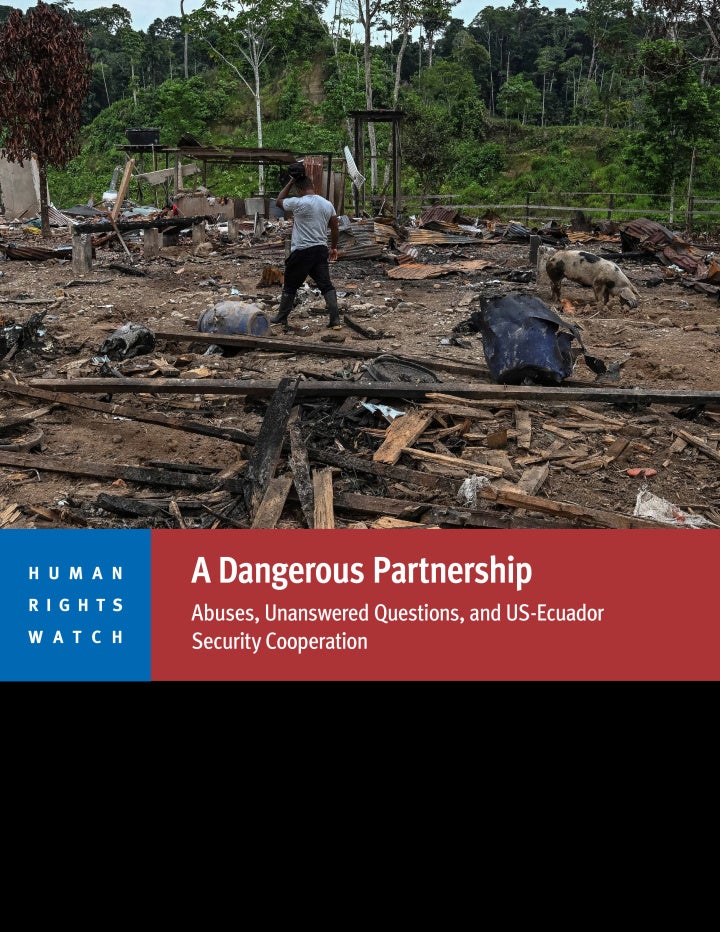
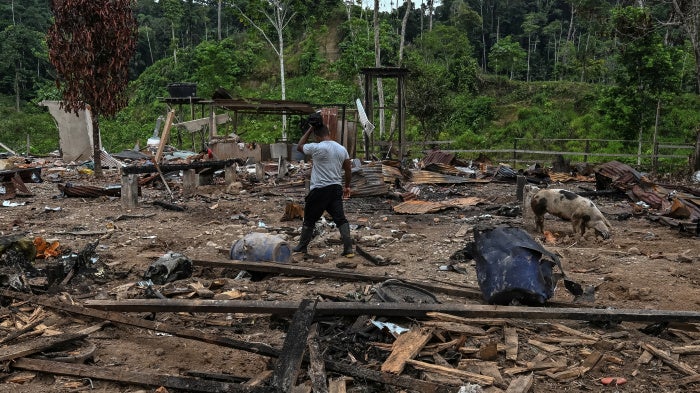
The 94-page report, "A Dangerous Partnership: Abuses, Unanswered Questions, and US-Ecuador Security Cooperation," documents serious human rights violations in a rural community on the Colombia-Ecuador border, as well as attacks on and the disappearance of fishermen at sea near the Galápagos Islands. Each incident either clearly implicates the US-Ecuador security partnership or surfaces questions about responsibility. Ecuadorian forces tortured and arbitrarily detained four farm workers, and later burned and struck a dairy farm, during what the United States called a “partnered operation.” And drones of unknown origin attacked two fishing vessels, injuring several crew members. A third vessel remains missing.
Despite a decade of promises by government officials to bring to justice those responsible for gross violations of human rights in El Salvador, the impunity of military officers and death squads members remains intact.
For ten days in May of this year, Ethiopia saw its first significant open civilian opposition for fifteen years, in a series of protests led by students. A wave of strikes was sparked by the government execution of 12 army generals on May 19. Earlier in March, the government had promised political tolerance and pluralism.
The policy of the Greek government with regard to the Turkish minority seems to be, as described by the Minority Rights Group, a "deliberate policy of discrimination with a long-term aim of assimilation." The findings of the Helsinki Watch mission certainly confirm this analysis.
The rule of law is only fitfully respected in Indonesia, the world's fifth largest country. This fact is vital to understanding the conditions of Indonesian prisons. Many of the senior staff of the Directorate of Corrections, the unit of the Ministry of Justice responsible for prisons, are able and concerned people with a clear commitment to prison reform.
Police Acquitted in Killing of Students in Quezaltenango
A Guatemalan appeals court has freed six National Police officers jailed for the 1987 kidnapping and murder of two university students. The appellate court ruling, which overturned the only conviction to date of security force officers for a crime of political violence, underlines the complete impunity with which the Guatemalan authorities commit gross violations of human rights.
Policies that Contribute to the Killings (A Middle East Watch Report)
This report examines three aspects of Israeli policy that have contributed to the frequency of unlawful killlings of Palestinians during the intifada. These are the open-fire regulations issued to Israeli troops operating in the occupied West Bank and Gaza Strip that are more permissive than what the internationally recognized standards of necessity and proportionality allow; the inadequate procedures followed by the Israel Defense Force (IDF) to investigate and punish troop misconduct against Palestinians; and the restrictions imposed by the IDF on independent bodies attempting to monitor its conduct in the occupied territories.
A comprehensive investigation of brutal human rights violations told in chillingly dispassionate style, Human Rights in Iraq describes how the Ba’ath regime subjects Iraqi citizens to forced relocation and deportation, arbitrary arrest and detention, torture, “disappearance,” and summary political execution.
An array of violent human rights abuses committed by public security units have become institutionalized in Mexican society. Americas Watch concludes that this pattern of excessive violence can only mean that either the Mexican government has adopted a policy of tolerating such behavior, or it has lost control over its police, security and prosecutorial agencies.
The Ghanaian government, the Provisional National Defence Council(PNDC), has attempted to crack down on churches and other religious organizations through the imposition of a controversial new law. PNDC Law 221 requires all religious bodies to register with the Ministry of the Interior, so as to make them "accountable" to the government.
A small group of rebel insurgents attacked the Liberian border town of Butuo in late December 1989, killing an undetermined number of soldiers and immigration officials. The government of Liberia responded to the attack with a show of force, sending two battalions to Nimba County, where Butuo is located.
As Cuba approaches the 36th anniversary of its revolution, it is engaged in an extended crackdown on independent peaceful activity and its human rights practices continue to be subject to the whim of the executive. Among the targets of this crackdown are newly-emerged human rights groups, whose establishment in recent years had given the appearance of greater openness in Cuba.