Abuses, Unanswered Questions, and US-Ecuador Security Cooperation
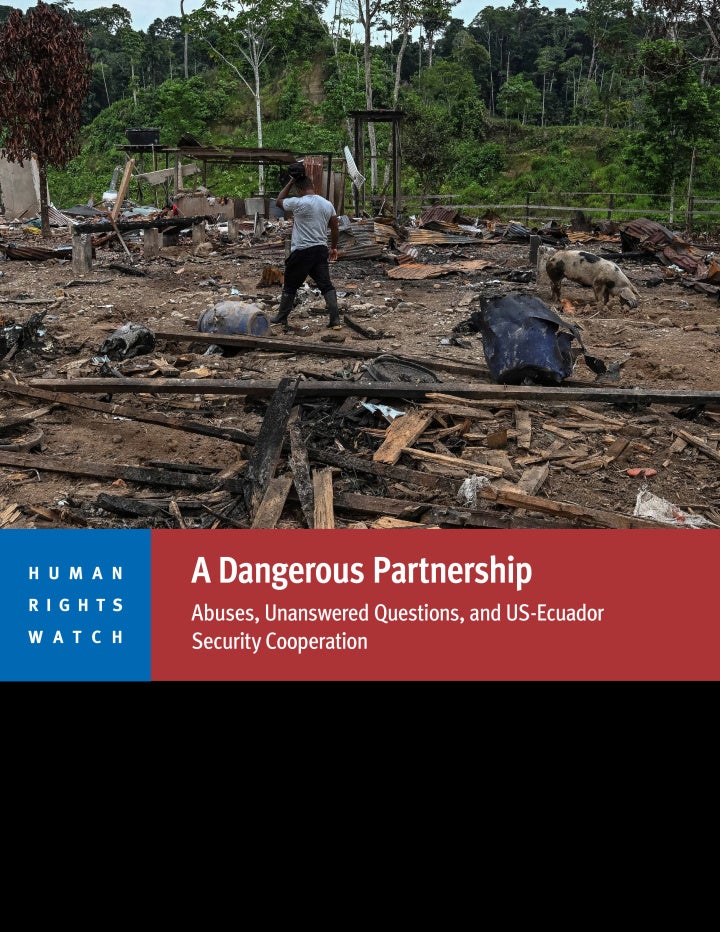
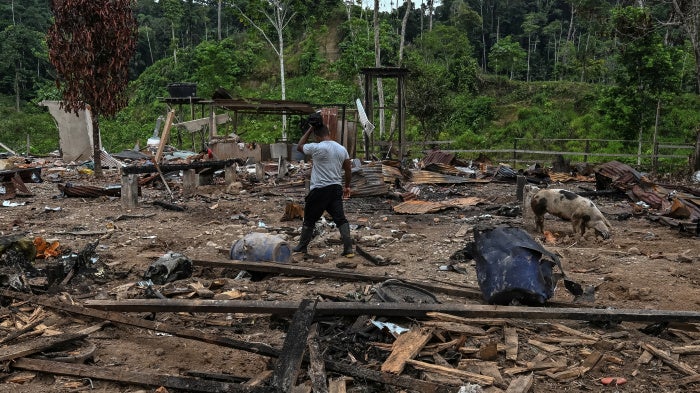
The 94-page report, "A Dangerous Partnership: Abuses, Unanswered Questions, and US-Ecuador Security Cooperation," documents serious human rights violations in a rural community on the Colombia-Ecuador border, as well as attacks on and the disappearance of fishermen at sea near the Galápagos Islands. Each incident either clearly implicates the US-Ecuador security partnership or surfaces questions about responsibility. Ecuadorian forces tortured and arbitrarily detained four farm workers, and later burned and struck a dairy farm, during what the United States called a “partnered operation.” And drones of unknown origin attacked two fishing vessels, injuring several crew members. A third vessel remains missing.
Two years after a bloody and devastating civil war, the human rights situation in Tajikistan remains precarious. Since the spring of 1993, refugees and internally displaced persons have returned to their villages in the southern province of Khatlon, from which the largest number of people were displaced following the war.
The U.S. has pursued the development of at least 10 different tactical laser weapons that have the potential of blinding individuals. The existence of most of these programs is not known to the American public, Congress, or even throughout the military, and services responsible for laser weapons seem largely unaware of the programs in research and development in other services.
For the last decade South Africa’s KwaZulu-Natal region has been troubled by political violence. This conflict escalated during the 4 years of negotiations for a transition to democratic rule, and reached the status of a virtual civil war in the last months before the national elections of April 1994, significantly disrupting the election process.
International Support for the Perpetrators of the Rwandan Genocide
After a year in exile, the perpetrators of the Rwandan genocide have rebuilt their military infrastructure, largely in Zaire, and are rearming themselves in preparation for a violent return to Rwanda.
One year after the genocide began in Rwanda, the crisis continues. Despite calls for justice inside and outside the country, no criminal trials, national or international, have taken place. The Rwandan government is now arresting some 1,500 persons a week, producing life-threatening overcrowding and appalling treatment in the prisons and fostering insecurity among the population at large.
The current epidemic of communal violence--violence involving groups that define themselves by their differences of religion, ethnicity, language or race--is today's paramount human rights problem.
Germany has been confronted with a disturbing escalation in violent crimes against those who are different, and especially those who are perceived as not ethnic German during the period since unification. Racism that is endemic in many societies has exploded in a public way in Germany.
Human Rights Abuses Along the U.S. Border with Mexico Persist Amid Climate of Impunity
U.S. Border Patrol agents are committing serious human rights violations, including unjustified shootings, rapes and beatings, while enjoying virtual impunity for their actions.
One year after the genocide began in Rwanda, the crisis continues. Despite calls for justice, no criminal trials, national or international, have taken place. As of April 1995, the Rwandan government was arresting some 1,500 persons a week, producing life-threatening overcrowding and appalling treatment in the prisons and fostering insecurity among the population at large.
The departure of the last U.N. troops of the Somalia operation in March 1995 marks a critical juncture for Somalia, and for international peacekeeping. In researching this report, we set out to discover what would be left behind when the U.N.
The Vietnamese government's recent detention of two prominent senior monks is the latest step in its campaign to suppress the Unified Buddhist Church, the main Buddhist organization in south and central Vietnam prior to unification of the country in 1975.
As the multinational force prepared to turn over operations to the U.N. Mission in Haiti (UNMIH) on March 31, 1995, political tensions increased and far from having brought stability, the U.S.-led force pointed only to a fragile security that impending parliamentary and presidential elections may rupture.
Economic and political changes in Russia have left many Russians staggering under the burdens of rising unemployment, high rates of inflation, disappearing social services and the encroaching threats of corruption and organized crime.
Human Rights Watch opposes the imposition of the death penalty on all criminal offenders in all circumstances because of its inherent cruelty. In addition, Human Rights Watch is concerned that the death penalty is most often carried out in a discriminatory manner on racial, ethnic, religious or political grounds.
Prisoners in Japan face routine violations of human rights from the moment of arrest through the end of their prison term. After being apprehended, Japanese suspects are placed in police detention (daiyo-kangoku) where they face severe pressure, often involving physical abuse, in order to obtain confessions.