Abuses, Unanswered Questions, and US-Ecuador Security Cooperation
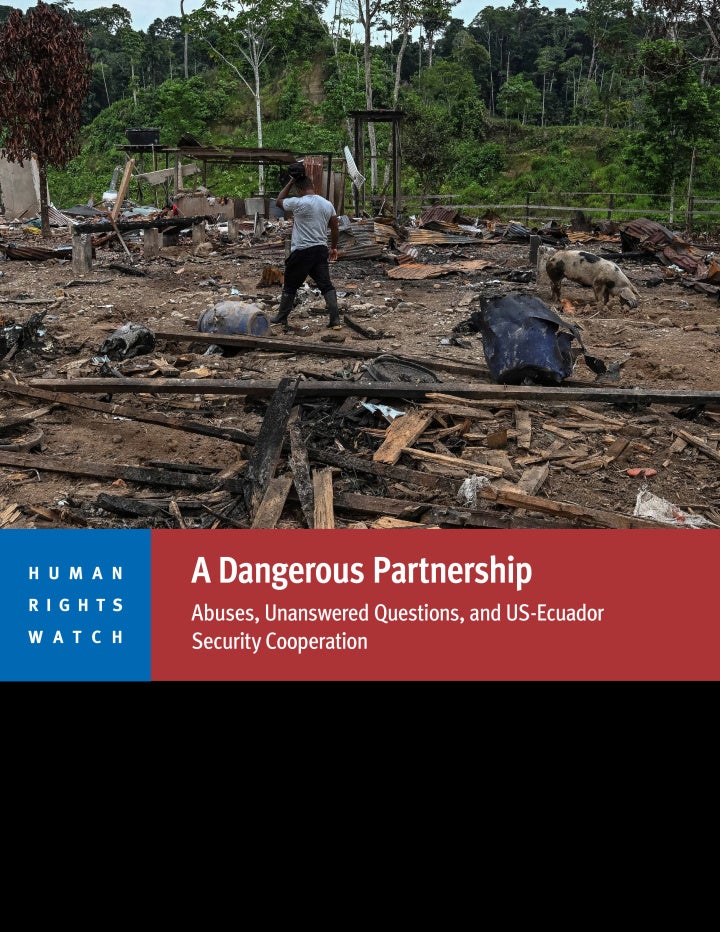
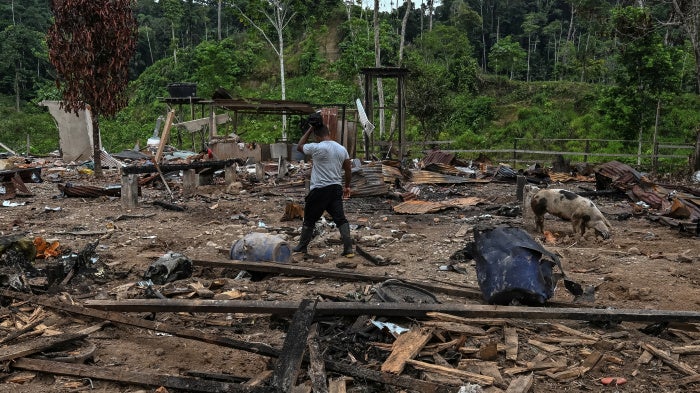
The 94-page report, "A Dangerous Partnership: Abuses, Unanswered Questions, and US-Ecuador Security Cooperation," documents serious human rights violations in a rural community on the Colombia-Ecuador border, as well as attacks on and the disappearance of fishermen at sea near the Galápagos Islands. Each incident either clearly implicates the US-Ecuador security partnership or surfaces questions about responsibility. Ecuadorian forces tortured and arbitrarily detained four farm workers, and later burned and struck a dairy farm, during what the United States called a “partnered operation.” And drones of unknown origin attacked two fishing vessels, injuring several crew members. A third vessel remains missing.
Millions of workers in Pakistan are held in contemporary forms of slavery. Throughout the country employers forcibly extract labor from adults and children, restrict their freedom of movement, and deny them the right to negotiate the terms of their employment. Employers coerce such workers into servitude through physical abuse, forced confinement, and debt-bondage.
This report focuses on Syria’s state security court and the continuing trials of individuals accused of membership in unauthorized political groups. It also examines the practice of torture in Syria, and the pressure and punishment placed on political prisoners after release.
On May 1, 1995, Croatian Army troops launched an offensive aimed at regaining control of Serb-held lands in western Slavonia, an area designated as a "United Nations Protected Area." By May 4, Croatian government troops had recaptured the area. During the week of May 8, we traveled to Croatia to assess the behavior of Croatian troops during and immediately after the offensive.
A Case-Study of Military Repression in Southeastern Nigeria
Two years after the annulment of the June 1993 presidential election, which was widely viewed to have been won by Chief Abiola, the Nigerian political climate was volatile and human rights violations pervasive. The repressive tactics of the government of Gen.
Rights Abuses Follow Renewed Foreign Aid Commitments
Since December 1994, there has been a notable deterioration in the human rights situation in Kenya, evidenced by Pres. Moi's crackdown against human rights activists, opposition politicians and internally displaced persons.
Gao Yu, 51, one of China’s most prominent journalists, was sentenced to six years in prison on November 10, 1994, for “illegally providing state secrets to institutions outside [China’s] borders” in a series of four articles in Mirror Monthly and Overseas Chinese Daily, both Hong Kong-based publications.
Bolivia, one of the world’s leading producers of coca leaf and refined cocaine, is also the largest recipient of U.S. counter-narcotics aid. The aid has led to new legislation, institutions and antinarcotics strategies in Bolivia that are shaped by U.S. concerns and dependent on U.S. funding.
On April 8, 1995, senior Mexican army officers invited us to discuss the human rights situation in Chiapas and offered information on the internal investigations conducted by the army into several violent incidents of the 1994 Chiapas uprising of the Zapatista National Liberation Army and its suppression.
By early 1995, the international tribunal established by the U.N. to adjudicate war crimes and crimes against humanity in the former Yugoslavia had indicted 22 individuals for serious violations of humanitarian law, including the crime of genocide.
eginning in June 1994, the government of Iraq issued at least nine decrees that establish severe penalties, including amputation, branding and the death penalty for criminal offenses such as theft, corruption, currency speculation and military desertion.
Haiti faced its first opportunity for genuine, democratic elections since the 1990 contest that brought Pres. Aristide to office with the parliamentary and local elections held on June 25, 1995.
One year after President Clinton unconditionally renewed Most Favored Nation status for China and international pressure on China to improve its human rights practices dropped off dramatically, the Chinese government continues to impose tight controls on dissent and to engage in a pattern of systematic abuse of prisoners.
Trafficking of Nepali Girls and Women to India’s Brothels
Hundreds of thousands of women and children are employed in Indian brothels—many of them lured or kidnapped from Nepal and sold into conditions of virtual slavery. The victims of this international trafficking network routinely suffer serious physical abuse, including rape, beatings, arbitrary imprisonment and exposure to AIDS.
Two years after a bloody and devastating civil war, the human rights situation in Tajikistan remains precarious. Since the spring of 1993, refugees and internally displaced persons have returned to their villages in the southern province of Khatlon, from which the largest number of people were displaced following the war.