Abuses, Unanswered Questions, and US-Ecuador Security Cooperation
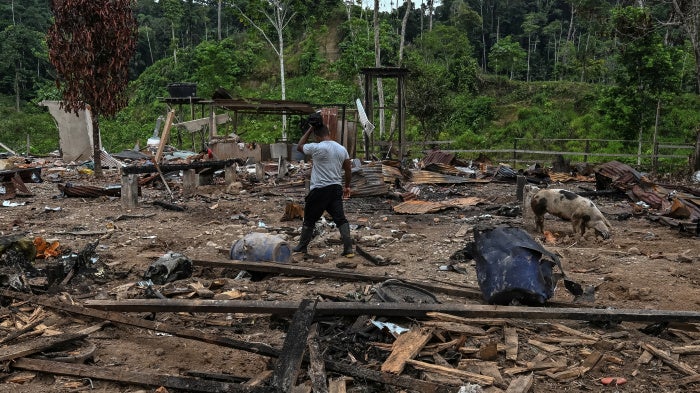
The 94-page report, "A Dangerous Partnership: Abuses, Unanswered Questions, and US-Ecuador Security Cooperation," documents serious human rights violations in a rural community on the Colombia-Ecuador border, as well as attacks on and the disappearance of fishermen at sea near the Galápagos Islands. Each incident either clearly implicates the US-Ecuador security partnership or surfaces questions about responsibility. Ecuadorian forces tortured and arbitrarily detained four farm workers, and later burned and struck a dairy farm, during what the United States called a “partnered operation.” And drones of unknown origin attacked two fishing vessels, injuring several crew members. A third vessel remains missing.
U.S. Policymakers Should Hold President Mubarak Accountable
President Hosni Mubarak of Egypt is scheduled to meet with members of Congress and the Administration, including President Bill Clinton, in Washington, D.C. This will be the Egyptian leader's second visit since April.
While the “zero-option” approach — the granting of citizenship equally to all who were permanent residents at the time the state in question gained independence — was rejected in Estonia, we uncovered no systematic, serious abuses of human rights in the area of citizenship.
Highlighting some of the human rights abuses of the previous five years, this report examines the structures of the judicial system and archaic statutes that permit the denial of due process; these include aspects of the military justice system as well as inefficiency in the civilian courts and a lack of transparency in internal police disciplinary procedures.
Beginning in late 1991, wide-scale atrocities committed by the Burmese military, including rape, forced labor, and religious persecution, triggered an exodus of ethnic Rohingya Muslims from the northwestern Burmese state of Arakan into Bangladesh. This report warned of the possible repatriation of nearly 240,000 refugees, housed in nineteen camps in and around the Bangladeshi town of Cox's Bazar.
In this investigation of the application of the 1991 Latvian law “On the Registration of Residents,” our findings indicate that the Department of Citizenship and Immigration has targeted certain non-citizen groups and denied them registration as legal residents of Latvia.
The Widespread Rape of Somali Women Refugees in North Eastern Kenya
While the tragedy in Somalia made daily news, the plight of thousands of refugees in neighboring Kenya remains unpublicized. Since 1992, approximately 300,000 Somalis have fled across the 800 mile Kenya-Somali border, most of them women and children. Many were the victims of violence, including rape, as they fled war-torn Somalia.
The eleven-year-old conflict in south Sudan continues to bring famine, pestilence and death to southerners (over one million people have died as a result of the war). This suffering is caused by gross abuses of human rights by the government and its Sudan Popular Armed Forces and the two factions of the rebel Sudan People’s Liberation Army.
Freedom of expression on campus in Indonesia became a major issue in mid-1993 with national attention focused on three court cases and the banning of a student newspaper. All of the cases illustrate the tight limits that the Indonesian government places on written and spoken criticism.
Citing violations of core political rights in Mexico — freedom of expression, freedom of association, freedom of assembly, and the right to vote — this report calls for the Clinton administration to address these and other human rights issues as it engages the Mexican government in trade negotiations.
On September 13, 1993, as Israel and the Palestine Liberation Organization met in Washington to sign an interim self-rule accord for Gaza and Jericho, protestors against this agreement were killed and injured in Beirut by Lebanese Army troops. The demonstration was held in defiance of an indefinite Lebanese government ban against all assemblies and processions.
Since the fall of the Ceausescu regime in 1989, Romania has experienced a dramatic increase in xenophobia and racist propaganda characterized by an increasingly vocal press and right-wing political parties.
On April 21, 1993, the Bolivian Supreme Court delivered a historic verdict, sentencing a former military dictator and forty-seven collaborators to lengthy prison terms for human rights violations, the disruption of a democratic government, and other offenses. This report reviews the verdict of the Bolivian Supreme Court.
Government efforts to Islamicize Pakistan's civil and criminal law, which began in earnest in the early 1980s, have dangerously undermined fundamental rights of freedom of religion and expression, and have led to serious abuses against the country's religious minorities.