Abuses, Unanswered Questions, and US-Ecuador Security Cooperation
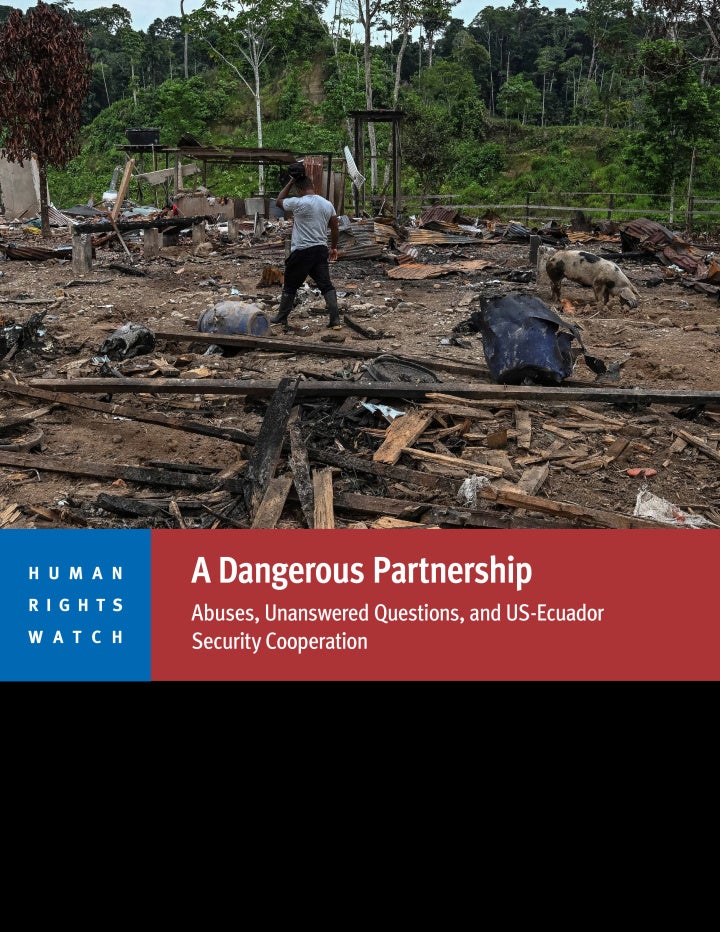
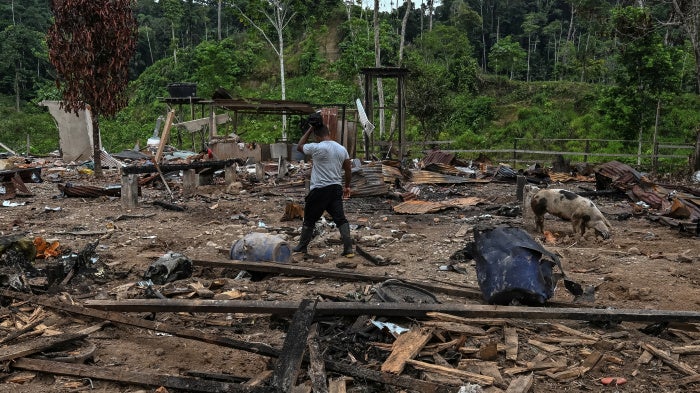
The 94-page report, "A Dangerous Partnership: Abuses, Unanswered Questions, and US-Ecuador Security Cooperation," documents serious human rights violations in a rural community on the Colombia-Ecuador border, as well as attacks on and the disappearance of fishermen at sea near the Galápagos Islands. Each incident either clearly implicates the US-Ecuador security partnership or surfaces questions about responsibility. Ecuadorian forces tortured and arbitrarily detained four farm workers, and later burned and struck a dairy farm, during what the United States called a “partnered operation.” And drones of unknown origin attacked two fishing vessels, injuring several crew members. A third vessel remains missing.
Eastern Slavonia, the only remaining Serb-held region of Croatia, is scheduled to revert to Croatian control by July 15, 1997. Some 120,000 to 150,000 Serbs living in that region will then come under the authority of their bitter opponent during the war.
Nearly 100,000 people, most of them Rwandans once resident in the camps of eastern Zaire, have fled to a site near Ubundu, where their further flight is blocked by the Zaire River. Among them are thousands of unarmed noncombatants as well as soldiers of the former Rwandan army (ex-FAR, Forces Armées Rwandaises) and militia responsible for the genocide of Tutsi in Rwanda in 1994.
This report documents a pattern of torture—according to internationally recognized definitions of the term—and mistreatment of security detainees by the Anti-Terror Branch (Teror 'le Mucadele Subesi) of the Security Directorate of Turkey’s Ministry of the Interior.
Disproportionate Sentences for New York Drug Offenders
In the past decade, the U.S. Congress and many state legislatures have established harsh criminal penalties for a wide range of drug offenses, often using the vehicle of mandatory minimum prison sentences. As a consequence, drug offenders in the United States face sentences that are uniquely severe among constitutional democracies.
A two-person Human Rights Watch delegation traveled to Guatemala in January 1997. The visit focused on reports of the discriminatory treatment of trade unionists at the assembly plants there of the U.S.-based corporation Phillips-Van Heusen (PVH), and allegations of obstacles posed by the company and the Guatemalan labor ministry to the union’s recognition for purposes of collective bargaining.
A two-person Human Rights Watch delegation traveled to Guatemala in January 1997. The visit focused on reports of the discriminatory treatment of trade unionists at the assembly plants there of the U.S.-based corporation Phillips-Van Heusen (PVH), and allegations of obstacles posed by the company and the Guatemalan labor ministry to the union's recognition for purposes of collective bargaining.
Human Rights Watch has uncovered evidence that the Yugoslav National Army (JNA) had an extensive and sophisticated chemical weapons program prior to the breakup of Yugoslavia in 1991; that the army of the Federal Republic of Yugoslavia (Serbia and Montenegro) inherited much of this program; and that the army of the Republic of Bosnia and Hercegovina produced crude chemical munitions during the Bos
China is increasingly exercising its authority over the territory of Hong Kong on a number of issues and has directed, for instance, that all the Vietnamese be cleared from Hong Kong before July 1. Such pressure has spurred the Hong Kong government to redouble its efforts to resolve the Vietnamese situation, which has embroiled the territory in controversy for over twenty years.
and Other Human Rights Obligations on the First Anniversary of its Accession to the Council of Europe
On February 28, 1996, the Russian Federation became a full member of the Council of Europe, an intergovernmental organization based in Strasbourg, France, which, among other goals, aims to protect human rights. Accession to the Council of Europe heightened expectations that the Russian Federation would take concrete steps to improve its poor human rights record in the year that has followed.
Between December 1996 and the beginning of March 1997, one of the worst outbreaks of communal violence in Indonesia in decades broke out in the province of West Kalimantan between indigenous Dayak people and immigrants from the island of Madura, off the coast of East Java.
Reaping the Rewards of “Ethnic Cleansing” in Prijedor
The same warlords who took control of the town of Prijedor, in northwestern Bosnia and Hercegovina, through systematic policies of ethnic cleansing—including pre-meditated slaughter, concentration camps, mass rape, and the takeover of businesses, government offices, and all communal property—have retained total control over key economic, infrastructure, and humanitarian sectors of the communit
This report examines the context within which children and their parents must struggle to exercise their rights and looks in detail at the legal provisions which deny them even the most basic rights and freedoms. It also reports on the current situation of children in Burma and the daily practices used by the military and other government agents which violate international law.
On Sunday, January 27, the people of Chechnya held presidential and parliamentary elections, the first since the brutal war ended there last fall. These elections may mark the beginning of a new era for Chechnya after twenty months of war and destruction.