Abuses, Unanswered Questions, and US-Ecuador Security Cooperation
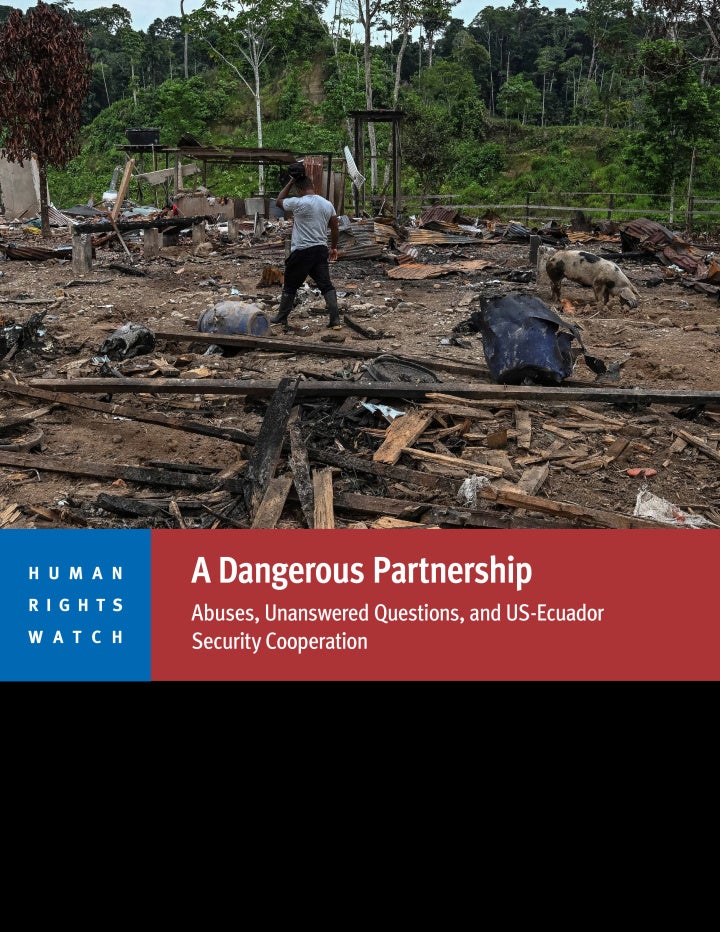
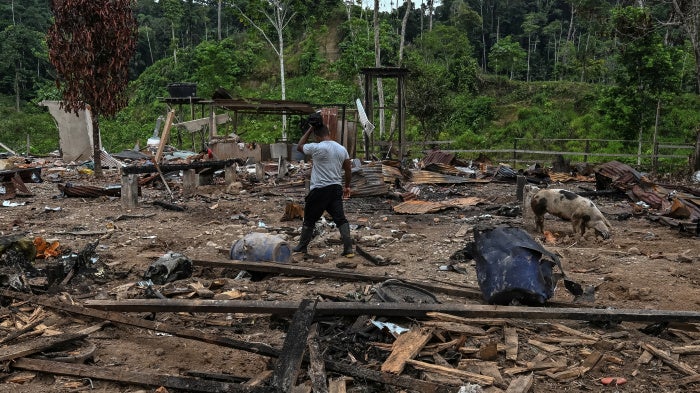
The 94-page report, "A Dangerous Partnership: Abuses, Unanswered Questions, and US-Ecuador Security Cooperation," documents serious human rights violations in a rural community on the Colombia-Ecuador border, as well as attacks on and the disappearance of fishermen at sea near the Galápagos Islands. Each incident either clearly implicates the US-Ecuador security partnership or surfaces questions about responsibility. Ecuadorian forces tortured and arbitrarily detained four farm workers, and later burned and struck a dairy farm, during what the United States called a “partnered operation.” And drones of unknown origin attacked two fishing vessels, injuring several crew members. A third vessel remains missing.
This report documents serious breaches of international humanitarian law, the rules of war, committed in Kosovo from February to early September 1998. The vast majority of these abuses were committed by Yugoslav government forces of the Serbian special police (MUP) and the Yugoslav Army (VJ).
The Impact of Felony Disenfranchisement Laws in the United States
The expansion of suffrage to all sectors of the population is one of the United States' most important political triumphs. Today, all mentally competent adults have the right to vote with only one exception: convicted criminal offenders .The racial impact of disenfranchisement laws is particularly egregious.
Violations of international humanitarian law -- the laws of war -- are not abstract concepts in Colombia, but the grim material of everyday life. War bursts into the daily activities of a farm, a village, a public bus, or a school with the speed of armed fighters arriving down a path or in four-wheel drive vehicles. Sometimes, armed men carefully choose their victims from lists.
Malaysia's Internal Security Act provides for preventive detention for up to two years with the possibility of renewal every two years. Any police officer may, without a warrant, arrest and detain anyone he has "reason to believe" has acted or likely to act in "any manner prejudicial to the security of Malaysia."
President Mohammed Khatami of Iran is scheduled to visit the United Nations next week. On the occasion of this newsworthy trip, Human Rights Watch has prepared the following backgrounder on the domestic situation in Iran. We also attach a recent press release on the Shi'a minority in Afghanistan, which may draw Iran into armed conflict outside its borders.
Sudan, once promoted as the bridge between the Arab and African worlds, is distinguished by human rights abuses arising from the government's determination to create an Arab Islamic state.
Reports that ethnic Chinese women were raped during riots in Jakarta in mid-May have generated an outpouring of rage from around the world and a furious debate inside Indonesia. Legislators in Taiwan and Hong Kong have threatened cut-offs of aid and expulsions of Indonesian migrant workers.
Retaliation Against Women in Michigan State Prisons
This report documents how women inmates who have been raped by guards in Michigan prisons are suffering retaliation from their attackers."In Michigan, a woman risks being sexually assaulted if she's imprisoned, and being terrorized by guards if she dares report the assault," said Regan Ralph, executive director of theWomen's Rights Division of Human Rights Watch.
Immigration Detainees in Jails in the United States
Human Rights Watch charges that the U.S. Immigration and Naturalization Service (INS) is now holding more than half of its detainees in jails where they are subjected to punitive treatment and may be mixed with criminal inmates.
Immigration Detainees in Jails in the United States
The U.S. Immigration and Naturalization Service (INS) is currently housing more than 60 percent of its 15,000 detainees in local jails throughout the country.
Arms Transfers to all Sides in the Civil War in Sudan
More than one million people may have died, with millions more forcibly displaced, since today's ongoing civil war broke out in Sudan in 1983. This conflict is spreading to other regions of the country and is linked to guerrilla wars in neighboring Eritrea, Ethiopia, and Uganda.
Ethnic discrimination in the Russian Federation has persisted and perhaps even worsened since the break-up of the Soviet Union. The government has failed to combat discrimination and is in many ways responsible for perpetuating discriminatory practices.
On July 20-21, 1998, an Algerian government delegation met with the United Nations Human Rights Committee to discuss Algeria's second periodic report regarding its implementation of the International Covenant on Civil and Political Rights (ICCPR).
A nationwide student protest movement played an instrumental role in forcing the resignation of President Soeharto on May 21, 1998 and in opening the door to democratic reform in Indonesia.
On July 15 and 16, 1998 Israel presented its initial report to the United Nations Human Rights Committee, the U.N. body of independent experts responsible for monitoring implementation of the International Covenant on Civil and Political Rights (ICCPR) and its two Optional Protocols.