Introduction
- On December 8, 2024, a coalition of armed opposition groups led by Hay’et Tahrir al-Sham (HTS) overthrew the government of Bashar al-Assad, ending over 60 years of Baath party rule in Syria.
- The transitional government is led by former HTS figures. HTS was responsible for human rights abuses and war crimes during the Syria conflict. Ahmed al-Sharaa was appointed interim president in late January 2025. Transitional authorities say that al-Sharaa will lead the country for a transitional period of five years until a permanent constitution is adopted and elections are held accordingly.
Severe economic and humanitarian challenges and ongoing mass displacement continue to strain Syrians as the country seeks to rebuild and chart a new future.
International Justice and Accountability for Assad-Era Crimes
- During Bashar al-Assad’s 24-year presidency, Syrian government officials committed a litany of war crimes, crimes against humanity, and serious human rights violations. During the conflict, other warring parties also committed grave abuses. The ousting of Bashar al-Assad’s government created a momentous opportunity for Syria to address this abusive legacy.
- Since then, Syria’s transitional authorities have taken some initial steps toward accountability. In May 2025, a National Commission for Transitional Justice and a separate National Commission for the Missing were established by presidential decree. In April 2026, Syria held its first domestic trial of a senior Assad-era official, Atef Najib, before the Fourth Criminal Court in Damascus. Other trials have been announced and opened at the same court.
- Significant questions remain as to how proceedings before Syrian courts will address the gravity and scale of the serious crimes that were committed. The National Commission for Transitional Justice's mandate is limited to violations committed by "the defunct regime," excluding victims of HTS, ISIS, the Syrian Democratic Forces, Turkish-backed factions, and other parties to the conflict. In the Najib case, the court invoked the Geneva Conventions, their Additional Protocols, and customary international law alongside Syrian law to characterize the alleged crimes, an apparent effort to draw on international standards. It remains unclear how this approach will function in practice, since Syrian law does not criminalize war crimes, crimes against humanity and other serious crimes, does not include command responsibility as a mode of liability and provides for the death penalty. There remains a need for urgent collection, safeguarding and analysis of evidence, including from mass grave sites and government records and archives. The trials to date do not appear to be coordinated with the ongoing drafting of a transitional justice law to address crimes committed before the fall of the Assad government. Civil society organizations working in or on Syria have criticized the absence of public consultation, inclusivity, and limited public communications in those efforts.
- Syria is not party to the Rome Statute of the International Criminal Court.
Recommendations
- Secure and preserve evidence of serious international crimes,
- Engage proactively with established international and other UN mechanisms, as well as with authorities in third states investigating and prosecuting crimes committed in Syria.
- Commit publicly to support all credible efforts to pursue impartial and independent justice for victims and survivors of crimes committed by all parties to the 2011-2024 conflict, explicitly expand the mandate of the National Commission for Transitional Justice to that end; and ensure the Transitional Justice Law, once introduced, applies in clear and unambiguous terms to grave violations by all parties to the conflict, not only the former government.
- Ratify the Rome Statute of the International Criminal Court and lodge a declaration under Rome Statute article 12 to give the court retroactive jurisdiction dating back to 2002.
- Conduct comprehensive legislative reforms to fully align Syria’s national legislation with the Rome Statute and international law.
Abolish the death penalty and uphold the moratorium on all executions.
March 2025 Constitutional Declaration
- Syria’s March 2025 Constitutional Declaration, meant to govern the country’s transitional phase, grants the president significant authority, including over judicial and legislative appointments, without any checks or oversight. The declaration does include provisions that appear to promote justice and human rights, but their effectiveness is uncertain without independent oversight.
- On July 7, 2026, President Ahmed al-Sharaa appointed all seven members of the Higher Constitutional Court by decree, with no role for parliament or any other body in the process. Syria's People's Assembly held its first session on July 12, 2026; its composition and powers remain heavily shaped by the executive.
Recommendations
- Amend the Constitutional Declaration to clearly limit presidential powers and subject executive decisions to meaningful legislative and judicial oversight.
- Establish mechanisms to ensure judicial independence.
- Establish an independent judicial council responsible for the appointment, promotion, discipline, and removal of judges.
- Ensure that appointments to the Higher Constitutional Court go through a transparent, independent process with input beyond the executive branch, rather than remaining solely at the president's discretion.
Accountability for Abuses by Transitional Government Forces
- Transitional government forces and government-aligned armed groups have committed grave abuses against civilians, particularly against members of minority communities, while there have been significant gaps in accountability.
- During military operations in the coastal governorates of Syria and Hama governorate in March 2025, government forces, aligned armed groups, and volunteers carried out widespread abuses. At least 1,400 people were killed, mostly civilians. The abuses occurred during a centrally coordinated Defense Ministry operation and continued after senior officials and commanders knew or should have known that violations were taking place.
- Similar atrocities occurred during the July 2025 violence in Sweida, where government security forces, allied Bedouin armed groups, and Druze armed groups committed serious violations.
- The UN Commission of Inquiry on Syria investigated both episodes of violence and found that grave crimes were likely committed. Its August 2025 report on the March 2025 coastal violence found that acts committed by government-aligned forces and by pro-former-government fighters alike may amount to war crimes, including murder, torture, and inhumane treatment of the dead. Its March 2026 report on the July 2025 Sweida violence went further, finding that violations, including widespread executions, torture, gender-based violence, and burning of homes by multiple parties to the fighting – government forces, Bedouin armed groups, and Druze armed groups alike – may amount to war crimes or crimes against humanity.
- In November 2025, a trial of alleged perpetrators of crimes and abuses in the coastal region in March 2025 opened at the Military Criminal Court in Aleppo, with over 300 members of the security forces and 265 people accused of being loyalists of the former government on trial. In July 2026, a trial of alleged perpetrators of the July 2025 violence in Sweida opened before the Military Criminal Court in Damascus. Both legal proceedings are ongoing at the time of writing. In the Aleppo case, the court is applying both military and civil law. Civilians should not be tried before military courts.
- Neither Syria’s Military Penal Code nor its ordinary one recognize command responsibility. leaving commanders and officials who ordered or allowed the killings at risk of escaping prosecution even as direct perpetrators face trial.
Recommendations
- Publish the legal basis for the Military Criminal Court proceedings related to the March 2025 coastal violence and the Sweida violence, including the decree or legal authority establishing their jurisdiction.
- Ensure transparency by publishing findings of government investigations into abuses committed during the March 2025 coastal operations, the July 2025 Sweida violence, and other operations involving transitional government forces or affiliated armed groups with appropriate protections for victims and witnesses.
- Ensure accountability not only for direct perpetrators but also civilian officials and military commanders who ordered, facilitated, knew or should have known about, or failed to prevent or punish serious abuses committed by their subordinates.
- Clarify and narrow the use of military court jurisdiction over civilian defendants, consistent with fair trial standards.
- Establish a transparent vetting process for all commanders and fighters entering military, security, or other public institutions; suspend people credibly implicated in serious abuses pending investigation; dismantle abusive units; and bring all forces under a unified, identifiable, and civilian-supervised chain of command.
- Protect individuals and communities from mob and retaliatory violence, promptly investigate and prosecute those responsible for violent attacks and sectarian incitement, and establish accessible reparations and complaints mechanisms for victims of abuses by security forces and affiliated groups.
- Repeal legislation that permits trial of civilians in a military court;
Syrian Detainees Transferred to Iraq
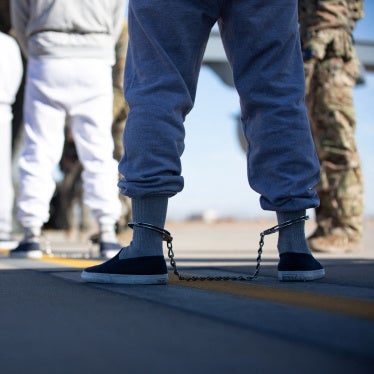
- Between January and February 2026, the United States military transferred approximately 5,700 men and boys detained for alleged ISIS affiliation from prisons run by the Kurdish-led Syrian Democratic Forces in northeast Syria to Iraq, where they are being held in at least one maximum security prison. More than 3,540 of those transferred self-identified as Syrians.
- In some cases, the Syrian detainees had been sentenced in then-Kurdish-led northeast Syria in proceedings that are were widely viewed as falling short of international fair trial standards. In other cases, they were held without charge or adequate judicial review. The detainees were transferred without an effective opportunity to challenge either their detention or removal. Several Syrian families allege their transferred relatives had no links to ISIS and had been arbitrarily detained by the Kurdish-led authorities.
- Iraq has a well-documented history of enforced disappearance, torture and other ill-treatment, and executions following grossly unfair counterterrorism trials. As of July 14, 2026, the Iraqi authorities had not yet indicated whether any of the transferred Syrians are credibly implicated in crimes in or against Iraq, raising questions over Iraq’s authority to detain or prosecute them.
Recommendations
- The transitional government of Syria, as well as international stakeholders such as the United Nations, should seek prompt repatriation of any Syrians among these detainees. If implicated in serious crimes, the returnees can be investigated or re-prosecuted in Syria, provided proceedings meet fair trial standards.
In the meantime, Syria and international stakeholders should help ensure Iraq has the resources to treat these detainees humanely, to promptly bring detainees before a court or similar judicial authority that will fairly review the legality and necessity of their continued detention. Judicial authorities should order the detainees’ immediate release if detention is not justified.
Freedom of Opinion and Expression
- The country’s Constitutional Declaration formally guarantees freedom of expression while maintaining provisions that could restrict peaceful speech. While protecting victims, preserving evidence, and combating incitement to violence or discrimination are legitimate and urgent objectives, article 49 uses broad and undefined terms that could criminalize historical inquiry, journalism, political debate, or other peaceful expression.
- Syrian authorities have continued to apply Assad-era defamation, insult, and cybercrime provisions against peaceful criticism and civic activism online.
- The Justice Ministry issued Circular No. 26 to restrict procedures in cybercrime cases and announced that it was reviewing the 2022 cybercrime law. However, the circular did not amend or repeal the law’s broadly worded speech offenses, leaving peaceful critics vulnerable to criminal complaints, detention, and prosecution.
Recommendations
- Suspend the enforcement of provisions in Cybercrime Law No. 20 of 2022 that infringe on Syrians’ right to freedom of opinion and expression and promptly repeal or amend them to comply with international human rights law.
- Decriminalize defamation, insult, criticism of public officials and institutions, and the peaceful dissemination of allegedly false information, and ensure that any civil remedies for reputational harm are necessary and proportionate.
- Release anyone detained solely for exercising their right to freedom of expression, drop related charges, and expunge convictions arising from speech protected under international human rights law.
Amend Article 49(3) of the Constitutional Declaration and any implementing legislation to ensure that they do not criminalize journalism, academic research, victims’ advocacy, historical debate, or other peaceful expression, and limit criminal liability to narrowly defined advocacy that intentionally incites discrimination, hostility, or violence.
Freedom of Association and Assembly
- Following decades of severe restrictions under the Assad government, Syrian civil society organizations have sought to re-establish and expand their activities, while Syrians have increasingly exercised their right to demonstrate.
- Syrian transitional authorities have shown greater openness to engagement with international and local humanitarian and civil society organizations, as well as allowing civil society to operate more independently. However, civil society representatives face continued challenges.
- In May 2026, the Ministry of Interior issued Syria’s first official framework recognizing peaceful assembly as a right. However, its restrictions raise serious rights concerns.
- Although authorities have applied some requirements unevenly and reportedly allowed many unregistered organizations to operate, the lack of clear and rights-respecting rules leaves organizations vulnerable to arbitrary interference and places their legal status in continuing uncertainty.
Recommendations
- Amend the May 2026 peaceful assembly framework to replace prior authorization with a simple notification system and affirmatively protect spontaneous and peaceful assemblies.
- Start a drafting process to revise the 1958 Associations Law to include broad participation by civil society and assistance from international human rights law experts. At a minimum, the new law should:
- Remove the authorities’ excessive powers to interfere in registration and activities of NGOs.
- Permit foreign funding of NGOs, whether foreign or local, so long as all foreign exchange and customs laws are fully observed.
Remove the government’s ability to impose any form of governmental management, or dissolve a NGO, without first obtaining a court order which the NGO has an opportunity to challenge before the courts.
Unexploded Ordnance/Remnants of War
- Over a decade of conflict resulted in extensive contamination by landmines and explosive remnants of war and continues to threaten the basic enjoyment of rights and is a major barrier to safe return and reconstruction efforts. Contamination from weapons used during the conflict has killed and injured hundreds of people, including children, since December 8, 2024, and continues to date.
- Syria is not yet party to the Mine Ban Treaty nor the Convention on Cluster Munitions.
Recommendations
- Work with international donors, humanitarian mine action operators and relevant national authorities to support and strengthen Syria’s humanitarian mine action structures, as well as its policies, procedures, accreditation and authorisation processes and capacity required to survey, mark, clear and release contaminated land in accordance with international standards and relevant national requirements.
- Expand and ensure adequate and predictable funding for survey, clearance, explosive ordnance disposal, risk education and victim assistance, and prioritise areas where explosive ordnance contamination poses the greatest risk to civilians.
- Strengthen national information management for mine action by consolidating, verifying and safely sharing data from relevant authorities, humanitarian mine action operators and other credible sources.
- Develop safe, sustainable, accessible and verified reporting pathways through which communities, humanitarian actors and public service providers can report suspected explosive weapon contamination and ownership.
- Develop clear procedures for the safe management, marking, securing and disposal of explosive ordnance and weapons stockpiles, ensuring that any action related to weapons or ammunition is carried out only by competent authorities or qualified specialised actors, with appropriate safeguards.
Accede to the Mine Ban Treaty and the Convention on Cluster Munitions.
Economic and Social Rights
- Syrians continue to face a dire economic and humanitarian crisis with a majority of the population living below the poverty line and facing food insecurity. Years of conflict have devastated infrastructure and severely limited Syrians’ access to housing, health care, education, electricity, public transportation, water, sanitation, and other essential services. By June 2026, humanitarian agencies had received only 36 percent of the funding required to address these needs.
- Despite these conditions, the transitional authorities increasingly present reconstruction as an investment-led process centered on large development projects. The Arab Reform Initiative found that authorities developed these projects within narrow official and business circles, without meaningfully consulting affected communities or resolving concerns over property rights, displacement, or access to public spaces. In June 2026, authorities detained two community organizers after they protested the Damascus Governorate’s decision to resume the project.
- A reconstruction process focused on attracting investment while Syrians lack basic services risks deepening violations of people’s socio-economic rights and reproducing Assad-era patterns of exclusion and dispossession.
Recommendations
- Prioritize the restoration and equitable provision of public services essential to rights, including water, sanitation, waste collection, electricity, health care, education, public transportation, and adequate housing, particularly in underserved and conflict-affected communities, and ensure that humanitarian assistance and basic services are distributed impartially without discrimination.
- Ensure that all reconstruction and development plans undergo transparent human rights and social impact assessments, reflect the priorities identified by affected residents through meaningful and accessible public consultations, and are publicly disclosed along with contracts, financing arrangements, land transfers, and selection criteria.
- Protect housing, land, and property rights during reconstruction by prohibiting forced evictions and arbitrary expropriation, guaranteeing due process, adequate compensation, and access to effective remedies, and establishing independent mechanisms to monitor public spending, investigate corruption, and hold government officials and private investors accountable
- Human Rights Watch news release, “A New Dawn for Syria,” December 8, 2024, https://www.hrw.org/news/2024/12/08/new-dawn-syria; Human Rights Watch news release, “One Year Since Assad’s Fall,” December 8, 2025, https://www.hrw.org/news/2025/12/08/syria-one-year-since-assads-fall.
- These include widespread and systematic arbitrary arrests; torture; enforced disappearances; deaths in detention; use of chemical weapons; indiscriminate and targeted attacks against civilians and civilian objects including hospital and schools; withholding humanitarian aid; and forcibly displacing Syrians. See: Human Rights Watch news release, “Syria: Families of ‘Disappeared’ Deserve Answers,” November 30, 2022, https://www.hrw.org/news/2022/11/30/syria-families-disappeared-deserve-answers; Human Rights Watch news release, “Syria: Bread Crisis Exposes Government Failure,” March 21, 2021, https://www.hrw.org/news/2021/03/21/syria-bread-crisis-exposes-government-failure; Human Rights Watch news release, “Syria: A Year On, Chemical Weapons Attacks Persist,” April 4, 2018, https://www.hrw.org/news/2018/04/04/syria-year-chemical-weapons-attacks-persist; Human Rights Watch report, “If the Dead Could Speak: Mass Deaths and Torture in Syria’s Detention Facilities,” December 16, 2015, https://www.hrw.org/report/2015/12/16/if-dead-could-speak/mass-deaths-and-torture-syrias-detention-facilities.
- These include attacking, kidnapping, and torturing civilians; recruiting children; looting; and sexual violence. See: Human Rights Watch report, “ ‘Everything is by the Power of the Weapon: Abuses and Impunity in Turkish-Occupied Northern Syria,” February 29, 2024, https://www.hrw.org/report/2024/02/29/everything-power-weapon/abuses-and-impunity-turkish-occupied-northern-syria; Human Rights Watch report, “Northeast Syria: Military Recruitment of Children Persists,” October 2, 2024, https://www.hrw.org/news/2024/10/02/northeast-syria-military-recruitment-children-persists; Human Rights Watch news report, “Syria: Turkey-Backed Groups Seizing
Property,” June 14, 2018, https://www.hrw.org/news/2018/06/14/syria-turkey-backed-groups-seizing-property. - Alice Autin, “Syria’s Transitional Justice Commission: A Missed Opportunity for Victim-Led Justice,” Human Rights Watch commentary, May 19, 2025, https://www.hrw.org/news/2025/05/19/syrias-transitional-justice-commission-missed-opportunity-victim-led-justice.
- Human Rights Watch, YouTube, @HumanRightsWatch, “The trial of Atef Najib opened in Syria on April 26,” May 7, 2026,
https://www.youtube.com/shorts/pocXe9_KZqs. - Human Rights Watch news release, “Syria: Constitutional Declaration Risks Endangering Rights,” March 25, 2025, https://www.hrw.org/news/2025/03/25/syria-constitutional-declaration-risks-endangering-rights.
- Syrian Arab News Agency, “President al-Sharaa appoints President of Supreme Constitutional Court,” July 7, 2026, https://sana.sy/en/presidency/2328021/.
- One-third of its 210 members were directly appointed by President Ahmed al-Sharaa, and the executive is not subject to a parliamentary vote of confidence. Al Jazeera, “مجلس الشعب السوري الجديد يفتتح أعماله.. وهذه تفاصيل الجلسة الأولى,” July 12, 2026, https://www.aljazeera.net/news/2026/7/12/%D9%85%D8%AC%D9%84%D8%B3-%D8%A7%D9%84%D8%B4%D8%B9%D8%A8-%D8%A7%D9%84%D8%B3%D9%88%D8%B1%D9%8A-%D8%A7%D9%84%D8%AC%D8%AF%D9%8A%D8%AF-%D9%8A%D9%81%D8%AA%D8%AA%D8%AD-%D8%A3%D8%B9%D9%85%D8%A7%D9%84%D9%87.
- These include summary executions, identity-based killings, looting, property destruction, and abuse of detainees. See: Human Rights Watch news release, “Syria: End Coastal Killing Spree, Protect Civilians,” March 10, 2025, https://www.hrw.org/news/2025/03/10/syria-end-coastal-killing-spree-protect-civilians; Human Rights Watch news release, “Syria: March Atrocities Demand Senior Level Accountability,” September 23, 2025, https://www.hrw.org/news/2025/09/23/syria-march-atrocities-demand-senior-level-accountability.
- Human Rights Watch news release, “Syria: End Coastal Killing Spree, Protect Civilians,” March 10, 2025, https://www.hrw.org/news/2025/03/10/syria-end-coastal-killing-spree-protect-civilians; Human Rights Watch report, “‘Are you Alawi?’: Identity-Based Killings During Syria’s Transition,” September 23, 2026, https://www.hrw.org/report/2025/09/23/are-you-alawi/identity-based-killings-during-syrias-transition.
- These include summary killings, abductions, arbitrary detention, looting, and destruction of civilian property. See: Human Rights Watch news release, “Syria: Abuses, Humanitarian Emergency Amid Sweida Clashes,” July 22, 2025, https://www.hrw.org/news/2025/07/22/syria-abuses-humanitarian-emergency-amid-sweida-clashes; Human Rights Watch report, “Syria: Accountability Lacking for Sweida Abuses,” January 15, 2026, https://www.hrw.org/news/2026/01/15/syria-accountability-lacking-for-sweida-abuses.
- UN News, “UN Syria Commission finds March coastal violence was widespread and systematic: outlines urgent steps to prevent future violations and restore public confidence,'' August 2025, https://www.ohchr.org/en/press-releases/2025/08/un-syria-commission-finds-march-coastal-violence-was-widespread-and, (accessed 13 July 2026)
- UN News, “Syria: UN Commission documents grave violations in July 2025 escalation in Sweida,” March 27, 2026, https://news.un.org/en/story/2026/03/1167210 (accessed July 13, 2026).
- Karam Al-Masri and Suleiman Al-Khalidi, “Syria opens first trial over coastal violence after Assad's fall,” Reuters, November 18, 2025, https://www.reuters.com/world/middle-east/syria-opens-first-trial-over-coastal-violence-after-assads-fall-2025-11-18/ (accessed July 15, 2026).
- Syrian Arab News Agency, “Syria launches trials over Sweida events following national investigation,” July 4, 2026, https://sana.sy/en/syria/2327241/ (accessed July 13, 2026).
- Human Rights Watch news release, “Iraq: Alleged ISIS Detainees Transferred from Syria at Risk of Abuse,” February 17, 2026, https://www.hrw.org/news/2026/02/17/iraq-alleged-isis-detainees-transferred-from-syria-at-risk-of-abuse; Human Rights Watch report, “Flawed Justice: Accountability for ISIS Crimes in Iraq,” December 5, 2017, https://www.hrw.org/report/2017/12/05/flawed-justice/accountability-isis-crimes-iraq.
- The other transferred detainees come from about 60 countries. May 2026 record of transferred prisoners on file with Human Rights Watch. See also: “US says over 5,700 suspected ISIL detainees relocated from Syria to Iraq,” Al Jazeera, February 15, 2026, https://www.aljazeera.com/news/2026/2/15/us-says-over-5700-suspected-isil-detainees-relocated-from-syria-to-iraq (accessed July 14, 2026).
- “Families of Syrian detainees protest in Damascus over transfers to Iraq,” Shafaq news, April 20, 2026, https://shafaq.com/en/Middle-East/Families-of-Syrian-detainees-protest-in-Damascus-over-transfers-to-Iraq (accessed July 14, 2026).
- Human Rights Watch report, “ ‘Everyone Must Confess’: Abuses against Children Suspected of ISIS Affiliation in Iraq,” March 4, 2019, https://www.hrw.org/sites/default/files/report_pdf/iraq0319_web_1.pdf; Human Rights Watch news release, “Iraq: Judges Disregard Torture Allegations,” July 31, 2018, https://www.hrw.org/news/2018/07/31/iraq-judges-disregard-torture-allegations; Human Rights Watch report, “’Life Without a Father is Meaningless’: Arbitrary Arrests and Enforced Disappearances in Iraq 2014-2017” September 27, 2018, https://www.hrw.org/report/2018/09/27/life-without-father-meaningless/arbitrary-arrests-and-enforced-disappearances.
- Article 49(3) criminalizes glorifying the former Assad government or its symbols, as well as denying, praising, justifying, or minimizing its crimes. In June 2026, the justice minister stated that prosecutors were pursuing such statements, encouraged citizens to report them, and announced that the ministry had prepared draft legislation to implement the provision. See: Human Rights Watch news release, “Syria: Constitutional Declaration Risks Endangering Rights,” March 25, 2025, https://www.hrw.org/news/2025/03/25/syria-constitutional-declaration-risks-endangering-rights; Syrian Arab News Agency, “Justice Minister: Denying deposed regime’s crimes violates Constitutional Declaration,” June 29, 2026, https://sana.sy/en/syria/2326287/ (accessed July 13, 2026).
- Haid Haid, “Syria’s civic opening is being tested one lawsuit at a time,” Al Majalla, June 17, 2026, https://en.majalla.com/node/331598/opinion/syria%E2%80%99s-civic-opening-being-tested-one-lawsuit-time (accessed July 13, 2026); “Syria frees activist Hassan Akkad days after he was detained,” June 21, 2026, https://www.aljazeera.com/news/2026/6/21/syria-frees-activist-hassan-akkad-days-after-he-was-detained (accessed July 13, 2026).
- Syrian Ministry of Interior, @SyMOIGov, X post, “ما هي محظورات النشر والإعلام؟…,” June 25, 2026, https://x.com/SyMOIGov/status/2070222639520440650 (accessed July 13, 2026); Dr. Mazhar al-Wais, @maabdwalshamee1, X post, “أصدرنا التعميم رقم (26) المتعلق بضبط إجراءات قضايا الجرائم الإلكترونية بما ينسجم مع الإعلان الدستوري، ويعزز حماية حقوق المواطنين وحرياتهم؛ كما نواصل دراسة قانون الجرائم الإلكترونية تمهيدًا لإجراء التعديلات اللازمة عليه بما يحقق التوازن بين حماية المجتمع وصون الحقوق والحريات,” https://x.com/maabdwalshamee1/status/2071582263364444239?s=46 (accessed July 13, 2026).
- For example, civil society representatives are required to undergo an onerous process to register or re-register their organizations and must obtain governmental approvals for nearly all operational activities. International organizations are regulated by the International Cooperation Directorate of the Ministry of Foreign Affairs and Expatriates. Local civil society organizations remain subject to the restrictive Associations Law No. 93 of 1958 and requirements concerning registration, temporary licensing, individual activities, and foreign funding; they are regulated by the Ministry of Social Affairs and Labor See: Human Rights Watch news release, “Syria: New Government Restricts Aid Operations,” May 12, 2025, https://www.hrw.org/news/2025/05/12/syria-new-government-restricts-aid-operations; Cathrin Schaer and Omar Albam, “How an Assad-era law is threatening Syrian civil society,” Deutsche Welle, February 5, 2026, https://www.dw.com/en/how-an-assad-era-law-is-threatening-civil-society-groups-in-syria/a-75824075 (accessed July 15, 2026).
- Syrian Network for Human Rights, “Between Licensing and Demonstrating: Syria’s First Framework for Peaceful Assembly,” May 4, 2026, https://snhr.org/blog/2026/05/04/between-licensing-and-demonstrating-syrias-first-framework-for-peaceful-assembly/ (accessed July 13, 2026).
- The framework requires organizers to obtain prior authorization, wait up to five days for a decision, and form a designated organizing committee. It also treats assemblies held without authorization as riotous gatherings subject to criminal penalties, excluding spontaneous protests and leaving broad discretion to local authorities. See: Syrian Network for Human Rights, “Between Licensing and Demonstrating: Syria’s First Framework for Peaceful Assembly,” May 4, 2026, https://snhr.org/blog/2026/05/04/between-licensing-and-demonstrating-syrias-first-framework-for-peaceful-assembly/ (accessed July 13, 2026).
- Human Rights Watch report, “Syria: Landmines, Explosive Remnants Harming Civilians,” April 8, 2025, https://www.hrw.org/news/2025/04/08/syria-landmines-explosive-remnants-harming-civilians.
- As of May 2026, over 80 percent of Syrian families face food insecurity. See, World Bank, Poverty and Equity Brief: Syrian Arab Republic, October 2025, https://documents1.worldbank.org/curated/en/099457204222541074/pdf/IDU-78eddafc-97fa-4d0e-9f74-fbedcbe6c5d2.pdf; WFP Syria Country Brief, May 2026, June 8, 2026, https://reliefweb.int/report/syrian-arab-republic/wfp-syria-country-brief-may-2026.
- Human Rights Watch news release, “Northeast Syria: Displacement Worsens Aid Crisis,” December 11, 2024, https://www.hrw.org/news/2024/12/11/northeast-syria-displacement-worsens-aid-crisis.
- UNFPA Syria Situation Report (1 May – 30 June 2026), July 8, 2026, https://www.unfpa.org/resources/situation-report-crisis-syria-may-june-2026.
- For example, the government resumed an Assad-era development project in Marota City without providing alternative housing to the thousands of displaced families and despite allegations of corruption and links to sanctioned contractors. See: Haid Hadid, “Rebuilding Without Buy-In: The Risks of Syria’s Top-Down Reconstruction,” Arab Reform Initiative, July 7, 2026, https://d2uecu6cucl1lj.cloudfront.net/ari/2026/07/07172650/ENGLISH-2026-07-Rebuilding-Without-Buy-In.pdf; Enab Baladi, “Investigation: How Marota City project left around 30,000 people homeless,” May 17, 2024, https://english.enabbaladi.net/archives/2024/05/investigation-how-marota-city-project-left-around-30000-people-homeless/; Syrian Legal Development Programme, “Marota City Is Not a Model for Syria’s Reconstruction,” March 1, 2026, https://sldp.ngo/en/blog/2973.
- Their names are Yaser Abbas and Ibrahim Sheikh al-Shabab. See: Haid Haid, “Syria’s civic opening is being tested one lawsuit at a time,” Al Majalla, June 17, 2026, https://en.majalla.com/node/331598/opinion/syria%E2%80%99s-civic-opening-being-tested-one-lawsuit-time (accessed July 13, 2026).
- This includes reliable waste collection, electricity, water, health care, and other basic services. See: Human Rights Watch report, “Rigging the System: Government Policies Co-Opt Aid and Reconstruction Funding in Syria,” June 28, 2019, https://www.hrw.org/report/2019/06/28/rigging-system/government-policies-co-opt-aid-and-reconstruction-funding-syria; Human Rights Watch, " Q&A: Syria’s New Property Law,” May 28, 2018, https://www.hrw.org/news/2018/05/29/qa-syrias-new-property-law.