- South Sudan’s army, opposition forces, and their respective allied militias abused residents and caused much of the population to flee during fighting in 2025 in Nagero County, Western Equatoria.
- Civilians have returned to Nagero town and environs, but continue to live in fear, and the government has continued to limit aid access into Nagero County as in other conflict-affected areas in the country.
- The government should suspend commanders credibly implicated in abuses, guarantee safe, immediate humanitarian access throughout Nagero County, and facilitate the safe and voluntary return of those displaced.
(Nairobi) – South Sudan’s army, opposition forces, and their respective allied militias abused civilians causing much of the population to flee during fighting in 2025 in Nagero County, Western Equatoria, Human Rights Watch said today. The abuses include intentional killings of civilians, rape and torture, or other cruel treatment that constitute war crimes.
Western Equatoria state has been the site of repeated fighting between the army and opposition forces since 2018, with both parties carrying out serious abuses against civilians. From January to February 2025 and then again from September to November 2025, South Sudan’s army–South Sudan People’s Defence Forces (SSPDF)–clashed with the Sudan People’s Liberation Army-in-Opposition (SPLA/IO) in Nagero County. During and after the clashes, government forces and allied fighters summarily executed at least eight civilians, including children; raped women; subjected other civilians, including detainees, to ill-treatment after accusing them of supporting the opposition; and burned and pillaged civilian property.
“Government forces and allied militia carried out serious abuses against civilian communities in Nagero County, leaving many with nothing to return to,” said Laetitia Bader, deputy Africa director at Human Rights Watch. “The government needs to investigate these violations promptly and effectively, and hold the leaders of these forces to account.”
Between March 2025 and June 2026, Human Rights Watch interviewed 31 survivors and witnesses from Nagero County, and 6 other sources. Some of those interviewed had been displaced to other areas, notably to Wau and Bazia (Western Bahr El Ghazal), and Juba, the country’s capital. Human Rights Watch also analyzed satellite imagery showing active fires or burn marks over several villages in Nagero County during January and February 2025. Civilians have returned to Nagero town and environs, but continue to live in fear, and the government has continued to limit aid access into Nagero County as in other conflict-affected areas. Human Rights Watch wrote to the army’s Chief of General staff on July 2, 2026, with preliminary research findings. The letter was reportedly forwarded onto the office of the Minister of Defence but received no response.
In January 2025, the army seized an SPLA/IO controlled checkpoint at a strategic bridge known as Kubri-Bo, triggering clashes. Thousands of civilians fled. On February 7 and 8, as government forces moved from the Kubri-Bo checkpoint south to their main barracks, soldiers detained and killed two school students and burned civilian property in Nagero town and surrounding areas.
On September 28, opposition forces attacked the Nagero town army barracks, prompting additional deployment of government forces. The UN reported that as of late September, at least 21,000 people had fled. In the weeks that followed, the army and allies summarily executed civilians, raped women, arbitrarily detained others, accusing them of supporting the opposition, and destroyed civilian property and infrastructure.
On October 6, government soldiers went to a makeshift camp where people had fled, ordering them to return home, witnesses said. The soldiers then killed six civilians, including three boys, they rounded up at the camp.
One man who witnessed the killings, said that 30 soldiers with “12 machine guns, RPGs and AK47s” took him, 4 other men and 4 boys away from the camp into the bush: “Soldiers tied us together two by two. At this time, one man escaped and soldiers ran and shot at him. The soldiers took a step back and took the big machine guns with bullets in a long chain. Then the soldier in charge gave the order to shoot.” The witness and one other survived. Government forces also pillaged and burned civilian property in and around the town and looted and damaged infrastructure, including health facilities and schools.
On September 29, five government soldiers went to the house of a 19-year-old woman in Lindi neighborhood and set alight six of her family’s houses and a food store. “Our home was burned to ashes,” she said. “They burned our clothes, mattresses, plastic chairs. We were planning to open a restaurant…they burned food such as new groundnuts and cassava flour.”
Government forces also beat and otherwise ill-treated and detained civilians, including in military barracks, as they tried to flee or after they returned home, often accusing them of being rebel fighters or supporters. Civilians began returning home around mid-October 2025, in response to warnings from the military that people found in the bush would be considered SPLA/IO fighters or collaborators, as well as deteriorating conditions in displacement areas.
Two women told Human Rights Watch that government soldiers raped them when they returned home. A 27-year-old woman said that government forces gang raped her and another woman near the Nagero army barracks on November 12. “Three of us were getting vegetables when we met five soldiers,” she said. “One woman threw her vegetables on the ground and ran away. The soldiers then warned the two of us, ‘If anyone runs, we will shoot them.’ They said, ‘Take off your clothes.’ Three soldiers raped us one after the other.” She said she had reported the attack to the neighborhood chief who then reported it to an army commander, but as far as she was aware, no action had been taken.
Multiple people interviewed and experts said that the army’s Division Six forces, along with special forces known as Mobile II, under commander James Nando, were reinforcements for locally posted army units throughout the violence. Media reports corroborated this. Nando had defected from the SPLA/IO in 2020, bringing a group of fighters with him, and has since been deployed alongside government forces. The US Treasury designated Nando on its sanction list in June 2023 for conflict-related sexual violence.
Opposition forces carried out attacks in and near civilian areas during the violence. One man said he was abused by armed men whom he suspected to be SPLA/IO forces or their allies because of their language. The man, age 52, said three-armed men beat him, his wife, and his nephew on October 21 at their home. They handcuffed the two men, marched them off into the bush where, the witness said, “They untied my hands and one pointed a gun at me. I started crying and praying and one said, ‘Are you not a man, why are you afraid to die?’…He took a step back aimed for my chest, his colleague pushed the gun away, but he shot my leg.”
In April 2026, the Integrated Food Security Phase Classification, a global group that includes UN agencies, humanitarian organizations, and other expert stakeholders, reported that insecurity in Nagero County still restricts people’s access to markets and farms. “How many times are we told to come home and that there will be no more fighting?” one person said. “But when people go back the SSPDF come and kill us and take our property. We run, leave our homes and when we get back, we find we have nothing to return to. How can we live like this and for how long?”
The South Sudanese government should take immediate action to end all abuses against civilians by its armed forces including suspending commanders credibly implicated in abuses pending inquiry; conduct independent, impartial, effective investigations, and publicly report on their findings, Human Rights Watch said. The government should also guarantee safe, immediate humanitarian access throughout Nagero County and facilitate the safe and voluntary return of those displaced.
The SPLA/IO should strictly observe its obligations under international humanitarian law, including to take all feasible precautions to avoid and in any event to minimize harm to civilians, such as during attacks on bases located near civilian areas that could foreseeably expose civilians to retaliation or crossfire. They should also immediately end all abuses against civilians, including those it accuses of links to the army.
The UN peacekeeping mission in South Sudan (UNMISS) should continue to deploy regular protection patrols and human rights monitoring missions to Nagero county. Donors should continue to press the government to allow safe and immediate access throughout conflict-affected areas, and increase assistance to Nagero County.
The African Commission on Human and Peoples’ Rights should consider undertaking a promotional or fact-finding engagement on the protection of civilians and accountability in South Sudan and report its findings to the AU Peace and Security Council. On its part, the Peace and Security Council should request regular reporting from the AU Commission and African Union Mission in South Sudan on civilian protection including in Western Equatoria, and publicly assess progress on the implementation of accountability mechanisms stipulated in the peace agreements, including the establishment of the Hybrid Court for South Sudan.
“Government authorities should ensure that communities repeatedly displaced in Western Equatoria are able to return home safely,” Bader said. “They can start by removing and holding to account abusive commanders and forces, and guaranteeing safe, immediate aid access.”
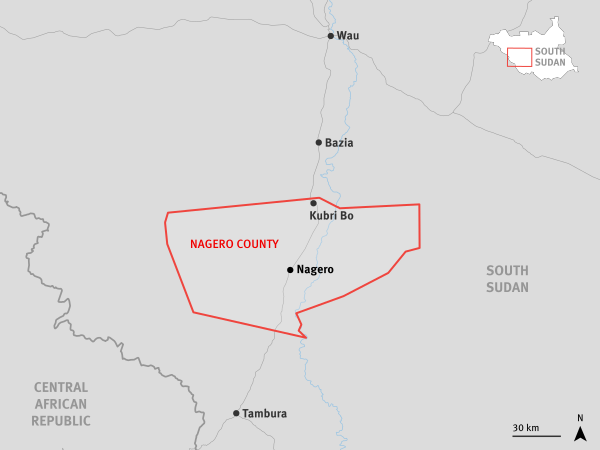
Longstanding tensions in Western Equatoria, including Nagero county between the South Sudan People’s Defence Forces (SSPDF) and the Sudan People’s Liberation Army-in-Opposition (SPLA/IO), have been compounded by tensions between the Balanda and Azande communities, widely perceived as aligned with the opposition and the government, respectively. Nagero County is predominantly inhabited by Balanda, while James Nando is Azande.
After government armed forces on January 6, 2025, took Kubri-Bo–a strategic junction linking Nagero and Tambura, in the south, to Wau, toward the north, fighting broke out between the warring parties and intensified after President Salva Kiir dismissed Western Equatoria Governor Alfred Futuyo Karaba, an SPLM/IO nominee and ethnic Balanda, and replaced him with a government-aligned candidate.
Government reinforcement soldiers came from Division 6 under General James Akech Adim and Nando’s forces stationed in Tambura and Maridi. This was reported as part of a broader government effort to clear SPLA/IO checkpoints along this road.
Fighting reignited on September 28 when the SPLA/IO forces attacked military barracks in Nagero town, and again on October 6, with violence continuing through mid-October.
While witnesses and survivors of abuses described below were not always able to identify their attackers, many attributed most abuses described in this report to government forces, because of their uniform or insignia, their language and vehicles, and which forces controlled the area at a given time.
Killings, including Summary Executions, Injuries of Civilians
Government forces and allies killed civilians, including summarily executing at least eight, during the violence in February and October 2025.
On February 7, as government forces withdrew from Kubri-Bo along the main road through Nagero Town, a 51-year-old man saw “four cars full of government soldiers” arrive at the Nagero town market. “The soldiers started beating people and shooting in the air and at people,” he said. “Before I could close my shop, they shot [dead] a man with a mental health condition. One soldier [then] came and shot me in the leg without saying anything. I remained on the ground until morning.” He saw the forces looting and burning shops and homes as they moved along the road through the town.
The forces spent the night in the town’s barracks.
On February 8, as they left their barracks, the soldiers detained and badly beat two young men, Jackson Erneo Kumbo and Stephen Natale Diko, students at a local secondary school, and then took them away. “I saw them forcing the two boys [young men] to sit down on the main road, beating them, with sticks and the back of machetes,” a witness said. “They took both their phones.”
That afternoon, the witness found the young men’s bodies riddled with bullets, 40 kilometers away. “Stephen’s head was badly injured, it was horrible, part of his face was missing. […] His body had also been burned along with the grass around. Jackson was shot in the chest, and […] his right hand and right leg were also broken.” Fearing government forces would return to Nagero town, relatives waited until early the following morning to bury them.
October 6 executions
In the early afternoon of October 6, 2025, in Nagero town, about thirty heavily armed soldiers arrived at makeshift camps where people had sheltered for over a week, three witnesses said. One witness said that six soldiers looted his cash and phones and warned him to return to town.
The soldiers detained the local chief, Jacob Paingbayo Carmello, who was in the camps, and took away four other men and three boys into the bush area, killing all but two men.
One man who escaped said, “When they tied us, they started firing. They shot many bullets at a go.” He said that the child who had been tied to him, called Saviour, was facing the soldiers and was shot first. “We both fell. I [managed to cut myself away] and started running. The area was full of trees, [bushes]. As I ran, the machine gun also shot towards me. I could see leaves falling around me, but no bullet hit me.” Saviour had been shot dead.
The other survivor said, “When they shot us, someone fell on top of me and I fell unconscious. I lay in that position until the next day. In the evening, I tried to get up and found I had been shot in the thigh and buttocks. The other bodies were starting to smell, and maggots were falling off my body when I moved. I tried to leave that place and started crawling.” He later realized he had been lying on his son’s body.
The army told the media that they had not killed civilians, claiming that those killed were fighters in civilian clothes.
A young woman and her brother returned to Nagero and were repairing their roof when two soldiers confronted them on October 30. The soldiers questioned her brother, saying: “‘When did you come to this house? We have been patrolling here for the last month, and nobody has been living here.’” Her brother said they had fled with other residents when the violence began and just returned.
The woman said, “The soldiers said, ‘If you fled, that means you are a rebel.’ They started beating him with a rubber stick and their guns. [My brother] told me in our language to run, while he fought the soldiers. He grabbed a knife from one soldier and stabbed him in the stomach. The other then shot [my brother] repeatedly in the chest and he fell down.”
Her brother died and the soldier later died of his injury.
Abusive, Arbitrary Detention; Other Ill-Treatment
People interviewed said that they were arbitrarily arrested and held in military barracks, beaten and ill-treated by soldiers as they fled the violence or when they returned home. The forces often accused civilians of supporting the opposition forces.
A 54-year-old man said he was detained on September 28, 2025, taken to the prison in Nagero town and accused of supplying the SPLA/IO with food and medicine. He said soldiers beat him twice a day with a rubber pole or stick for 11 days in a row. He was denied food and water for the first two days. He said, “Water would be poured on me, and I would be given 120 lashes on my buttocks and back. This only stopped when a new captain took over.” The man was released after a church representative intervened.
Once he returned home, harassment by soldiers still in the area forced him to flee: “The soldiers did not allow us to live freely or work in our farms. They could beat anybody they got. They said anybody who lived in that area is SPLA/IO and they will be shot or arrested.”
A 45-year-old woman said soldiers detained her on October 7 in Nagero town along with her mother and eight other women, holding them for three days at their base at Kubri-Bo. “The men were kept separate and I did not see them until I left. The women [were made to] fetch water and cook beans for the soldiers.”
A 31-year-old woman who sheltered in a makeshift camp, which she said was protected by the opposition forces, left on October 7. Government forces stopped her group, she said, and asked, “Where we came from, what we saw in the IO camp, whether we were wives and children of rebels, why we ran from our homes. They beat people with rubber pipes and beat two boys with the backs of their guns. The soldiers asked them for money, but they said they didn’t have and that they were students. The soldiers then said, ‘Oh you are the true rebels.’ They were beaten badly.”
Rape and Sexual Violence
In addition to the two women mentioned above who were raped when they returned home, a 25-year-old woman said she and another woman were gang raped while collecting firewood with two other women in late October:
One soldier climbed up a tree maybe to keep watch. Three soldiers took the woman in her 30s a small distance and raped her there. Another soldier tied the other woman, in her 50s, with a rope on her hands and feet and left her seated. Two soldiers started tearing my clothes and pushing me to the ground. I tried to refuse and they beat me and pointed a knife and a gun at me saying, ‘If you disturb, we will finish you.’ When they were done, the [lookout] soldier came down from the tree, beat, slapped and also raped me.
Burning, Looting, Destruction of Civilian Property
During the violence in February, September, and October, 2025, government forces looted food stores, as well as other private and public property.
Witnesses to both episodes said soldiers deliberately burned their property and burned homes including grass thatched houses, notably along the road through Nagero town and surrounding villages. Others said they were not sure if some burning was the result of crossfire, or had spread from other fires started by the soldiers such as when they burned grass along the roadsides to deprive opposition fighters of coverage.
A civil society representative documented homes being burned in multiple neghborhoods on February 7 and 8 including in Awolbot, Bandala, Bangaru, Diayanga, Kpangu, Mapiso Naagbagi, Nakptaguru, Nakpanangbara, Ngoi, Maringindo, and Zamoi.
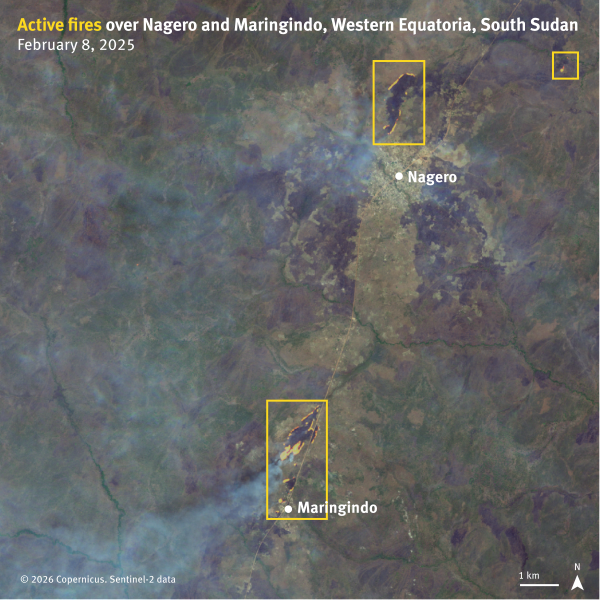
Human Rights Watch analyzed satellite imagery from the morning of February 7, 2025, showing smoke plumes over Nakptaguru, a village four kilometers north of Nagero town. Imagery from the following day shows active fires in the northwest part of Nagero town and over Maringindo village, about nine kilometers south on the road to Tambura.
People interviewed and activists said that government forces again burned civilian property on September 28 and 29.
On September 29, nine government soldiers stopped a man, 29, as he fled with his family. They forced them to return home in Nakptaguru neighborgood and beat him in front of his children: “[They said] ‘If you are not a rebel, why are you running away?’ They started beating me with ropes, with their hands and guns, my children started crying.” They looted cassava, groundnuts, millet flour, and chickens, and other civilian goods and infrastructure, and burned down his two houses.
In addition to the burning, the forces also stole personal goods from civilians, and damaged and looted civilian property.
The 27-year-old woman beaten alongside her stepmother said the soldiers stole her father’s bicycle and radio, and the battery from a solar panel, then burned their homes.
The 54-year-old man who was detained on September 28 and taken to a prison in Nagero town said the soldiers first looted three new bicycles, two 20-liter jerricans of petrol, solar batteries and lamps, and a big box with medicines.
People interviewed said that government forces also damaged and looted healthcare and education facilities.
A 56-year-old man who guarded a small health facility said that on September 28, soldiers attacked the facility, beat patients, doctors and nurses, and looted it. He said that four soldiers entered the facility: “They…pushed [the doctor] down using a gun. They broke down the door, found medicine and set it on fire. Then…took a laptop, and removed six installed solar batteries. Two climbed the roof and took down nine solar panels and three new batteries in cartons. They forced the doctor and other people…to carry the looted goods.”
A 58-year-old man said that 15 soldiers, some in uniforms and others in civilian clothes, arrived in a military pick-up truck and Landcruiser on October 7 at the Nagero primary school: “One jumped from the truck and started shooting bullets in the air then he opened the school gate. I…[hid] but could see them clearly. They broke into classrooms, into offices and into stores using iron bars. They broke windows and took everything they could find into the cars and then they drove off.”
Humanitarian Impact, Aftermath of Violence
After clashes broke out on September 28, 2025, some civilians fled into army barracks in the town while many fled into the nearby bush and forest, then further afield. REACH, an organization that provides humanitarian data, reported that displaced community leaders and elders said that the entire population of eight neighborhoods of Nagero Payam was displaced, with local authorities reporting that 16,000 people were sheltering around a church in Bazia town alone. Thousands remained displaced into 2026.
Displacement was particularly harsh on older people, people with disabilities, and pregnant people.
A 34-year-old man said that when he fled toward Bazia in late September a journey of four to seven days on foot, five older people died on the way apparently from illness and inadequate food, and one woman died after childbirth. A health official said that a 67-year-old man who was unable to walk due to severe rheumatism was left behind for two months after his family fled the September violence. “The man’s remains were found when people returned to visit in November,” the official said. He also said a blind man in his 70s died in mid-October in the bush after his grandson fled leaving him alone.
Media reported in January 2026 that the looting of health facilities had compounded an already struggling health system, forcing patients to travel long distances or rely on traditional remedies that they might not have otherwise prioritized if other medical care was available.
A survivor from the October 6 executions said that when he eventually returned to Nagero, one of his children fell ill, “I took him to the health facility, and found [it] empty. There was a bed but no mattress.” A medical volunteer said he cried when he saw the state of the main health facility in Nagero town and that as of June 2026, while they had received some very basic supplies, they had no lighting because they had not been able to replace the solar panels that had been destroyed, or other basic supplies such as bandages.
A school official said all the schools in the town were damaged or looted, adding that only half of the schools in and around Nagero were functioning as of June 2026 because teachers have not returned: “Pupils lack exercise books, people who return have no money to buy these things.” A survivor of the October 6 executions said they have still not been able to harvest crops and so he cannot afford to send his children back to school.
The Integrated Food Security Phase Classification warned in April 2026 that an already critical nutrition situation in Nagero county was expected to deteriorate further through July because of ongoing insecurity.
Two witnesses of the October 6 summary executions say they have seen some of the same soldiers involved in the incident around the town. A relative of the two students killed on February 8 said that he reported the case, but over a year later no investigation has taken place, and he cannot even afford to build a tombstone for the two. “Every morning I wake up and see the spot where we’ve buried them, we’ve not built with cement, just with soil,” he said. “It rains on top of it.”