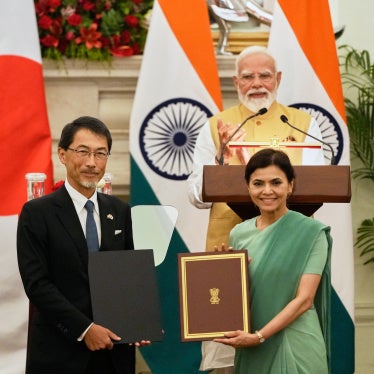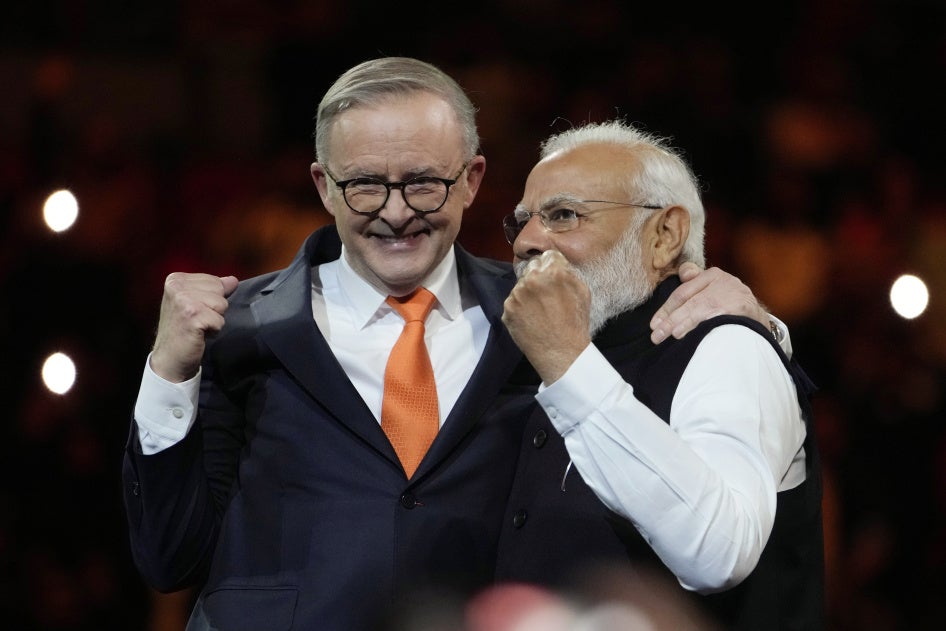
“Prime Minister Modi is the boss!” declared Prime Minister Anthony Albanese in May 2023, seemingly impressed and a little star struck by the enthusiastic welcome his Indian counterpart, Prime Minister Narendra Modi, received from the Indian Australian community. The size of the crowd reminded Anthony Albanese of a Bruce Springsteen concert.
Soon after, our Human Rights Watch office received a flurry of messages and calls from media outlets to talk about India’s slide into authoritarianism under Modi’s Hindu majoritarian Bharatiya Janata Party (BJP) led government over the past decade, something Albanese seemed to ignore.
Albanese’s enthusiasm for Modi and apparent lack of concern for the Modi government’s increasing human rights violations, eventually drew so much criticism that the Australian prime minister tersely asked everyone to “chill out a bit.”
But it is hard to “chill out” when Albanese reduced serious human rights concerns — discrimination against religious and ethnic minorities and repression of the media — to political differences and divergent viewpoints. When pressed by journalists, Albanese said to one that it’s not up to him “to pass a comment on some of the internal politics in India,” and to another that, “we all have different views about people in politics.”
Albanese can and should take a different approach when Modi returns to Australia this week.
With well-documented attacks on marginalized communities and a government crackdown on media and civil society, the Modi government’s violations were far more significant than Albanese made them out to be in 2023. And in the three years since his last visit, the Modi government has weakened India’s democratic institutions and intimidated and harassed critics, prosecuting them under counterterrorism, sedition and hate speech laws. Violence against religious minorities has increased and BJP leaders routinely use hate speech to target Muslims and Christians, while the government curbs criticism online.
In 2023, Albanese seemed to believe that publicly raising human rights concerns would risk damaging an important strategic relationship. The opposite is true. Although Albanese stayed quiet on human rights, Modi felt completely comfortable to raise his own concerns about the rights and safety of the Hindu minority community in Australia. He openly addressed the attacks on Hindu temples in Australia, as he had done when Albanese was in his country. This didn’t degrade the relationship; in fact, it rightfully came with assurances of “strict action” on the issue.
When Modi visits Australia this week there will be important conversations around trade, investment, regional stability, geopolitics and a changing world order, technology and security cooperation. But human rights should also be central to these discussions — initiated by both governments — because they form an intrinsic aspect of any strong relationship and are key to a stable world.
For Australia’s part, the government should address the democratic backsliding and repression within India, as well issues that directly affect Australian society, such as allegations of transnational repression linked to India. Authorities in Canada and the United States have investigated allegations that Indian agents or their associates targeted Sikh activists abroad. Canadian intelligence agencies have publicly identified India as a source of foreign interference in Canada’s democratic institutions and processes. A 2024 ABC investigation alleged that the Indian authorities were also monitoring and intimidating critics in the diaspora community in Australia — allegations which India has denied.
The Modi government has, moreover, cancelled visas or denied entry to journalists, academics, activists and other critics of his government, including members of the diaspora. In April 2024, Australian journalist Avani Dias, who then the ABC’s South Asia correspondent, reported that she had to leave India after the government did not extend her journalist visa until moments before it was due to expire, seemingly for political reasons.
The two governments should also discuss areas of shared concern. Australia should raise recent Indian government measures that seek to significantly expand state control over online speech and enhance government authority over digital platforms. Both countries share a common interest in ensuring that internet governance frameworks respect freedom of expression, privacy and due process.
As Prime Minister Anthony Albanese welcomes Prime Minister Narendra Modi, he should celebrate the growing ties between the two countries by making clear that human rights remain central to the relationship, because democratic partnerships are strongest when they are built on principles as well as common interests.