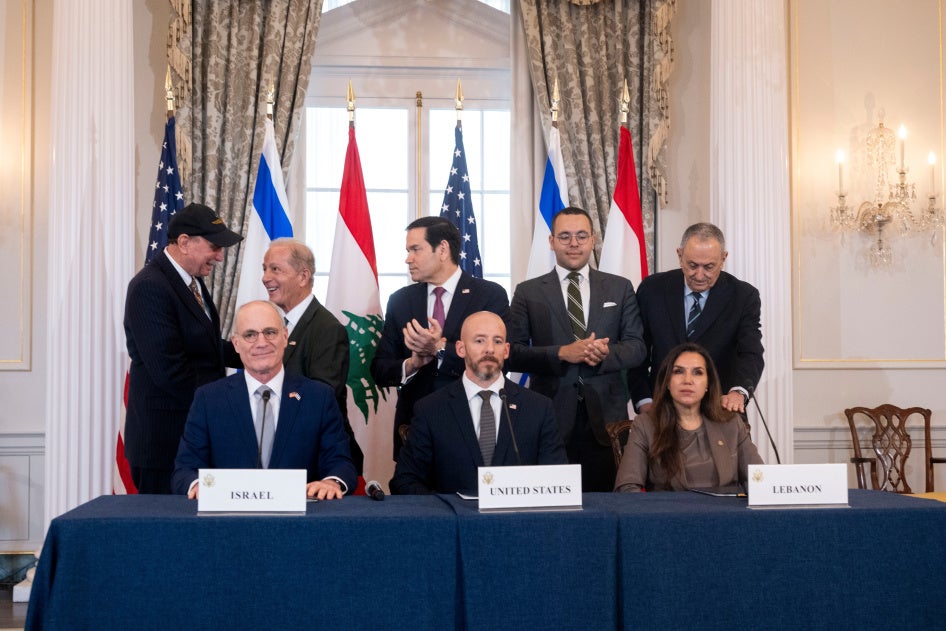
(Beirut) – The Israel-Lebanon framework agreement signed in Washington on June 26, 2026, threatens to betray war crimes victims in Lebanon, Human Rights Watch and five human rights and press freedom organizations said today. Parts of the text appear to be aimed at preventing victims of serious international crimes from seeking justice before international forums. Others seem to acquiesce to the prolonged and indefinite forced displacement of tens of thousands of residents of vast swathes of southern Lebanon occupied by Israeli forces.
The agreement comes following months of hostilities resulting in immense civilian harm, including as a result of war crimes, violations of international humanitarian law, and gross human rights abuses. Yet, Clause 13 of the agreement commits the governments of Israel and Lebanon to the cessation of “all hostile or adverse actions in international political or legal fora.”
To the extent that this agreement is interpreted to prevent Lebanon and Israel from having recourse to international courts, including the International Criminal Court (ICC) and the International Court of Justice (ICJ), it would contradict the countries’ international legal obligations to pursue accountability for serious international crimes committed on their territories. The agreement does not appear to commit Israel to halt any initiatives in international forums against Hezbollah.
Clause 3 further violates international law and the prohibition of forced displacement, conditioning the return of residents to specified zones along the border, currently occupied by Israel, to the “successful disarmament of non-state armed groups and dismantlement of their infrastructure.” Under international humanitarian law, people must be allowed to return once hostilities have ended or the reasons for their displacement cease to exist.
“Time and time again, we have seen civilians in Lebanon pay the price for successive cycles of conflict and serious violations and crimes under international law with no accountability,” said Agnès Callamard, secretary general of Amnesty International. “Victims of war crimes and other violations deserve justice. Any agreement that fails to center their rights to justice, accountability, and reparations will falter underneath the very impunity it builds. The past few years have made it abundantly clear: rampant impunity comes at a cost to us all. States that claim to uphold the international legal order must speak out: justice, reparation, and respect for international law in Lebanon and beyond are nonnegotiable.”
Since 2023, Amnesty International, Human Rights Watch, Legal Agenda, the Lebanese Center for Human Rights (CLDH), the Union of Journalists in Lebanon, and other rights groups have documented the Israeli military’s repeated violations of the laws of war and apparent war crimes in Lebanon. They include apparent direct attacks on civilian objects and civilians, indiscriminate attacks and other unlawful attacks that have killed medical personnel, journalists, and entire families; and the unlawful use of white phosphorus, which causes horrific burns, over residential areas.
Amnesty International found in a recent report that the Israeli military has forcibly displaced tens of thousands of Lebanese civilians, committing the war crime of unlawful transfer, while continuing the extensive destruction of civilian property and infrastructure it began in 2024 across southern Lebanon. Amnesty International and Human Rights Watch have also documented Hezbollah’s firing of unguided rockets at northern Israel, which have unlawfully killed and injured civilians.
Amnesty International, Human Rights Watch, Reporters Without Borders, Legal Agenda, CLDH, and other Lebanese and international rights and media groups, have repeatedly called for investigations into, accountability, and reparation for international law violations committed during the ongoing hostilities. In a February 2026 open letter to Lebanon’s deputy prime minister and justice minister, the groups highlighted the urgent need for decisive action from Lebanon’s government to ensure justice, accountability, and reparations for victims of serious violations of international humanitarian law committed in Lebanon, including seeking accountability at international legal forums.
“It is imperative that Lebanon promptly provides the ICC with the jurisdiction to investigate and prosecute such crimes,” said Wadih Al Asmar, president of CLDH. “Any delay amounts to tolerance of impunity and further injustice for victims.”
The groups called on the authorities to accede to the ICC’s Rome Statute and file a declaration with the ICC, accepting the court’s jurisdiction under article 12(3) of the Rome Statute, to investigate and prosecute crimes under international law committed on Lebanese territory since at least October 2023, and support the establishment of prompt, thorough, independent, and impartial domestic judicial investigations into war crimes committed on Lebanese territory. Lebanon’s parliament should put into place a legal framework for these efforts by adopting, without delay, a law criminalizing war crimes and other acts that are crimes under international law, in line with international standards.
In March, hostilities escalated again, as did serious international law violations. A UN Office of the United Nations High Commissioner for Human Rights’ (OHCHR) assessment team is already deployed in Lebanon, documenting violations of international humanitarian law and human rights violations and abuses committed since March 2, at the request of Lebanese authorities.
Under OHCHR’s terms of reference, to which Lebanese authorities agreed, the UN team would “examine options for accountability that may be available” and “safely document, preserve and secure all information collected together, with a view to enhancing its use in future accountability processes.”
Victims of serious international law violations, as well as their family members and loved ones, have demanded justice.
“Not only does this agreement risk further entrenching impunity, but it includes a clause that signals that political expediency outweighs the fundamental rights of those who have suffered atrocious violations,” said Lama Fakih, program director at Human Rights Watch. “It risks denying justice to victims at a time when mounting evidence points to repeated unlawful Israeli attacks causing extensive civilian harm and widespread destruction.”
Since October 8, 2023, more than 8,700 people, including at least 569 children and 357 medical workers, have been killed in Lebanon, according to Lebanon’s Health Ministry. Israeli forces have also repeatedly targeted and killed identifiable journalists covering the war, according to Reporters Without Borders. Hezbollah attacks have killed at least 32 civilians since October 2023, according to Israeli media.
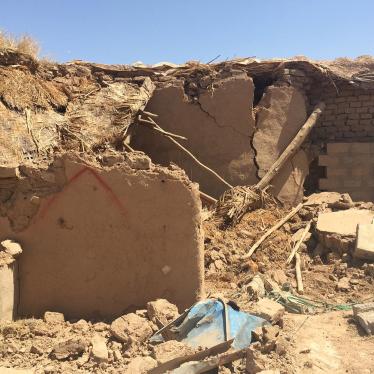
Hundreds of thousands of people remain displaced in Lebanon following displacement orders issued by the Israeli military, which has also occupied nearly 600 square kilometers of Lebanon’s border villages, prohibiting residents from returning.
While the agreement notes that both Israel and Lebanon recognize the importance of “the safe return of [southern Lebanon’s] civilian population,” it effectively consents to the prolonged and indefinite displacement of tens of thousands of residents of southern Lebanon by making their return, as well as reconstruction, contingent on conditions subject to “confirmation”. The agreement makes no mention of justice or reparation for victims of serious international humanitarian law violations, such as those subjected to unlawful transfer and those whose homes and agricultural lands have been unlawfully destroyed.
“The Lebanese government has conceded a right that is not its right: the right of the victims to pursue and hold the perpetrators accountable,” said Elsy Moufarrej, president of the Union of Journalists in Lebanon. “This is the right of the people who lost their loved ones, whose homes and memories were destroyed. This is the right of those who performed their duties despite the dangers, like journalists and emergency medical workers.”
The Lebanese and Israeli governments should not implement the agreement in a way that overlooks the rights of victims and survivors and should make clear that the agreement, including clauses 3 and 13, does not override the two government’s international legal obligations, the groups said.
Governments, including those that have previously supported accountability for crimes under international law committed in Lebanon, should make clear that their support for a political settlement does not extend to provisions that foreclose the possibility of justice, reparation and return of the displaced, the groups said.
“Accountability and respect for international law are not bargaining chips,” said Ghida Frangieh, head of litigation at Legal Agenda, “They are legal obligations. International law is clear: States cannot waive or negotiate away their obligation to investigate and prosecute the most serious crimes of concern to the international community as a whole. Nor can states extinguish individual rights to truth, justice, and reparation.
“Lebanese authorities should urgently take concrete steps to uphold their obligations under international law by pursuing every possible path to accountability, including granting jurisdiction to the ICC and pursuing reparation for international law violations. And they must secure the right of the displaced to return to their homes. There cannot be peace without justice.”
List of signatories:
- Amnesty International
- Human Rights Watch
- Lebanese Center for Human Rights (CLDH)
- Legal Agenda
- Reporters without Border
- Union of Journalists in Lebanon