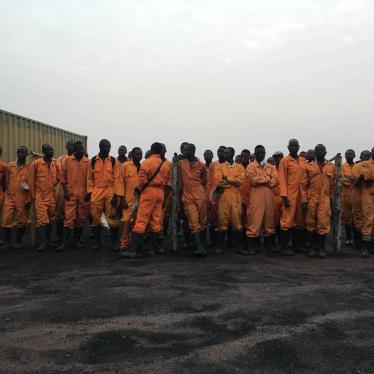
(Nairobi) – Rwandan military forces and the M23 armed group carried out a campaign of forced recruitment and abusive detention of thousands of captured combatants and civilians in eastern Democratic Republic of Congo, Human Rights Watch said in a report released today.
The 78-page report, “‘Death Was Everywhere’: Arbitrary Detention, Killings, and Forced Recruitment by the M23 and the Rwanda Defence Force,” documents large-scale roundups and arrests in North and South Kivu provinces in eastern Congo, as well as grave abuses against detainees at the Rumangabo and Tshanzu training camps in North Kivu, between mid-2024 and December 2025. M23 fighters, backed by Rwandan military personnel, have committed murder, torture, corporal punishment, and used forced labor and child soldiers, researchers found. These abuses are war crimes and should be investigated as possible crimes against humanity.
“The Rwandan-backed M23 is running so-called training camps in eastern Congo, where recruits have suffered abuse and torture, at times with deadly consequences,” said Clémentine de Montjoye, senior Great Lakes researcher at Human Rights Watch. “Regional bodies and partner governments should press Rwanda’s authorities to stop these grave abuses and support accountability for those responsible.”

Human Rights Watch interviewed 102 former detainees who escaped the Rumangabo and Tshanzu camps, were deployed with the M23, or later surrendered to the Congolese army, witnesses to abuses, as well as United Nations, M23, military, intelligence, media, and diplomatic sources. Human Rights Watch interviewed former detainees in person in Uganda and several towns in Congo and by phone in M23-controlled areas. The report also draws on verified, geolocated videos and photographs, satellite imagery of Rumangabo and Tshanzu camps, and 3D reconstruction to estimate the number of people loaded onto trucks.
Since 2024, the M23 has carried out forced recruitment drives among both civilians and captured combatants, Human Rights Watch found. After the armed group captured large swaths of territory and key eastern cities in 2025, these efforts increased in areas under their control. Thousands of Congolese soldiers, Wazalendo militia allied with national forces, police, and civilians—including children as young as 12—were recruited, sometimes voluntarily, although often forcibly.
M23 fighters set up ambushes and checkpoints on roads, apprehended people at hospitals, churches, and schools, and summoned residents under false pretenses or with threats before transporting them in trucks to the two camps.
People in the camps were beaten and lacked adequate food, water, medicine, and health care. Former detainees described summary executions and beatings of people who tried to escape the training centers or who drank water, ate food, or relieved themselves without permission. “If we were caught trying to drink from puddles on the ground, the guards beat us violently,” said a civilian held for five months. The M23 held children at Tshanzu camp for training and forced labor and selected some for guard duty and to beat other detainees.
The total number of camp deaths could only be determined if all mass graves were found and excavated, but former detainees indicated that hundreds, perhaps more, died from the harsh conditions, beatings, and executions in both camps throughout 2025.
A former detainee who was held at Tshanzu said: “I was just a student, I had never seen a dead body before. They made me bury bodies seven times, we put them in a big grave.”
Former detainees identified Rwandan soldiers during roundups and among the trainers and commanders in the camps because of their uniforms, equipment, accents, and inability to speak French or Kiswahili—which are not widely spoken in Rwanda—in conversations with detainees. Military, intelligence, and UN sources confirmed the involvement of Rwandan forces.
Rwanda’s extensive military presence and impact on M23 operations in eastern Congo show that Rwandan forces exercise effective control over the area, meeting the legal threshold for belligerent occupation under international humanitarian law. Rwandan officials could be held criminally liable for the actions of M23 forces at the training centers.
Rwandan government and M23 officials have long denied, but failed to investigate, allegations of abuse. Other armed groups in Congo, including some supported by Rwanda, have engaged in forced recruitment and the use of child soldiers in eastern Congo. Over the years, neither Congo nor Rwanda has taken serious action regarding these grave crimes, Human Rights Watch said.
In May 2026, Human Rights Watch conducted phone interviews and visited Makala prison in Kinshasa, the capital, where scores of civilians forcibly recruited by the M23 and later surrendered to Congolese forces are detained. Thirty-four detainees, including fourteen children, said Congolese military intelligence held and interrogated them for several days to a month after they surrendered before transferring them to Makala.
On June 9, Human Rights Watch wrote to Congo’s justice and defense ministers seeking information about the legal basis for their detention and other issues.
Rwanda’s international partners, including the United Nations, the African Union, the European Union and its member states, and the United States, should publicly address Rwanda’s longstanding cycles of abuse and impunity in eastern Congo and review military assistance and cooperation programs with Rwanda to ensure they are not fueling further serious violations. They should promote accountability, including by imposing further targeted sanctions against M23 and Rwandan commanders and officials responsible for abuses and supporting domestic and international justice efforts.
Congolese judicial authorities should seek to preserve evidence of crimes committed in Rumangabo and Tshanzu and bring appropriate prosecutions. As part of its ongoing inquiry in eastern Congo, the Office of the Prosecutor of the International Criminal Court (ICC) should investigate alleged war crimes and crimes against humanity committed by Rwandan and M23 forces in the context of forced recruitment campaigns and the detention of recruits in their training camps.
“The forced recruitment of civilians, including children, is part of a decades-long cycle of abuse in eastern Congo,” de Montjoye said. “Concerned governments need to show that the atrocities being committed by Rwanda and the M23 in their training camps require urgent action to stop them and show no one is beyond the reach of justice.”