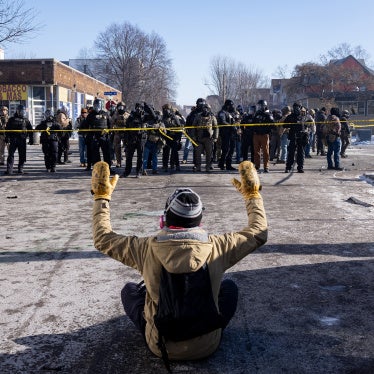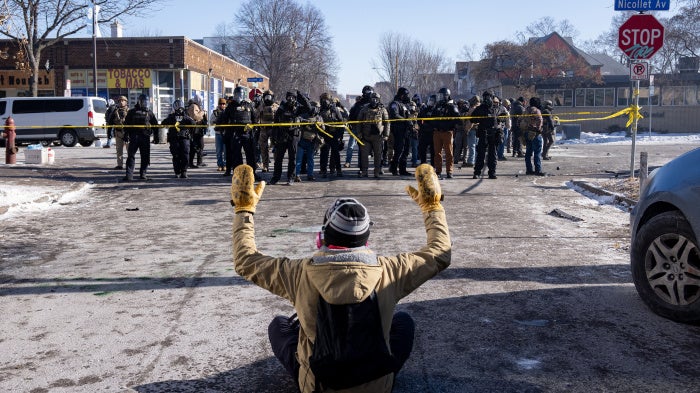
Summary
The Trump administration launched “Operation Metro Surge” in December 2025, an unprecedented deployment of thousands of federal immigration agents and officers to the state of Minnesota in the United States. During the operation, Human Rights Watch documented how masked and armed officers: unlawfully killed two people and injured others; unlawfully arrested and detained hundreds; engaged in racial profiling, harassment, and surveillance; and terrorized Minnesotans, chilling their rights to freedom of expression and assembly, and impacting their rights to education and health, among others.
This report details how the federal government caused a human rights crisis in Minnesota, particularly in and around the Twin Cities of Minneapolis and St. Paul, and how residents faced further abuses when they collectively acted to protest, prevent, and stop these violations of their rights, in a significant movement for human rights and civil liberties. It proposes recommendations to stop ongoing abuse and remedy past harm.
Abusive practices have long been a feature of US immigration policy. But since taking office in January 2025, the second Trump administration has violated rights on an entirely new scale. As part of its immigration enforcement campaign, it has deployed Department of Homeland Security (DHS) officers from Immigration and Customs Enforcement (ICE) and Customs and Border Protection (CBP) to US cities and towns. Operation Metro Surge was the largest such deployment of immigration agents since Trump took office, but the federal government has deployed agents to streets across the United States to rapidly expand detention and deportation while flagrantly disregarding human rights and the rule of law.
This report is based on interviews with over 130 people, including immigrants, human rights defenders, lawyers, healthcare providers, educators, current and former government officials, and others with first-hand knowledge of Operation Metro Surge and its impacts. Interviews were supplemented with analysis of photographs, videos, sworn declarations and legal petitions, judicial decisions, documentation by local human rights defenders, independent surveys, medical and public health research, news articles, and records maintained by healthcare professionals, educators, businesses, and organizations providing food assistance.
Over the course of around three months, ICE and CBP stopped, arrested and detained thousands of people in Minnesota, including US citizens, refugees, green card holders (permanent residents), individuals with pending asylum applications or other applications for immigration relief, as well as unauthorized immigrants. Many of these individuals appear to have been stopped and detained based on their race or ethnicity, violating their right to non-discrimination and freedom from arbitrary detention.
The Trump administration claimed that Operation Metro Surge was designed to keep Americans safe and often stated that it was targeting noncitizens with violent criminal histories. But the operation itself caused significant harm, and nearly two out of three immigrants arrested by ICE during Operation Metro Surge had no prior US criminal history whatsoever.
Detained individuals, including both immigrants and US citizens, were typically held initially at the Bishop Henry Whipple Federal Building south of Minneapolis, where many were blocked or impeded from accessing counsel and subjected to inhuman and degrading conditions, including overcrowded and dirty cells, continuous shackling, prolonged exposure to bright lights, and being forced to sleep on cold floors without beds or bedding, and lack of access to adequate health care.
Lawyers undertook a herculean effort to rapidly file habeas corpus petitions on behalf of unlawfully detained individuals, many of which resulted in court orders for immediate release. The government has violated many of these court orders.
People in Minnesota who opposed Operation Metro Surge organized and deployed rapidly to the streets, set up group chats, and used community spaces to defend rights by protesting, observing, and monitoring the conduct of federal agents and their widespread abuses.
The government’s response was harsh and abusive. Federal agents surveilled, harassed, intimidated, arbitrarily arrested, and injured people who were engaged in lawful and protected activities, including observing agents or protesting their operations.
Operation Metro Surge entailed the rampant use of excessive force. In two cases that sparked outrage across the United States and internationally, federal immigration agents shot and killed US citizens Renee Good and Alex Pretti. Federal agents shot a third Minneapolis resident and pulled guns on dozens more. Agents also violently smashed car windows without justification, physically threw people to the ground who were not resisting arrest, and deployed chemical irritants and flash-bang grenades on dozens of occasions, sometimes at close range and without warning, resulting in injuries, including to journalists.
Operation Metro Surge spread terror and fear. In some cases, residents wanted to exercise their rights to observe or protest, but were too afraid of being abused or killed to do so.
Many immigrants and people of color were so terrorized by the government’s racial profiling, arbitrary arrests, and violence that they restricted their movement or completely sheltered in their homes for weeks or months. As a result, people delayed or went without health care, including prenatal and postnatal care and treatment for chronic conditions. Thousands of students in Minnesota missed school or felt obliged to shift to virtual learning, and many who continued to attend did so while experiencing fear and anxiety which impacted their ability to learn. Families and individuals sheltering in place also struggled to access food or go to work, undermining their income security and rights to food and housing.
Again, Minnesota residents organized themselves to provide grocery delivery, rent and other financial assistance, transportation to school, work, and healthcare appointments, and other forms of support to their communities.
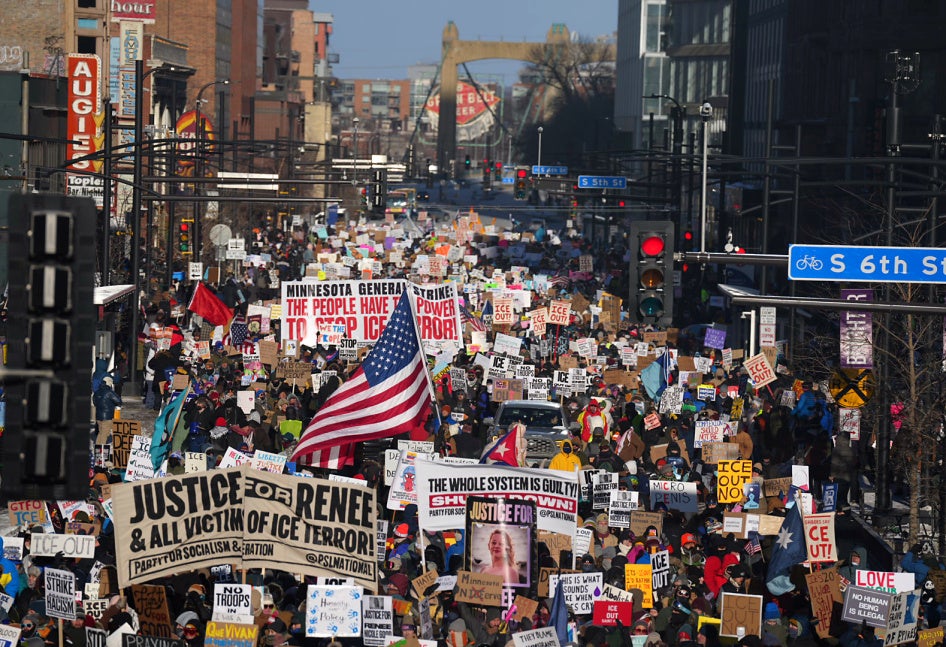
On one hand, the government’s actions were directly felt through the abuses and crises it was inflicting on communities. On the other hand, its harm was felt in how these actions further undermined the availability and accessibility of essential elements of a host of economic, social, and cultural rights, especially education and health care. In the words of one human rights defender, the government was “failing in almost every regard. Every single time there is a gap, our neighbors are the ones who are filling it.”
Operation Metro Surge also caused severe mental and emotional distress for many people, negatively impacting their mental health. Residents reported experiencing anxiety, fear, and trauma from being subjected to or witnessing ICE abuse. One US citizen who immigrated to the United States 30 years ago highlighted that the anti-immigrant actions and rhetoric associated with Operation Metro Surge left him questioning his place in the United States. “Where do I belong on this planet?” he asked. Mental health experts interviewed for this report assessed that the mental health impacts of the surge will be long-lasting and require significant resources to overcome.
While Operation Metro Surge has formally ended, most of those responsible for its abuses have not been held accountable. At the time of writing, residents report ongoing fear and risks of long-term harm from the operation.
This report demonstrates the need for urgent and comprehensive action to repair the harms suffered across the state and ensure non-repetition in Minnesota or elsewhere. Human Rights Watch calls on the US government to immediately stop its abuse of immigrants and other US residents, including citizens, and to take steps to hold those responsible to account, including through investigations and prosecutions where appropriate. If the current administration and Congress fail to take the necessary action, future administrations should make accountability and reform a central pillar of their agendas.
In the face of the federal government’s recalcitrance, Minnesota state officials can play a critical role in preventing further abuses and impunity and promoting truth and justice for the harms wrought by Operation Metro Surge. The state government should continue its important efforts to investigate abuse and ensure that the statewide council announced in March to investigate Operation Metro Surge is fully empowered to document the full human rights impact and make recommendations.
US immigration policy and practices must be rights-respecting. Detention should only be used as a measure of last resort and must comply with international human rights standards and guarantee the safety, dignity, and wellbeing of those detained. The Department of Homeland Security and its agencies, including ICE and CBP, should be overhauled, with transparency and oversight mechanisms reconstituted and strengthened, meaningful protections implemented against the unnecessary use of force, and consistent accountability imposed for officials at all levels.
This report identifies individuals with senior leadership responsibilities and oversight of the agencies responsible for Operation Metro Surge and recommends that they be investigated for their potential roles in the abuses documented in this report.
Finally, in consultation with local communities, including health care and social service providers, educators, and other experts, all levels of government should consider steps to support residents who had their access to health care, education, work, and food disrupted by the abuses of Operation Metro Surge.
Recommendations
To the US Congress
Ensure oversight and accountability for federal agencies:
Hold comprehensive oversight hearings to investigate the conduct of federal agents in Minnesota during Operation Metro Surge, including Department of Homeland Security (DHS) agents within Immigration and Customs Enforcement (ICE) and Customs and Border Patrol (CBP), and other federal agents potentially involved in abuses, including Bureau of Prisons officers with the Department of Justice (DOJ).
Pass legislation that generally prohibits immigration enforcement at sensitive locations, including schools, health care facilities, places of worship, and courthouses.
Pass legislation restricting the use of face coverings for the purpose of obscuring identity by law enforcement and other government employees, generally requiring that agency, name, and badge number be clearly identified, and limiting the use of unmarked vehicles that obscure agency or agent identities in immigration enforcement operations.
Immediately conduct robust oversight of ICE detention, including physical, in-person inspections and through use of subpoena authority.
Reconstitute and ensure all congressionally designated oversight bodies— such as the Office of the Immigration Detention Ombudsman (OIDO), DHS Office of Inspector General and DHS Office for Civil Rights and Civil Liberties (CRCL)— have adequate funding and the capacity, staff, resources, authority, and independence needed to effectively monitor DHS practices, receive complaints, investigate abuses, and ensure accountability for unlawful conduct and rights violations.
Pass legislation explicitly prohibiting racial profiling in immigration enforcement.
Limit immigration detention:
Repeal sections 236(c) and 235(b) of the Immigration and Nationality Act and any other provision of law requiring mandatory immigration detention.
Revise the Immigration and Nationality Act to make clear that immigration judges can set and redetermine bond regardless of manner of entry, status, or other factor when a person is facing DHS detention.
Pass legislation requiring that when supervision and monitoring are necessary due to a proven safety concern or likelihood of absconding, DHS should utilize, to the maximum extent possible, alternatives to detention programs that achieve the aims of immigration enforcement in a humane and effective manner, with a view towards transitioning away from immigration detention in favor of such approaches.
Oppose requests to fund expanded detention capacity.
To the US Executive
Ensure accountability and independent oversight:
End any formal or informal immigration arrest and deportation quotas.
Make a public commitment to uphold human rights in all immigration enforcement and commit to holding perpetrators of abuse to account and to remedying all violations.
In consultation and coordination with state and local agencies, launch investigations into senior officials responsible for directing and overseeing Operation Metro Surge and hold all officials responsible for committing or directing violations of law or DHS policy, including on use of force, accountable.
Retain, reinstate, and cooperate with all congressionally designated oversight bodies—such as OIDO and CRCL—and restore budget allocations necessary to strengthen their capacity through staffing and resources to monitor detention conditions, ensure access to adequate complaint procedures, investigate abuses, and ensure accountability for rights violations.
Establish a special mechanism to receive complaints and process and pay claims for reimbursement to individuals for loss of income and property, or other costs incurred, including health care costs, due to Operation Metro Surge rights abuses.
Limit immigration detention and implement alternatives to detention:
End mandatory detention.
To the maximum extent permitted by law, direct DHS to use immigration detention only as a measure of last resort, for the shortest possible duration.
When supervision and monitoring are necessary due to a proven safety concern or likelihood of absconding, utilize to the maximum extent possible alternatives to detention programs that achieve the aims of immigration enforcement in a humane and effective manner, with a view towards transitioning away from immigration detention in favor of such approaches.
Protect access to rights-essential services and spaces:
Restore and improve upon the October 27, 2021 Guidelines for Enforcement Actions in or Near Protected Areas (also known as the “Sensitive Locations Memo”) which forbids, with few exceptions, immigration enforcement activities in schools, places of worship, healthcare facilities and other protected locations, public or private.
Codify the substance of the memo into regulation.
Mandate regularly scheduled trainings on protected and sensitive areas.
Require documentation of any exceptions applied, to be audited routinely.
Include disciplinary consequences for violations by agents and relevant personnel.
Expand the prohibited actions at sensitive or protected locations to include not just physical enforcement, but also surveillance, license plate scanning, and questioning.
Direct agents to provide advance notice before entering protected or sensitive areas, including notice to facility owners and leadership (e.g., school principals), unless exigent circumstances are present, properly documented, and subject to review (e.g., providing additional security at a school during an emergency).
Make clear that the list of locations categorized as sensitive, protected, or providing essential services in the memo is non-exhaustive.
Expand named locations to include the following in the non-exhaustive list:
Courthouses and other venues where individuals must appear for legal proceedings or obligations (e.g., immigration court, civil and family court, parole and probation check-ins, traffic court).
Government offices where individuals complete administrative processes (e.g., tax preparation or collection offices, U.S. Citizenship and Immigration Services (USCIS) field offices, Department of Motor Vehicles (DMV) offices, Social Security offices, Family and Children’s Services offices, and agencies charged with enrollment and operation of public programs like Medicare, Medicaid, Special Supplemental Nutrition Program for Women, Infants, and Children (WIC), and Supplemental Nutrition Assistance Program (SNAP).
Non-government facilities that provide legal or civic support services (e.g., legal aid clinics, immigration nonprofits, domestic violence shelters and services, community-based service centers, food banks, youth centers and services).
Any polling station or voting center, to prevent potential deterrence of US citizens from in-person voting due to fears of ICE conduct.
Establish a grievance system for community members to report inappropriate enforcement or presence in sensitive and protected areas.
Publish compliance reports regularly, including the number of enforcement actions that occurred at or near protected and sensitive areas, use of exceptions, complaints received, and outcomes of investigated grievances.
Restore the April 27, 2021 Guidance to Limit ICE and CBP Civil Enforcement Actions In or Near Courthouses.[1]
Rebuild and expand humanitarian protections and pathways:
Re-designate or extend, as appropriate, Temporary Protected Status (TPS) for people fleeing countries where extraordinary conditions continue to make return unsafe.
Restore humanitarian parole for people from Cuba, Haiti, Nicaragua and Venezuela.
To the Department of Homeland Security
Halt abusive law enforcement practices:
Withdraw any remaining surge of federal agents to Minnesota and refrain from opening a similar effort anywhere else.
Publicly commit to a major overhaul of DHS policy and conduct, commit to uphold international human rights standards at all times, and implement a no tolerance policy for agents involved in unlawful, abusive, or disrespectful conduct.
Refrain from excessive use of force and retrain all agents in accordance with international human rights standards, including on the use of force.
Document and investigate all use-of-force incidents, including deployments of less lethal munitions and the threat or use of lethal force. Publicize use-of-force incident reports and the results of related investigations.
Ensure that all public-facing enforcement agents wear uniforms clearly identifying their agency, name, and badge number, and as a general rule, prohibit them from wearing face coverings for the purposes of obscuring identity while carrying out their official duties.
Limit detention to the maximum extent and ensure dignified conditions:
Use immigration detention only as a measure of last resort, for the shortest possible duration.
If detention cannot be avoided, ensure detention conditions comply with the United Nations Standard Minimum Rules for the Treatment of Prisoners, including ensuring access to all necessary health care, including mental health care that is voluntary and adequately resourced.
Ensure that people in detention are able to access any legal counsel they might have, including by providing private meeting spaces, sufficient phone access, and timely information about legal rights and proceedings during the processing period.
Ensure all immigration detention facilities, whether contracted with private companies or state/local facilities, meet minimum standards, including ensuring adequate access to counsel.
Ensure human rights-compliant use of technology in immigration operations:
Ensure any deployment of technology by DHS meets international human rights law and standards, including principles of necessity and proportionality.
Ensure any technology developed and/or deployed by DHS meets federal transparency and accountability requirements, including detailing use in the DHS AI Use Case Inventory and undertaking and publishing required risk and impact assessments, including Privacy Impact Assessments and Privacy Threshold Analyses, in a timely manner.
Ensure any data acquired, processed, analyzed, and stored by DHS is subject to strong data protection safeguards that align with human rights laws and standards.
To the Department of Justice
In coordination with state and local authorities, launch independent and impartial federal civil rights investigations into reported incidents of excessive force and other violations by federal agents in Minnesota, including:
The killings of Renee Good and Alex Pretti, ensuring the investigations are in line with international standards set forth in the Minnesota Protocol on the Investigations of Potentially Unlawful Deaths, which require they be prompt; effective and thorough; independent and impartial; and transparent.
The shooting of Julio Cesar Sosa-Celis;
Threats of lethal force, including the unnecessary drawing and pointing of firearms at individuals who posed no threat of serious injury or death;
The use of less lethal munitions or other force without adequate warning and in a manner disproportionate to legitimate law enforcement objectives, or when nonviolent means would have been effective;
The use of excessive force during arrests, including smashing car windows, throwing individuals to the ground, or dangerously pressing or pulling on an individual's head or neck; and
Racial profiling in stops, arrests, and detentions.
Refrain from bringing arbitrary prosecutions against individuals for exercising their rights to freedom of expression and peaceful assembly.
To the Minnesota State Government
Ensure adequate resourcing, support, powers, and follow-up for the work of the council created by an executive order in March 2026 to assess the full impact of Operation Metro Surge and Operation PARRIS on Minnesota, including its impacts on safety, health, education, and economy. The council should undertake a full review of the human rights impacts of Operation Metro Surge and Operation PARRIS, and issue recommendations to protect human rights.
Engage with local advocates, health care providers, teachers, union organizers, and other community leaders to develop plans and mechanisms for accountability and compensation for harm aligned with human rights standards and community demands.
Ban 287(g) agreements between local law enforcement agencies and ICE.
Consider any lawful steps to prevent the development of new immigration detention facilities, including the purchase and conversion of warehouses and other commercial spaces not designed to humanely house people, absent guarantees the facilities will ensure humane and dignified treatment consistent with human rights standards.
Establish and fund independent, community-based, culturally and linguistically accessible mental health and psychosocial support services for people affected by Operation Metro Surge, regardless of immigration status. These services should be voluntary, confidential, and not linked to immigration enforcement or information-sharing with federal agencies.
Explore whether additional funding is needed for schools and free tutoring services for students to help them catch up after weeks of educational interruption.
Investigate surveillance of residents by federal agents, including what tools and tactics agents have used to track and target Minnesotan residents and explore any necessary steps to safeguard state and local data from unauthorized use by the federal government, including data collected by the Minnesota Department of Public Safety and other state and local government entities.
To Minnesota Local Prosecutors
Refrain from arbitrarily prosecuting individuals for engaging in protected activities, including observing and protesting federal agents.
To the extent possible under US law, continue to investigate and prosecute federal agents for violations of state criminal laws.
Launch an investigation into allegations of unlawful surveillance by federal agents, including what tools and tactics agents have used to track and target Minnesotan residents.
To Local Law Enforcement in Minnesota
Refrain from entering into 287(g) agreements.
Refrain from using less lethal weapons or other force against protesters without adequate warning or justification, and ensure that any use of force is necessary and proportionate to the circumstances.
To Other Governments and UN Mechanisms
UN Special Rapporteurs should send communications, request country visits, and address developments in the United States in their reports and statements. They can also offer their legal and policy expertise to officials seeking to uphold human rights at the state and local level.
During the next UN Universal Periodic Review of the United States, UN member states should make recommendations for the United States to implement legal and policy measures to end racial profiling, prevent and sanction excessive use of force by security forces, and ensure accountability for the rights violations identified in this report, including the broad impact of Operation Metro Surge on the rights to health, education, work, housing, and food.
Methodology
Between January and March 2026, Human Rights Watch interviewed 136 people in Minnesota, including immigrants, community leaders, lawyers, members of civil society, current and former government officials, healthcare providers, educators, and other Minnesota residents who have experienced abuse and/or engaged in community response efforts, including protest, documentation of the actions of federal immigration agents, and mutual aid activities like delivering groceries or giving rides to school or health care appointments to affected neighbors.
Interviewees were informed of the voluntary nature of the interview, the purpose of our research, and how the information would be used. Human Rights Watch did not compensate interviewees. Most interviews were conducted individually; some were conducted in pairs or small groups when the interviewees preferred. Many interviews were conducted in person, and some were conducted virtually. Interviews were conducted in English or Spanish.
Human Rights Watch has used pseudonyms for the many interviewees who elected to remain anonymous due to privacy and security concerns, including fear of retaliation by the US government for speaking out against its abuses.
Human Rights Watch complemented interview testimony with analysis of 52 videos and various photographs taken between November 2025 and February 2026. Videos and photographs analyzed by researchers at Human Rights Watch were also reviewed by members of staff with visual verification expertise. To determine the location of each video and photograph, researchers matched landmarks with available satellite imagery, street-level photographs, or other visual material. Where possible, Human Rights Watch used the position of the sun and any resulting shadows visible in videos and photographs to estimate the time the content was recorded. Researchers also confirmed that each piece of content had not appeared online prior to the date it was posted.
Human Rights Watch has adopted specific terminology to distinguish between audiovisual content that we have analyzed, and audiovisual content that we have also verified. In the report, Human Rights Watch uses the term “reviewed” for content that has been seen but has not gone through several verification checks. We use the term “analyzed” for content that has been reviewed and appears authentic, but for which we have confirmed some but not all temporal, geographic, or contextual aspects. We use the term “verified” for videos or photographs where we were able to confirm the location, timeframe, and context in which they were taken.
Human Rights Watch also conducted quantitative analysis of US Immigration and Customs Enforcement (ICE) Enforcement and Removal Operations (ERO) arrests, detentions and deportations (“removals” by ICE’s definition) data released in response to a Freedom of Information Act (FOIA) request made by the UCLA Center for Immigration Law and Policy and made public by the Deportation Data Project.[2] The data on removals is supposed to include every deportation made by ICE ERO and includes removals through March 10, 2026. Criminal history data from the ICE releases includes the most serious charge of conviction that ICE has in its databases and is standardized according to National Crime Information Center (NCIC) codes. Analysis on arrests and detentions is released under the same FOIA requests and is linked to the deportation data by an anonymous identification variable. All processing and analysis code was written in the programming language R.
Researchers also visited several sites across Minneapolis, St. Paul, and surrounding areas, including a range of affected neighborhoods, mutual aid hubs, local businesses, a hospital, memorial sites, and the protest site outside Bishop Henry Whipple Federal Building, which houses the ICE regional field office and serves as a temporary detention facility.
We met with staffers from Minnesota congressional and Senate offices, the Minnesota governor’s office, and the Commissioner of the Minnesota Department of Human Rights.
Human Rights Watch also acquired and analyzed relevant court filings, including habeas corpus petitions and decisions and various sworn declarations from victims, advocates, and government officials.
Researchers also analyzed a database managed by Minnesota residents to document detentions, use of force, and other activities by federal immigration agents in their communities.
We also reviewed relevant laws and policies, news articles, academic papers, public health studies, surveys, government and civil society reports, statements by leading medical associations, and statements by government agencies and officials.
On February 5, Human Rights Watch requested access to ICE’s regional field office and the ICE detention facility at the Bishop Henry Whipple Federal Building in Minnesota as well as a meeting with the Acting Director of the ICE field office but did not receive a response.
On April 30, Human Rights Watch wrote to the Department of Homeland Security, the Department of Justice, the Federal Bureau of Investigations, and senior ICE and CBP leadership with a summary of findings and questions, but had not received a response by the time of publication.
I. Background
Immigration Authorities
Several federal agencies within the United States government have authority to enforce US immigration laws, including Immigration and Customs Enforcement (ICE) and Customs and Border Protection (CBP), both component agencies of the Department of Homeland Security (DHS).[3]
ICE includes various sub-agencies, including Enforcement and Removal Operations (ERO) and Homeland Security Investigations (HSI). ERO officers carry out arrests and manage detention and deportation operations.[4] HSI agents are responsible for investigating violations of immigration law and transnational crime.[5]
CBP officers manage ports of entry to the United States, where they conduct inspections of people and goods entering and at times exiting the country, and have authority to conduct seizures and arrests.[6] CBP has multiple components, including the United States Border Patrol, which monitors the US border between ports of entry, operates traffic checkpoints within a “reasonable distance” of the US border (generally 100 miles per federal regulation, an area that covers the location of nearly two-thirds of the US population[7]), and may also pull over drivers or otherwise stop people they reasonably suspect of a federal crime or violating immigration law.[8]
Border Patrol also contains the Border Patrol Tactical Unit (BORTAC), a special operations unit focused on “high-risk” law enforcement, sometimes abroad, that has historically focused on terrorism and drug enforcement.[9]
Some local law enforcement agencies also elect to carry out immigration enforcement operations pursuant to partnerships with ICE, often called “287(g) agreements” in reference to the provision of the Immigration and Nationality Act (INA) that authorizes these arrangements.[10]
Immigration Policies and Abuses
Human Rights Watch has documented violations of immigrants’ human rights by the US government for decades—going back eight US administrations—including abusive policies, arrests, detention conditions, and removals.[11] For example, immigration enforcement has caused family separation by ripping thousands of children away from parents who faced prosecution for improper entry.[12] It has entailed rampant DHS misconduct, including physical and sexual abuse of migrants.[13] The US government has implemented asylum metering and expelled or forced asylum seekers to wait months in dangerous conditions in Mexico for an asylum appointment.[14] It has deported asylum seekers to Cameroon where they faced persecution and other serious human rights violations.[15] And for decades, it has enforced mandatory detention policies that indefinitely lock up tens of thousands of immigrants, dozens of whom have died in detention.[16]
Since taking office in January 2025, the Trump administration has ramped up the US government’s abuse of immigrants while pursuing policies of mass detention and mass deportation. The administration has drastically eroded access to asylum, terminated humanitarian parole programs, and sought to terminate Temporary Protected Status for most previously designated countries; these actions threaten the legal status or claims of hundreds of thousands of people who cannot stay in or safely return to their countries of origin.[17] The administration has also deported immigrants to third countries where they have no ties or may face torture or persecution, including 252 Venezuelan migrants who were subjected to torture and other abuses after the United States sent them to El Salvador.[18]
To serve the policies of mass detention and deportation, the administration has carried out abusive raids and detentions. It has also carried out large-scale campaigns involving a concentrated deployment of ICE and Border Patrol for days or weeks to various cities, including Chicago, Illinois; Charlotte, North Carolina; Los Angeles, California; New Orleans, Louisiana; and the Twin Cities of Minneapolis and St. Paul in Minnesota.
In 2025 in Los Angeles, federal immigration agents carried out hundreds of abusive raids where they would approach people in unmarked vehicles, rapidly move on them in military gear, brandish weapons, seize and shackle them, sometimes using additional force, and take them into custody, operating in a way that appeared to be deliberately violent, deeply traumatizing, and discriminatory.[19] These raids specifically targeted places where Latino people work, shop, eat, and live, and federal officials acknowledged that agents considered a person’s perceived race, ethnicity, or national origin as key factors in deciding whom to detain.[20]
Immigration operations have sparked protests around the country, including large, sustained protests in Los Angeles and Chicago in 2025. In both cities, Human Rights Watch documented excessive use of force by federal agents against protesters, legal observers, and journalists, including the use of less lethal force without warning, including the use of chemical irritants and the firing of projectiles, resulting in injuries.[21]
Amidst these abuses, the Trump administration has gutted key transparency and oversight mechanisms for DHS, including the Office for Civil Rights and Civil Liberties (CRCL), which investigates discrimination, physical abuse, and other potential civil rights violations by ICE, Border Patrol, and other DHS officers. CRCL has had its capacity decimated through drastic staffing and resource realignments and cuts.[22]
Accountability has also been curbed by the widespread use of unmarked vehicles and face coverings by federal immigration agents, making them unidentifiable, potentially emboldening their abusive behavior and making it more difficult to report.[23]
II. Operation Metro Surge
At the beginning of December 2025, the Trump administration announced “Operation Metro Surge,” a campaign that would deploy thousands of federal immigration agents to Minnesota, largely targeting the neighboring Twin Cities of Minneapolis and St. Paul.[24]
Operation Metro Surge came amid a backdrop of increasing national attention on fraud investigations related to the administration of publicly funded social services in Minnesota, including a prominent and ongoing investigation that began in 2022 involving the misuse of federal funds for meals for students.[25] Trump administration officials seized upon the involvement of defendants of Somali descent in the case to broadly target Somali Americans and immigrants in Minnesota with racist language and threats to their legal status.[26]
On January 6, DHS stated that agents had been deployed to Minnesota “to keep Americans safe and ERADICATE fraud” and that Operation Metro Surge was its largest operation ever.[27]
Court filings indicate that over the course of Operation Metro Surge, DHS deployed an additional 3,000 ICE ERO and HSI officers to the St. Paul ICE field office, compared to a usual average of 190 officers to cover Minnesota and four surrounding states, with only about 80 ERO officers normally assigned to Minneapolis and St. Paul.[28] In early January, CBP officials, including CBP officers and Border Patrol agents, were also deployed to the streets of Minneapolis—not somewhere they normally operate—with over 1,000 of them assigned to Operation Metro Surge by the beginning of February.[29]
The large number of officers became a highly visible presence, and many residents encountered them during their everyday activities. A February-March 2026 survey by the US Immigration Policy Center at the University of California San Diego found that over 28 percent of Minneapolis residents had at least one interaction with federal agents during Operation Metro Surge.[30]
Thousands of people were arrested during Operation Metro Surge, including at least 4,000 immigrants, the majority of whom had no US criminal history, and many of whose arrests were unlawful.[31]
The unprecedented deployment of federal agents and the skyrocketing arrests of residents deeply disrupted daily life across the Twin Cities and beyond. Operation Metro Surge entailed a wide range of human rights violations, including two unlawful killings, and many other incidents of excessive force, racial profiling, unlawful detentions, denial of access to counsel, and inhuman and degrading conditions of detention. Access to health care, education, and food were all significantly affected as was the ability of many people to earn an income, further undermining people’s rights.
Immigration operations, including raids and detentions, were taking place in Minnesota prior to the announcement of Operation Metro Surge. One immigrant rights activist told Human Rights Watch he thought the federal government was preparing to ramp up operations in Minnesota after two high-profile immigration raids in St. Paul in November drew crowds of protesters, one of which is covered in this report.[32] This anticipation was widespread, and immigrant rights groups and Minnesota residents had been organizing trainings on constitutional rights, including the rights to observe and document law enforcement activity, for weeks before Operation Metro Surge began.[33]
An immigration attorney told Human Rights Watch: “From the outside it looks like this infrastructure appeared overnight, but it was months of planning and training people to be legal observers.”[34] The Immigrant Defense Network, a statewide network of immigrant rights groups, reported in early February that nearly 30,000 Minnesotans had been trained as constitutional observers to monitor and document law enforcement activity to ensure constitutional rights are respected.[35] This preparation helped enable ordinary residents to document widespread abuse and mobilize opposition to the government’s violent policies and operations.
Community response efforts also entailed comprehensive and adaptive measures to protect people’s jobs and incomes, access to public services, and physical and mental health. People mobilized school safety patrols; grocery delivery; ridesharing and accompaniment to work, school, and healthcare appointments; and rent and other financial support to people who lost income. In addition to these organized and iterative strategies, community-based support was responsive to addressing many other acute concerns: a church opening its doors to pepper sprayed neighbors to flush their eyes; a trauma therapist offering a home visit to a neighbor whose car window was smashed by federal agents; a bar owner encouraging her patrons to visit the neighboring cafe whose sales dropped after Operation Metro Surge began.[36] One woman noticed people were being released from federal detention into subzero temperatures, without their IDs, a phone, or a way to get home; soon she had organized volunteers to work around the clock to receive them and help them get home safely.[37] They became such a fixture that federal agents reportedly began telling people to look for the volunteers in the neon vests outside when they released them.[38]
Residents of all backgrounds contributed to these efforts, but women and LGBT people played a prominent role. Activists built on existing networks and found opportunities to strengthen solidarity between different and intersecting communities and identified and delivered on new and changing needs as the days and weeks went on.[39]
Some residents described how the community response to Operation Metro Surge was facilitated in part by the grassroots organizing and mutual aid networks that developed or strengthened in 2020, following the killing of George Floyd by a Minneapolis police officer.[40] The killing sparked a wave of mass protests against the longstanding pattern of abusive killings of Black people by law enforcement in the United States.[41]
The federal government responded harshly to the grassroots resistance to Operation Metro Surge. The operation became not only a violent assault against immigrants, but also violated the rights and freedoms of Minnesota residents who organized to protest or oppose the operation. Operation Metro Surge highlighted the US government’s abusive and expanding surveillance practices, harassment and intimidation techniques, blatant disregard for human rights and the rule of law, and pervasive impunity and barriers to accountability.
Operation Metro Surge also appears to have contributed to eroding trust in law enforcement generally. The February-March 2026 survey by the US Immigration Policy Center at the University of California San Diego found that nearly 60 percent of respondents in Minneapolis and St. Paul agreed they “generally have less trust in law enforcement now as a result of how [ICE and CBP] conducted” Operation Metro Surge.[42] One former CBP officer told the New York Times that some of his colleagues were concerned that CBP would not be able to successfully conduct law enforcement operations in the future, given the response to Operation Metro Surge.[43]
Abusive Arrests and Detentions
During Operation Metro Surge, ICE and CBP stopped, arrested, and detained thousands of people in Minnesota, including US citizens, refugees, green card holders, individuals with pending asylum applications or other applications for immigration relief, as well as unauthorized individuals.
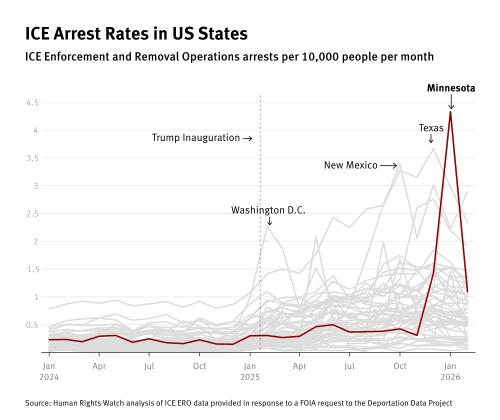
The total number of individuals arrested by DHS during Operation Metro Surge remains unclear, but according to data from ICE ERO (a sub-agency of DHS) obtained by the Deportation Data Project and analyzed by Human Rights Watch, ICE ERO officers alone arrested approximately 4,000 immigrants in Minnesota between December 1, 2025 and February 28, 2026.[44]
At the height of the operation, ICE arrested over 100 people per day.[45] While more arrests have been made in other states such as Texas, Minnesota had the highest per capita arrest rate in the country during the surge.[46]
Many of these cases amount to arbitrary arrest or detention and violated Minnesota residents’ human right to liberty and security of person. Many arrests or detentions appear to have been the product of racial profiling that violates the right to nondiscrimination, while others appear to have violated the rights to freedom of expression and assembly, including the rights of human rights defenders.
The Trump administration claimed that it was detaining many “dangerous criminal illegal aliens.”[47] However, ICE ERO data reveals that nearly two out of three individuals they arrested had no US criminal record.[48]
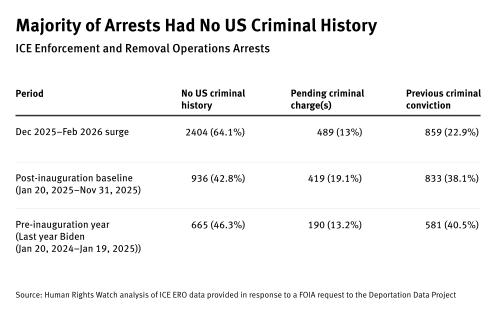
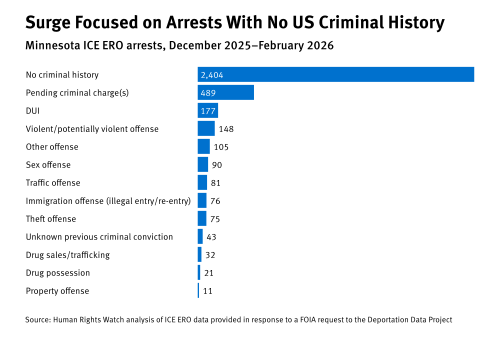
The following sections document how federal agents appear to have engaged in widespread racial profiling, stopping people based on skin color or presumed nationality, regardless of citizenship; how agents arrested and detained refugees and individuals with pending immigration applications in circumstances that cast strong doubt as to whether there was any legitimate, individualized basis for this; and the criminalization of citizens observing or protesting Operation Metro Surge.
Human Rights Watch interviewed 12 individuals who had been stopped, arrested, and detained in Minnesota during Operation Metro Surge—including individuals who were temporarily moved out of state—as well as witnesses, lawyers, and refugee resettlement and immigration experts, and reviewed video evidence and legal filings and court decisions, including dozens of habeas corpus petitions and corresponding judicial orders.
Racial Profiling
Federal agents appear to have engaged in widespread and routine racial profiling by stopping, arresting, or detaining individuals on the basis of their race or ethnicity.[49] Human Rights Watch interviewed directly impacted individuals, as well as lawyers and civil society representatives, analyzed arrest data, and examined judicial decisions and the sworn declarations of 29 individuals, including 20 US citizens, many of whose accounts evidence racial profiling.[50]
In 2025, the US Supreme Court lifted a lower court’s temporary order blocking immigration arrests based solely on certain factors, including apparent race, ethnicity, or language, while the underlying lawsuit unfolds before the lower court.[51] This ruling—while not creating binding law on the issue—has, in effect, meant that immigration agents may feel that there are no clear judicial constraints on their ability to stop and arrest people on the basis of their race or ethnicity. In practice, these stops and arrests have often been carried out arbitrarily and in apparent violation of the international human rights law prohibition on racial discrimination.[52]
In Minnesota, US citizens and immigrants alike were racially profiled in the ordinary course of their day—approached by federal agents while driving, while at work, or while shoveling snow.[53] They were abruptly stopped on the street by masked federal agents, often asked about their immigration status, and often arrested without warrant or any stated or apparent reason.[54] Minnesota residents of Somali and Latin American descent were notably targeted, despite the fact that the overwhelming majority of these communities are US citizens or have green cards.[55]
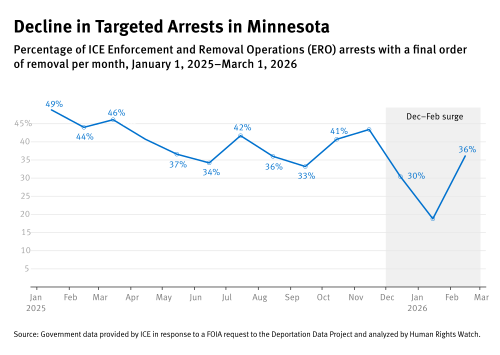
ICE data does not directly indicate whether agents detained anyone based on a warrant or previous knowledge of a person’s status. However, throughout the last year of the Biden administration and the first 11 months of the Trump administration, approximately 37 to 39 percent of people arrested in Minnesota by ERO officers already had administrative or judicial orders for removal, meaning immigration officials knew they were deportable.[56] During January 2026, this dropped to 19 percent, which is consistent with testimony that ICE seemed clearly to have stopped many people based merely on subjective observations they deemed suspicious, like a person’s perceived race, ethnicity, national origin, or spoken language.
The US Immigration Policy Center survey found alarming rates of racialized interactions with federal agents. As noted above, the survey found that over 28 percent of respondents in Minneapolis had at least one interaction with federal agents; however residents of color were about 40 percent more likely than white residents to have an interaction.[57] Of respondents who had an interaction with agents, nearly 52 percent of people of color said that they were randomly stopped on the street, compared to 37 percent of white respondents, and nearly 63 percent of respondents of color reported that they were randomly stopped while driving, compared to 46 percent of white respondents.[58]
Additionally, nearly 81 percent of Minneapolis respondents of color who had an encounter with agents “were asked about their race, ethnicity or national origin” compared to 48 percent of white respondents; 73 percent of respondents of color who had an interaction with agents were asked about citizenship, compared to 45 percent of white respondents; and nearly 60 percent of respondents of color who had an interaction reported that federal agents “did not believe they were lawful permanent residents or U.S. citizens despite showing them identification,” compared to 34 percent of white respondents.[59] In other words, residents of color in Minneapolis were 73 percent more likely to be disbelieved about their lawful status after demonstrating it to agents than white residents.
In a legal challenge to alleged racial profiling in Minnesota during Operation Metro Surge, federal judge Eric Tostrud found that DHS had unlawfully and repeatedly stopped residents “based solely on their race or ethnicity” and also conducted warrantless arrests without cause.[60] The following testimonies were presented in the case:
Pedro Moreno was asked by federal agents at his work site where he was from, and he showed his green card. An agent said it was “fake” and Moreno was handcuffed and taken to Whipple. The judge found that Moreno “was stopped because he looks Hispanic.”[61]
Mahamed Rufai Eydarus, a 25-year-old US-born citizen, was shoveling snow as agents approached him and his US citizen mother and asked for their IDs. The agents questioned Eydarus about speaking Somali to his mother. The judge found that Eydarus and his mother “were stopped and detained based solely on their race or ethnicity.”[62] The incident left him feeling “constantly stressed and afraid.”[63]
Ali Dahir, a 44-year-old Somali US citizen, was stopped outside his apartment building by ICE and asked for his ID and whether he was a US citizen. He provided his US passport card but was detained for 30 minutes;[64] the judge found that he was detained “based solely on his race or ethnicity.”[65]
F.A., a 22-year-old Somali US citizen, was stopped while driving to work. ICE vehicles boxed her in, and 10 men approached her, some with guns drawn. Most were masked and they did not identify themselves. They asked for her ID and if she was a US citizen.[66] F.A. stated, “I believe I was stopped solely because of the color of my skin and [my] appearance, including wearing a hijab.”[67] The judge said: “I agree.”[68]
Based on this and other evidence submitted to the court, Judge Tostrud determined that 23 residents were subjected to illegal race-based stops and detentions and 11 were arrested without probable cause, and concluded that DHS had “adopted a policy” allowing agents to stop residents “based on race or ethnicity.”[69]
Individuals interviewed by Human Rights Watch described similar types of incidents:
Libia, who is Latina, has lived in the United States for nearly 20 years. She has a pending application for cancellation of removal and has a work permit.[70] She was detained on her way to work. “What I don't understand is why they stopped me,” Libia said. She said that she overheard one of the agents ask another, “Why did you stop her? The license plates are alright,” an apparent reference to federal immigration agents’ practice of checking vehicle license plates to investigate owner identity and any criminal record.[71]
C.S. was outside with a whistle and an “observer” vest in early January when they saw Border Patrol agents get out of a black SUV with tinted windows and approach a dark-skinned man wearing a long robe like many Somali men in the area wear. C.S. said the agents talked to the man for less than 30 seconds, then forced him into their vehicle. Human Rights Watch reviewed part of the interaction that C.S. recorded on their phone, while blowing their whistle to mobilize other observers to witness the incident. The agents drove off with the man, but then later returned to the area and released him. The man told C.S. that he had shown the agents his papers in the car. He told C.S. that the agents had used racial slurs and told him he was lucky that someone was there to record the incident, seeming to imply that he would not have been released otherwise.[72]
A healthcare provider in the Twin Cities told Human Rights Watch that multiple members of her staff who are people of color have been stopped on their way to work and asked for identification, and some of them have been stopped more than once, she said. She said that she and other staff who are people of color had begun carrying multiple forms of identification, including their passports.[73]
There are also reports of Native Americans being racially profiled.[74] In one incident recorded on camera in Robbinsdale, Jose Roberto Ramirez, a 20-year-old Red Lake Nation member, was pulled out of his car by ICE and detained.[75] Members of the Native American Caucus in the Minnesota state legislature condemned the apparent racial profiling of Native Americans, saying: “Native peoples are Indigenous to [the] country, existing on this continent for thousands of years before the colonization of this nation.”[76]
The Native American head of an NGO that provides social support services to Native women told Human Rights Watch that she stayed at home during periods of Operation Metro Surge due to fear of profiling. She described it as a “slap in the face” for members of federally recognized tribes to be profiled and detained.[77] “Not only is it horrific to see your immigrant neighbors and friends being terrorized,” she said, “it was shocking to learn we also had to watch our own backs too.”[78]
Many immigrants and people of color feared being seized or otherwise harmed because of these practices. As a result, many US citizens of color began to carry their US passport on them wherever they went. Everyone was impacted, from union organizers,[79] to medical providers,[80] teachers,[81] students,[82] business owners,[83] and local elected officials.[84] A US citizen business owner, originally from East Africa, told Human Rights Watch: “I don’t have any criminal record. This is my home. My kids were born here. But now I keep my passport in my pocket.”[85] A Latina union organizer, born in the United States, shared her fears and how she tried to protect her safety when moving around the state:
“I carry around my US passport. If I’m going somewhere, I share my location or I text when I am coming and going. It’s a real concern for safety for presenting as Latina. Because I am not white, right now, I could be mistreated or arrested. As a woman, to be grabbed by masked men, to be taken into a vehicle, and maybe taken somewhere else and thrown somewhere randomly–it’s terrifying. And you know there is no accountability. These masked men have full rein to do whatever they want with me.”[86]
Reasonable fear of racial profiling by federal agents caused people to significantly reduce their movements in the Twin Cities, and some to shelter at home entirely. Some interviewees told Human Rights Watch that immigrants and people of color sometimes took rides to school or work with a white person, in the hopes of minimizing being profiled by ICE.[87] A white Minneapolis teacher who had been driving two students to school who did not feel safe leaving the house said: “I find it ironic I’m driving two US citizens to school and back – they were born here. I’m an immigrant, but they’re safer in a car with a white man.”[88]
A later section of this report examines in detail the effects of Operation Metro Surge on people’s freedom of movement, and its impacts on the enjoyment of other human rights, including mental and physical health, education, work, housing, and food.
Arrests of Refugees
“It’s a massive betrayal of what these people were promised. A refugee was invited to be here.”[89]
–Staff member with a refugee resettlement organization
Many refugees who lawfully resettled in Minnesota were detained by the federal government during Operation Metro Surge. These refugees had been invited by the government to immigrate to the United States, and they had been granted refugee status after being “carefully and thoroughly” screened through “rigorous background checks and vetting.”[90] They had escaped armed conflict and other life-threatening situations, and were building new lives in Minnesota, with the support of the US government.
Yet on January 9, 2026, the federal government announced Operation PARRIS (Post-Admission Refugee Reverification and Integrity Strengthening) to re-assess the 5,600 refugees in Minnesota who did not yet have green cards (permanent residency).[91] Instead of conducting assessments in an orderly way through regular office appointments, refugees – who had followed all the rules and had no criminal history or orders of removal – were targeted and detained “often without a warrant or notice.”[92]
Many refugees targeted by Operation PARRIS had already applied for green cards,[93] but face application backlogs at US Citizenship and Immigration Services (USCIS).[94]
An individual who works with a refugee resettlement organization in Minnesota told Human Rights Watch that many of the refugees targeted under PARRIS had undergone an “18 to 34-month” vetting process before arriving in the United States, and they had spent ten or more years in refugee camps.[95] Despite this vetting, one of their refugee clients was arrested and “taken for a whole week” to Texas, where he did not have access to legal representation. He was subsequently released and then granted a green card, the interviewee said.
Refugees were targeted for arrest on their way to work and at home.[96] In one case, a refugee stated that an unknown man came to his home pretending that he had hit the refugee’s car; when the refugee “went outside to check the damage, he was surrounded by armed men and arrested.”[97] According to the refugee resettlement expert interviewed by Human Rights Watch, refugees were also sent letters instructing them to come to appointments with ICE, but were then “detained within a few minutes and whisked off to Texas.”[98] “This kind of conduct is why people became refugees,” she said. “They are reliving something they experienced... Our families love America. They are proud to be here. They can’t understand how America would let this happen.”[99]
On January 28, 2026, a federal judge ruled that US law “do[es] not permit prolonged detention” of refugees in these circumstances and ordered the federal government to stop arresting refugees.[100] In his ruling, Judge John R. Tunheim stated:
Refugees have a legal right to be in the United States, a right to work, a right to live peacefully—and importantly, a right not to be subjected to the terror of being arrested and detained without warrants or cause in their homes or on their way to religious services or to buy groceries. At its best, America serves as a haven of individual liberties in a world too often full of tyranny and cruelty. We abandon that ideal when we subject our neighbors to fear and chaos.[101]
The consequences of Operation PARRIS on refugees in Minnesota have been severe: alongside arbitrary deprivation of liberty, it caused widespread fear, mental harm, and resulted in families staying at home for many weeks to avoid ICE. “People’s lives have been destroyed,” said the refugee resettlement expert.[102] She added: “I am extremely ashamed of this. This is not how you treat a human being.”[103]
Other Unlawful Detentions of Immigrants
“My daughter has nightmares, and I have nightmares at night. I can't sleep, thinking that they are going to arrest me again, and I am afraid. She is scared, too. All I could think about when I was [in detention] was, ‘Am I going to see my daughter again? Am I going to see my husband again?’”
–Libia, who has lived in the United States for 20 years and has a work permit and pending application for cancellation of removal
Many individuals with pending immigration applications were unlawfully detained during Operation Metro Surge.
Under international human rights law, any deprivation of liberty that has no basis in domestic law is per se arbitrary; thus any detention by US authorities not permitted by US law is a violation of international law.[104] However, “[a]n arrest or detention may be authorized by domestic law and nonetheless be arbitrary.”[105] Deprivations of liberty must be reasonable, necessary and proportionate, and in the context of immigration detention, must also be reassessed as the detention “extends in time.”[106] The UN Human Rights Committee maintains that the detention of an asylum seeker “in the absence of particular reasons specific to the individual, such as an individualized likelihood of absconding, a danger of crimes against others, or a risk of acts against national security” is arbitrary.[107] Other individuals who have pending immigration applications and are meeting requirements laid out by the government such as reporting to administrative check-ins or court hearings have arguably demonstrated that alternative measures are effective to meet the state’s immigration control aims, making detention of such individuals unnecessary. Immigration detention also should “not be based on a mandatory rule for a broad category” of immigrants.[108]
Immigrants can challenge their detention as unlawful and seek release by filing a habeas corpus petition in federal court. Investigative journalism outlet ProPublica tracks habeas corpus petitions filed since January 2025 and recorded 50,489 petitions filed across the United States from then through May 2026.[109] ProPublica found that more habeas petitions were filed “in the first 13 months of the second Trump administration than in the past three administrations combined.”[110] The tracker recorded 1,367 petitions in Minnesota from January 2025 to May 2026 – with nearly all of those filed since December 2025 when Operation Metro Surge began.[111]
Media outlet Politico compiled filings from over 12,000 habeas cases resolved from July 7, 2025, to May 15, 2026, challenging detentions by ICE nationwide. Their dataset shows that nearly 10,800 of these challenges were successful, with judges ruling against the Trump administration and ordering release or a bond hearing for the detained individuals in about 90 percent of cases.[112] In Minnesota, Politico identified 532 habeas cases resolved between December 1, 2025 and May 15, 2026, 466 of which, or 88 percent, resulted in an order for the person’s release or a bond hearing.[113] For 387 of these cases, the judge rejected the Trump administration’s argument that the person was subject to mandatory detention, according to Politico’s analysis.[114]
Kira Kelley, an attorney, filed habeas petitions for 65 individuals detained in Minnesota between December 2025 and March 2026, and she shared the details of these cases with Human Rights Watch. The majority (55 cases, or 85 percent) resulted in a judicial order for release of the detained individual, or for the individual to be given a bond hearing that resulted in their release. Several of these individuals had lived in the United States for decades. Some arrived as children. Many have parents, children, or partners in the United States. Many had pending asylum claims. Many were arrested on their way to work, or at their immigration check-ins. For example:
An individual from Somalia had filed for asylum in the United States. He had work authorization from DHS and his case was pending on appeal when he was detained by ICE in December 2025. After Kelley filed a habeas petition, a judge ordered his release, finding that the government had not identified a legal basis for his detention. He had been detained for over one month.[115]
An individual lawfully entered the United States as part of the Haitian Humanitarian Parole Program and had a work permit and a pending asylum application. He was detained by ICE as he was scanning his work badge at the airport in Minnesota. He was unlawfully detained for over two months before a judge ordered his release.[116]
Diana, 20, and her brother William, 19, are Minnesota residents from Ecuador who applied for Special Immigrant Juvenile Status, a type of legal protection for youth under age 21 who have faced abuse, neglect, or abandonment by one or both parents. William was driving Diana and a friend who is a minor US citizen when all three were detained by ICE. The federal government did not argue that Diana or William had any criminal history, and a judge found no legal basis for their detention and ordered their release.[117]
Oscar arrived in the United States as a child in 2021 and was placed in the custody of the Office of Refugee Resettlement (ORR), a government agency responsible for caring for unaccompanied children, and later released to his father. Oscar has a work permit and pending applications for asylum and Special Immigrant Juvenile Status. A judge determined his detention was unlawful and ordered him immediately released, but it took the government two weeks to comply with the order.[118]
Belizario has lived in the United States for decades and has a valid work permit and a pending asylum application. He was unlawfully detained on his way to volunteer at a food pantry in mid-January. The government never produced a warrant for his arrest or any claim that he had violated the terms of his supervision or work authorization, and a judge ordered him immediately released.[119]
Notably, the Trump administration has repeatedly failed to abide by court orders related to immigration detention, including orders to release unlawfully detained immigrants.[120] One federal judge in Minnesota called “the extent of ICE’s violation of court orders … extraordinary.”[121] The judge found in February that the administration had violated 210 court orders across 143 cases and wrote, “[t]he Court is not aware of another occasion in the history of the United States in which a federal court has had to threaten contempt — again and again and again — to force the United States government to comply with court orders.”[122]
According to ICE ERO data, 25 percent of those arrested during Operation Metro Surge were released. Another 24 percent were still detained as of March 10, 2026. Forty-nine percent of those arrested were removed from the United States or left pursuant to a grant of “voluntary departure.”[123] However, this does not mean 49 percent of arrests were lawful.
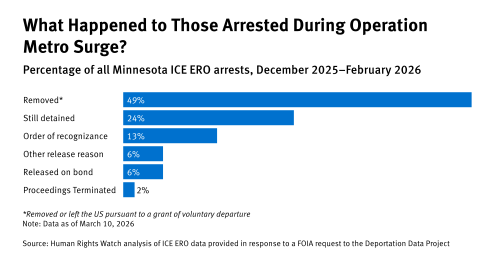
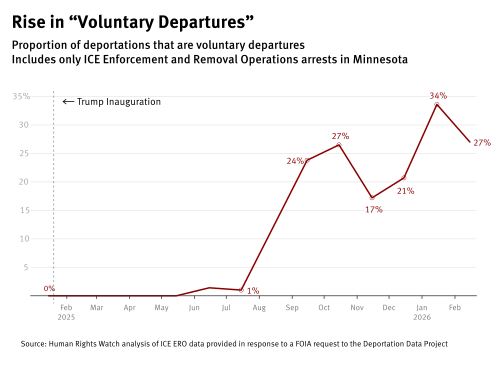
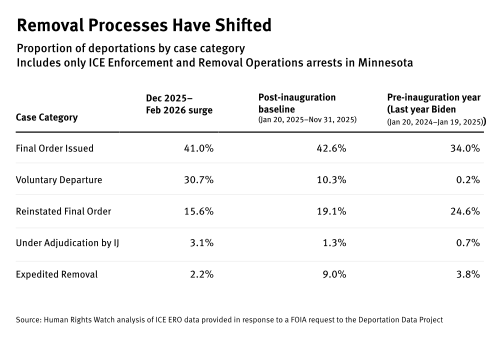
There has been a sharp increase in the number of people who left the United States following a grant of “voluntary departure,” with hundreds of those arrested in Minnesota leaving the United States through this process in recent months.[124] Voluntary departure is a process under US immigration law that allows an immigrant to leave the United States without a removal order and avoid a 10-year re-entry bar.[125] It many cases, however, the reality is one of coercion. Without access to legal representation, many immigrants are unaware of their eligibility for immigration relief like asylum or that they are waiving this relief by accepting voluntary departure. Due to dire conditions in detention, lack of access to counsel, fear of removal to third countries, and/or pressure from immigration authorities, many immigrants are made to feel as though “voluntary departure" is their only option.[126]
Additionally, according to ICE ERO data, in the first two months of 2026, dozens of people arrested in Minnesota were removed while their cases are still coded as “under adjudication by an Immigration Judge [IJ].” The proportion of people categorized under this removal process, which raises fundamental fairness concerns, more than doubled during Operation Metro Surge (December 2025-February 2026), and was more than four times higher during that period than during the last year of the Biden administration.[127]
Arrests of Observers and Protesters
“The more we continue to show up and be truth tellers, the better it is for us in the long run.”[128]
In response to the gross mistreatment of immigrants in Minnesota, many residents joined together to observe, protest, and advocate against rampant rights violations. Federal agents responded by criminalizing many of these human rights defenders: surveilling, harassing, arresting, and detaining them.
The National Lawyers Guild (NLG) of Minnesota’s legal hotline documented 524 cases of US citizens detained during Operation Metro Surge while or after reportedly engaging in protest, including 245 detentions by federal agents and 279 detentions by local law enforcement.[129] The NLG Minnesota chapter estimates that these numbers are an undercount, as cases were primarily collected through NLG infrastructure and self-reporting.[130]
International human rights law guarantees the rights to freedom of expression, association, and peaceful assembly.[131] Freedom of expression includes the right to seek, receive, and share information and ideas.[132] These rights may be exercised through a range of activities, including observing, recording, and protesting law enforcement activities.
The United Nations Declaration on Human Rights Defenders, adopted by a consensus that included the United States, recognizes that human rights defenders—people who act to protect human rights—play an essential role in “safeguarding democracy” and “promoting human rights and fundamental freedoms.”[133] States should uphold and guarantee rights that are essential to the work of human rights defenders, including the rights to peaceful assembly, association, and expression, which entails the right to access and disseminate information on human rights conditions.
Before and during Operation Metro Surge, Minnesota residents—like many people around the country—trained as constitutional observers to document abusive immigration enforcement practices. They blew whistles, monitored and followed ICE vehicles, and filmed ICE interactions with a view to preventing abuse and collecting evidence for accountability.
Federal agents often arrested or threatened observers engaging in this conduct, claiming these protected activities were impeding or obstructing their operations in violation of Title 18 of the U.S. Code, section 111, which prohibits forcibly assaulting, resisting, opposing, impeding, intimidating, or interfering with federal officers in the performance of their official duties.[134] In some cases documented by Human Rights Watch, however, such claims appear indefensible.
For example, federal agents told M.S. that whistling and filming were “impeding” their operations and threatened him with arrest. M.S. said he had been driving to donate blood when he passed Border Patrol agents in a grocery store parking lot.[135] He parked his car and started recording and blowing a whistle. Human Rights Watch analyzed an 11-minute video M.S. recorded of the incident. In the video, federal agents in two unmarked vehicles drive up to and stop in front of M.S. One agent, with the Federal Bureau of Prisons (BOP), a Department of Justice component agency, tells M.S. he is interfering in an investigation and if he does not stop whistling and leave, he would be arrested. M.S. asks the agent how he is interfering as three Border Patrol agents step out of one of the vehicles and approach him. One of the Border Patrol agents cites 18 U.S.C. § 111, while another uses their phone to film M.S. M.S. offers to back up to wherever agents want him to stand, but an agent says that filming is “impeding” and threatens to arrest M.S. if he does not leave.
A criminal defense lawyer told Human Rights Watch that many people were arrested while following ICE in their vehicles.[136] The lawyer described the typical pattern she saw when agents engaged an observer: the agents pulled the observer over, gave a warning, and got back in their vehicle and kept driving; if the observer continued to follow them, agents approached their car more aggressively, drew guns, broke windows with batons, detained the observer, and took them to the Whipple Federal Building for processing. However, the lawyer said there was no apparent pattern of when ICE decided to engage with observers or leave them alone. “The feeling of living in this is just chaos,” the lawyer said. “You don’t know at any given time what’s about to happen…How do I advise on legal risks when you can’t really assess them?”
Human Rights Watch investigated five cases in which US citizens appear to have been arbitrarily arrested by ICE or Border Patrol agents while observing, documenting, or peacefully protesting Operation Metro Surge.[137]
In one case, federal agents violently arrested Francesca, who was observing ICE activity by driving behind agents.[138] A verified video filmed by a person in the passenger seat of Francesca’s car shows five federal agents approach the vehicle. One of the agents says Francesca’s full name, then tells her to “open now,” referring to the door of the vehicle. One second later, he breaks the driver’s seat window, covering Francesca in shattered glass. The agents repeatedly tell Francesca she is under arrest and force her out of the vehicle. One agent tells the passenger that Francesca was “impeding” by following them and allege she was not yielding to their vehicle. Francesca was arrested and taken to Whipple Federal Building before being released; as of a month after the incident, she had not been charged with any crime.
In a similar case, Border Patrol agents arrested Nathan for following them. Nathan told Human Rights Watch that agents threw him to the ground even though he had his hands up and then ridiculed him and took selfies with him while he was handcuffed in their vehicle. Before the arrest, Nathan said, he had been driving behind a Border Patrol vehicle and honking. The Border Patrol vehicle stopped, and agents approached Nathan saying, “this is your one warning.” They threatened to break his window and pull him out and detain him if he kept “impeding” them.[139]
After Nathan continued honking and yelled out of the window to notify nearby pedestrians that agents were in the area, the agents again stopped and approached his car. They opened both the driver and passenger side doors and pulled Nathan out of the driver’s side. A video filmed by a witness and shown to a Human Rights Watch researcher shows agents throw him to the ground. Nathan told Human Rights Watch that agents then handcuffed him, put him in their vehicle, and drove him to the Whipple Federal Building. “They told me I’d go away for like five years,” he said. When he arrived at Whipple, Nathan said he was told to sign a piece of paper that said he had committed assault, which he refused to sign. Nathan said about half a dozen agents proceeded to discuss his case in front of him and that one asked the others if Nathan had his hands up the whole time he was arrested, and the others answered ‘yes.’ The agents then gave Nathan a new piece of paper that said he had impeded an officer rather than assaulted one and told him he could sign it and be released but would have to later show up in court. Nathan signed the form and was escorted out by agents.[140]
Another observer described receiving conflicting instructions before their arrest, making it impossible to comply with agents. The observer, Sawyer, said that he was following and observing ICE when he noticed them arresting someone. He pulled over to film the incident from a distance. An agent approached Sawyer’s car, told him to leave, and banged on his window. Sawyer nodded in agreement, waved, and began to pull forward. Another agent, slightly further up the road, approached Sawyer’s car with his hand out. The agent then stepped in front of the car and reached for his gun. Sawyer was startled by this, as Renee Good had been killed just a couple of days before by an ICE officer who approached her car in a similar fashion. Sawyer, confused as to what the agents wanted him to do, hit the brakes and put his car in park. The first agent then started to hit Sawyer’s window, prompting him to duck and cover, afraid that if he opened the door suddenly the agent would accidentally hit him. The agent shattered Sawyer’s window, sending glass into Sawyer’s face and cutting his forehead. Sawyer said that he got out of the car and the agents had him lay face down on the road and handcuffed him behind his back, before putting him in their vehicle. The agents took Sawyer to the Whipple Federal Building, where he said he was held for four hours. Sawyer said he was never directly told why he was arrested. One agent at Whipple told him that if he did not assault an officer, he must have obstructed them.[141]
Sawyer was released after a few hours without charges, but he still feels afraid sometimes when he is in his car. He also described his ongoing concern for the noncitizens he saw at Whipple: “It was really emotional seeing people there, and it was like, they’re not going to be able to leave here like I am. That’s one of the heavier emotional [things] that still impacts me.”
Human Rights Watch interviewed two other individuals who appear to have been arbitrarily detained by federal agents, including Angela, who was observing Border Patrol agents when they smashed her car window, pulled her out, zip-tied her hands, and took her to Whipple for a few hours.[142] Another observer, Dalton, was arrested by federal agents—at least one of whom was wearing a vest that said “ICE,” he said—after following their vehicles in his car.[143] Agents approached Dalton’s car and told him to stop following them and appeared to take a photo of Dalton and his license plate, Dalton said. After Dalton continued to follow and observe the agents, they again approached his car, smashed the window, pulled him out, pushed him to the ground, and handcuffed him, all in under a minute, he said. Dalton was taken to Whipple for a few hours before being released. He was never told why he was arrested, he said.
The ACLU of Minnesota filed a lawsuit challenging the arrests and use of force against observers and protesters as violating their constitutional rights “of information gathering, recording, and/or protesting events of public interest, including the conduct of federal agents on duty in a public place” under the First Amendment, and to “be free from unreasonable seizures, specifically, seizure and arrests without probable cause,” under the Fourth Amendment.[144] The lawsuit is pending as of May 2026.
Criminal Charges Against Observers and Protesters
In February, Reuters reported that at least 655 people had been charged nationwide pursuant to 18 U.S.C. 111 since the summer of 2025, when the Trump administration ramped up its immigration arrests, more than double the number of such charges over the same period the year before.[145] The National Lawyers Guild of Minnesota documented, and Human Rights Watch confirmed, 43 cases of people charged under 18 U.S.C. 111 in Minnesota from December 2025 through February 2026.[146] According to the NLG, as of April 1, thirteen of these cases had been dismissed, and only three of the remaining cases were being charged as felonies; the vast majority were dropped to misdemeanor charges.
Another 39 people, including journalists Don Lemon and Georgia Fort, and photographer Junn Bollman, were charged under different federal statutes criminalizing interference with religious freedom in connection with a protest inside a church in St. Paul in January, where the regional ICE field office director, David Easterwood, is a pastor.[147] The arrests of Lemon, Fort, and Bollman sparked widespread condemnation as interference with freedom of the press.[148]
The NLG of Minnesota also documented six other cases of individuals who received federal felony charges and 49 individuals who received administrative citations from federal agencies, including CBP and the Federal Protective Service (a law enforcement agency within DHS).
CBS reported in late January that federal prosecutors in Minnesota have raised concerns that “they are facing pressure to rush to file criminal charges against people accused of assaulting federal officers without conducting a formal investigation.”[149] At least six federal prosecutors and another eight staff members from the U.S. Attorney’s Office in Minnesota reportedly resigned during Operation Metro Surge.[150]
The NLG of Minnesota also documented 232 cases of individuals who were charged with state crimes, including in connection with noise demonstrations outside of hotels where ICE agents were staying, demonstrations outside the Whipple Federal Building, and a demonstration outside the Minneapolis-Saint Paul International Airport.[151]
Threats and Use of Excessive Force
“Someone asked me to explain it in one word. This is terrorism. It was never this unsafe until [federal agents] came here.”
–Anne, who manages a local store’s mutual aid distribution[152]
Human Rights Watch documented the repeated excessive use of force by ICE and Border Patrol agents. In two incidents that sparked national outrage, federal agents unlawfully shot and killed two Minneapolis residents.[153]
Federal agents threatened other residents with lethal force, pulling guns on them without justification on numerous occasions. Agents also smashed car windows without justification, physically threw people to the ground who were not resisting, and deployed less lethal weapons such as chemical irritants and flash-bang grenades, sometimes at close range and without warning.
The US Immigration Policy Center February-March survey provides additional empirical evidence of the scope of the harms. Of the 28 percent of Minneapolis residents who said they had at least one interaction with federal agents, 23 percent reported being physically assaulted, and 26 percent reported that agents used chemical irritants such as pepper spray. Further, 38 percent said that agents “already had their weapons drawn when they approached them” and 30 percent said that agents “drew their weapons on them” during the interaction, indicating that 68 percent of respondents who interacted with agents specifically experienced interactions in which agents had their weapons drawn.[154]
The threats and excessive use of force by federal agents terrified residents and had a chilling effect on their exercise of the rights to freedom of expression, association, and peaceful assembly, and, as detailed later in this report, created such a climate of fear that many residents stayed home or limited their movements, impeding access to goods and services essential to the enjoyment of a range of economic, social, and cultural rights. Other residents continued to exercise their rights, often at risk to their physical safety and liberty.
While there is evidence that some individuals participated in activities like throwing objects toward officers (including fireworks on at least two occasions) or blocking vehicles,[155] as well as incidents of vandalism,[156] these actions do not automatically justify using force against an entire crowd of protesters. Under human rights standards, law enforcement officers should “as far as possible, apply non-violent means before resorting to the use of force and firearms. They may use force and firearms only if other means remain ineffective or without any promise of achieving the intended result.” When force is used, it should be with restraint, in a way that is proportionate to the circumstances.[157]
Shootings
Federal agents shot three Minneapolis residents in January. Two of these shootings were fatal. An ICE officer unlawfully shot and killed Renee Good on January 7, and Border Patrol agents unlawfully shot and killed Alex Pretti on January 24. An ICE agent also shot Julio Cesar Sosa-Celis in the leg in North Minneapolis on January 14.
Fatal Shootings
Renee Good
Human Rights Watch’s analysis of four videos and witness statements found that the January 7 fatal shooting of 37-year-old US citizen Renee Good amounted to an unlawful use of lethal force by ICE.[158]
Video footage shows Good’s car in the middle of Portland Avenue near 34th Street in south Minneapolis.[159] A witness said Good was blocking the street with her car, and a statement by Good’s wife in a local media outlet indicated that they were alerting neighbors of ICE’s presence before the shooting.[160]
In the video footage, unmarked vehicles attempt to pass Good’s car, which is stationary in the middle of the street. Good appears to signal at the vehicles to go around her. One vehicle does, and she signals for a second vehicle to pass, but it stops perpendicular to Good’s car. Two officers get out and walk toward Good, shouting: “Get out of the car.”
One of them tries to open the driver’s seat door by grabbing the handle and then reaching inside the window. A third officer, Jonathan Ross, approaches from the passenger side. Good briefly reverses in an apparent attempt to get away from the officers. The third officer walks to the driver’s side as Good begins to turn and drive in the opposite direction of the officers. Pulling out his gun, the third officer fires three shots at Good in short succession at eye level, first through the windshield, then through the driver’s seat window. Good’s car crashes into a parked car a short distance away.
The videos analyzed by Human Rights Watch are inconclusive as to whether the vehicle made contact with Ross. However, they do show that at the time when the shots were fired, the officer was positioned on the left side of the vehicle, outside its direct path, and the vehicle was moving away from the officers. These facts did not justify the use of lethal force, which is only permissible where strictly necessary to protect against an imminent threat to life. Good posed no such threat.
After the killing, the Department of Homeland Security (DHS) quickly issued a statement claiming that Good tried to kill ICE officers with her vehicle in “an act of domestic terrorism.”[161] This account is entirely inconsistent with any reasonable analysis of the video footage, which shows Good attempting to pull away from the officers.
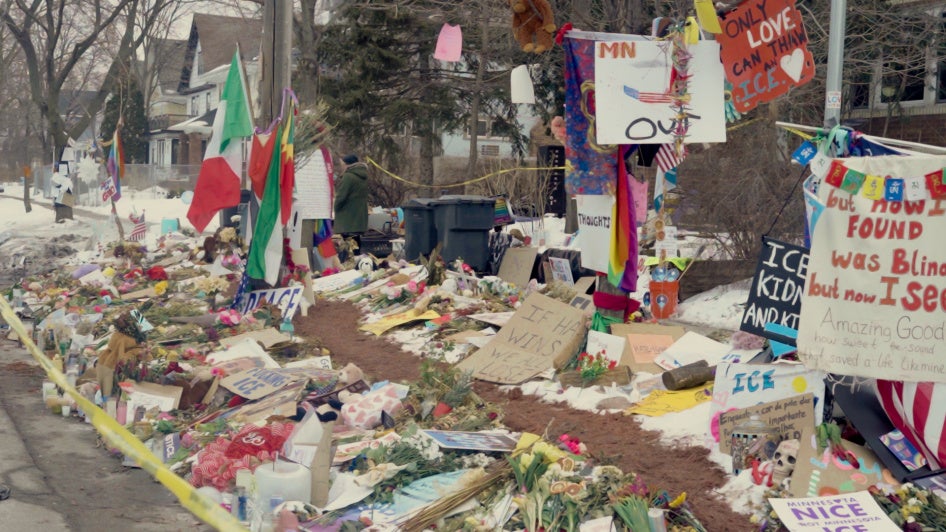
Alex Pretti
On January 24, Border Patrol agents shot and killed 37-year-old US citizen Alex Pretti on Nicollet Avenue, near 26th Street. Human Rights Watch reviewed witness testimony, interviewed a witness, and verified and analyzed eight videos taken before, during, and after the shooting, determining that it constituted an unlawful use of lethal force.[162]
Pretti was peacefully observing and filming agents minutes before they shoved him and other observers, sprayed him in the face with a chemical agent, beat him with a metal canister, and shot him ten times. No available evidence shows that he did anything to threaten the lives of the officers that would justify the intentional use of lethal force under international human rights standards.
A witness said in a sworn statement that Pretti was directing traffic and observing agents when an agent told Pretti and the witness to back up, and another agent threatened observers with pepper spray.[163] The witness said that Pretti approached the agents “just with his camera out. I didn't see him reach for or hold a gun.”[164] Another witness stated that they saw Pretti yelling at agents, but “did not see him attack the agents or brandish a weapon of any kind.”[165] A third witness said they “did not observe Mr. Pretti strike anyone or brandish a weapon.”[166]
Video footage shows an agent shoving one of the two other observers and then shoving Pretti. Pretti puts his arm around the observer who was shoved as the agent then shoves the third observer. Pretti then places himself between the third observer and the agent. The agent sprays a chemical irritant into Pretti’s face from arm’s length and Pretti staggers and falls toward the observers, with his back to the agent, who continues to spray him. Pretti appears to either reach for one of the observers or their backpack as an agent shouts, “Get back.”
Agents then surround Pretti and pull him to the ground. Two agents struggle with Pretti as he appears to be face forward on his knees. Two more agents move in on Pretti as they continue struggling. One agent lunges for Pretti’s waistline near his right hip. Video footage shows another agent near Pretti’s head repeatedly striking him with a small canister. One of the men repeatedly screams that Pretti has a gun, and another male voice can be heard saying, “Gun, gun, gun!” Simultaneously, the agent reaching for Pretti’s waistline removes a gun from Pretti’s right hip, quickly stepping back with it. Another agent draws his handgun and pivots around to Pretti’s rear pointing it in Pretti’s direction as two other agents try to restrain Pretti. A shot is heard as the agent who unholstered his own firearm continues to move around Pretti. At the time of the shot, he is the only agent within view who has unholstered his firearm, while the agent holding Pretti’s firearm carries it away.
After the shot, Pretti reels up, planting his right foot with his left knee still on the ground; his left hand swings from the center of his waist to his left side and his right hand is around his back on his right side. As the agent who unholstered his weapon stands over Pretti from behind, three more shots are fired in quick succession. The handgun’s slide is seen moving to the rear, indicating rounds are being discharged from the weapon. The agents around Pretti back away, as the agent who struck Pretti with the canister also unholsters his firearm. It is not clear if he fires his weapon. In total, agents fired 10 shots, based on Human Rights Watch’s video analysis.
The Department of Homeland Security (DHS) claimed that an agent defensively shot Pretti.[167] In a news conference hours after the shooting, then-DHS Secretary Kristi Noem stated that Pretti, who was reportedly a legal firearm owner with a permit to carry in Minnesota, approached officers with a handgun and “reacted violently” when they tried to disarm him.[168] Human Rights Watch’s analysis of the videos and witness testimony contradict this account: no testimony or video suggests that Pretti brandished his weapon or that he did anything to threaten any agents.
One witness, Jay, described to Human Rights Watch the minutes leading up to the shooting, which revealed that agents were treating the handful of observers who were present in a needlessly aggressive and threatening manner.[169] Jay and other observers were filming ICE and Border Patrol agents outside a local business. Jay said that the agents responded aggressively, telling the observers to stay on the other side of the street, physically pushing them, and shaking cans of pepper spray at them.
Another witness, C.R., similarly said in a sworn declaration that they were approached by an agent "quickly, shaking a can of chemical irritant at us in a threatening manner,” even though C.R. was “a significant distance away from the agents’ activity down the block.”[170]
C.R. saw agents “aggressively” approach Pretti and other observers across the street, they said. C.R. also saw an observer appear to slip and fall, before multiple agents “descended upon the observer, held her to the ground, and started to handcuff her.”[171] C.R. then saw an agent shove another observer to the ground, who Pretti tried to help up before agents pepper sprayed and “tackled him to the ground.”[172] “I watched as at least four agents punch, kick, and hit Mr. Pretti in the head several times with a can of chemical irritant,” C.R. said.[173]
Jay, meanwhile, said they saw “a jumble of people crowding around someone” across the street and then heard gunshots. Jay saw the agents start to back away from where they had been crowded, revealing Pretti’s body on the ground, as the gunshots continued. After the shooting stopped, Jay saw agents approach Pretti’s body and said it looked like they were focused on locating Pretti’s gun.
Jay saw the Minneapolis Police Department arrive and set up police tape within a couple of minutes of the shooting. Federal agents then told Jay and the other remaining observers that they had to leave and started pushing them. Jay saw a woman tell agents she was a medic and try to get to Pretti. Two agents physically pushed her back, and one agent pepper sprayed her at some point, Jay said. An agent also threatened C.R. “with a can of chemical irritant” as C.R. was talking to a 911 operator immediately after the shooting, C.R. said in their sworn declaration.[174]
About five minutes after the shooting, Jay said a firetruck and emergency personnel arrived, followed by an ambulance. The emergency vehicles could not get directly to Pretti on Nicollet Avenue, so emergency personnel had to run to him on foot from 26th street, Jay said.
Describing the impact of witnessing Pretti get shot, Jay said: “It has traumatized me in a way where I’m no longer able to do this work. I’m no longer able to respond to ICE sightings, because of an emotional reaction that I have.”
C.R. similarly said that since the shooting “my fear and anxiety have been pervasive. I feel paranoid and distracted from work or my other everyday responsibilities. Every time I leave my home, I have a physical anxiety reaction. … I have had to take a break from exercising my right to protest because I am fearful that federal authorities will take retaliatory action against me.”[175]
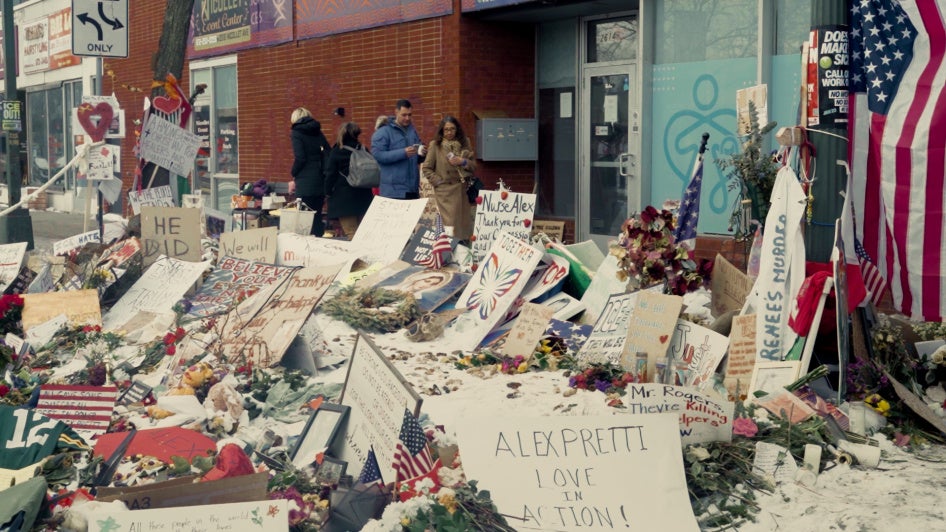
Nonfatal Shooting
On the evening of January 14, at around 7 p.m., an ICE officer shot Julio Cesar Sosa-Celis in the leg in a North Minneapolis neighborhood.[176] Witness accounts indicate that an agent shot Sosa-Celis as he was fleeing into his home, suggesting likely excessive use of force.[177]
DHS published a statement on X three hours after the shooting, claiming that an officer shot Sosa-Celis in self-defense after he fled from ICE in his vehicle, crashed his car, and violently assaulted officers.[178] Federal prosecutors charged Sosa-Celis with assault two days later.[179] However, a few weeks later, on February 12, prosecutors moved to dismiss the assault case against Sosa-Celis based on “newly discovered evidence” that was “materially inconsistent” with the charges, though this evidence was not publicly explained.[180] The following day, the acting director of ICE, Todd Lyons, issued a statement admitting that video evidence indicated that two officers had lied under oath about the shooting and could face termination.[181]
Researchers verified a 9 minute video from a CCTV camera published by the City of Minneapolis on April 6, depicting the encounter between Sosa-Celis, his housemate Alfredo Aljorna, and the ICE officer prior to the shooting.[182] The CCTV footage shows Aljorna driving onto the sidewalk of N 24th Avenue, quickly braking and coming to a halt as another vehicle with blue police lights follows closely behind. Aljorna gets out of his car and starts running towards his apartment, approximately 35 meters away, as an ICE officer chases him on foot. Sosa-Celis can be seen standing outside the apartment. As Aljorna runs towards the apartment, Sosa-Celis tosses down a shovel he had been holding, contradicting DHS claims that the shovel was used to attack the ICE officer.[183] Aljorna falls right in front of the entrance to the apartment, leading to a physical confrontation as the officer apparently tries to detain Aljorna and Sosa-Celis appears to get involved.[184] The confrontation lasts about 10 seconds before Aljorna and Sosa-Celis run inside the apartment. It is not possible to determine from the video what occurs between the three individuals during those seconds or precisely when the agent fires the shot that his Sosa-Celis in the leg.
Indriany Mendoza Camacho, Sosa-Celis's partner, told MPR News that she witnessed the shooting. She said that agents shot Sosa-Celis through the door, hitting him in the leg, after he had fled into their home.[185] A Facebook Live video filmed and streamed by someone in Sosa-Celis's residence after the shooting shows an occupant who is on the phone with 911 report that ICE had shot Sosa-Celis in the leg when the occupants closed the door to the apartment.[186] Aljorna’s attorney also reportedly presented a photograph in court of a bullet hole in the door, which was also published by the Minnesota Star Tribune.[187]
Multiple sources reported that ICE threw tear gas into the residence after the offices shot Sosa-Celis. The home had children inside. The officer then entered to detain Sosa-Celis and Aljorna.[188]
Violent Arrests
Federal agents used excessive force when detaining or attempting to detain people in Minnesota, including people targeted for their status, their appearance, or for observing or protesting federal agents. This included violently breaking into homes with guns drawn and without showing a judicial warrant,[189] smashing car windows and sending glass shards on to passengers,[190] throwing or pushing people to the ground while detaining them,[191] and dangerously grabbing or pressing on people’s heads or necks.[192]
In one case, in early December, ICE agents carried out a violent raid on a split-level home in Burnsville, Minnesota.[193] Sofia Alvarado, a US citizen who lives in the upstairs portion of the home, was cooking when she received a call from one of the downstairs tenants saying that immigration agents were outside.[194] She checked her home security footage and saw an agent had detained a man as he and a woman who lived downstairs arrived home. The woman had run into the downstairs part of the home from an external entrance. Sofia could see the agent’s car still in the driveway on the camera’s livestream. After about two hours, Sofia, her mother, her 20-year-old daughter, and her 15-year-old niece—all US citizens—heard a strong blow on their front door. Terrified, they ran into the bathroom. They then heard a second blow to the door and around 15 armed and masked agents broke in.
The agents came down the hallway and busted open the door to the bathroom with their guns drawn. The three women and the girl held up their hands and said they were citizens, offering to show their papers, but the agents refused to let them do so. The agents had the family sit down at the kitchen table and confiscated their cellphones while they searched the home, looking in the closets, under the couch cushions, and in the drawers of the furniture. “It was very frightening with those weapons,” Sofia said.
ICE held the four of them at the table for half an hour while they detained people downstairs, breaking two additional doors in the process. Sofia asked agents about the damage before they left, noting that it was freezing outside and now their front door would not close. An agent told her they would send a letter, but Sofia had still not received anything two months later.
Sofia, who has lived in the US for over 20 years, said she has never felt this level of fear. The entire family now carries their passports everywhere, afraid of being stopped for being Latino. "We’re always afraid when we go out,” she said.
In another case, in early January, Valentina and Hector, a couple from Central America, were driving home from work, together with Valentina’s cousin Luis, when they were surrounded by unmarked vehicles.[195] They stopped their vehicle and agents approached. One opened Hector’s car door, grabbed the back of his neck, pushed his face down toward the steering wheel, and pressed what appeared to be a taser against his stomach, but did not fire it. Hector, who suffers from a throat condition, began coughing, threw up, and then had difficulty breathing. Valentina and people who had gathered nearby to observe the incident called 911, and an ambulance later transported Hector to the hospital.
In another incident in January, Jenna entered a restaurant south of the Twin Cities after learning that ICE was stationed in the parking lot, apparently making employees afraid to leave.[196] Jenna held the door handle as agents approached, but as one went to push the door open, she let go and put her hands up defensively, she said.
Researchers verified a video filmed from a car across from the restaurant capturing the moment ICE agents opened the door and violently detained Jenna.[197] In the video several agents are seen in the parking lot as three of the agents moved towards the entrance of the restaurant. One of them opens the door to the restaurant before grabbing Jenna and throwing her to the ground. Two other agents appear to handcuff her and put her in the back seat of an unmarked vehicle.
Jenna said she hit her knee, elbow, and head, either on the ground or a parked car next to them. Jenna was taken to Whipple Federal Building where she was held for three hours, and only provided a small bandage, band-aids, and a frozen sandwich to ice her knee. Two days after her release, she went to the emergency room, where she was diagnosed with post-concussion syndrome, a contusion on her elbow, and a sprain of her right knee, according to her hospital release papers reviewed by Human Rights Watch.[198]
In another case, an emergency room doctor in the Twin Cities told Human Rights Watch that someone in ICE custody arrived with a head injury. ICE told other hospital staff the person slipped and fell, maybe into a wall, the doctor said.[199] But the doctor said he viewed this explanation as entirely inconsistent with the injuries the man presented with, which were so severe that the doctor transferred him to a hospital specialized in trauma care. The doctor said the man had started to develop bruising and swelling around his eye while still at the hospital where he works, which he said indicated that the injury happened shortly before the man arrived, presumably during his arrest.
Other Threats and Force Against Observers and Protesters
As discussed in various sections above, federal agents carried out a range of physically violent acts, arrests, and threats of violence or arrest that intimidated residents. Many of these acts seemingly sought to deter their engagement in protected activities, such as observing and filming federal agents. In addition to arresting residents—sometimes violently—agents pulled firearms on them, smashed their car windows, and “boxed in” their vehicles, physically trapping them.
Drawing and Pointing Firearms
Federal agents repeatedly and without justification pointed lethal weapons at residents who were posing no physical threat to agents or others.
According to a database managed by a group of Minnesota residents to document detentions, use of force, and other activities by federal immigration agents in their communities, observers reported at least 22 incidents of federal agents drawing guns or pointing them at observers, people targeted for detention, or others in the Twin Cities and surrounding areas from late December 2025 to mid-March 2026. This does not include incidents where agents approached a residence with guns drawn, or the three shootings by agents described above.[200]
On one occasion in early December, ICE agents boxed in two observers with their vehicles and one of the agents unnecessarily pulled out his gun and pointed it at them.
In a video verified by Human Rights Watch researchers, the observers are following ICE vehicles as they arrive at an intersection. A black SUV stands idle facing towards them; the observers begin reversing and the black SUV begins driving head-on towards them. Moments later, a second unmarked vehicle blocks the road behind the observers’ car, forcing them to stop. Someone, presumably an agent, can be heard shouting “get out the fucking car.” Several agents surround the vehicle and one ERO agent approaches with his gun aiming at the driver. He holsters the gun and then says, “keep fucking recording,” “keep it up and you’re going to get arrested,” and “you follow us again and we’re going to pull you out of the car, understood?” The driver keeps her window up and announces she is going to call 911. Another agent appears to film or photograph the driver as the observers reported the incident to a 911 dispatcher. As the observers talked to the 911 dispatcher, the agents get back in their cars and leave the scene. “They were out just terrorizing people,” the passenger in the car told Human Rights Watch.[201]
In another similar incident, Jordan said she was following ICE vehicles a few blocks from her house when they boxed her in. One agent approached the driver’s side with his gun pointed at Jordan, she said. She put her phone up against her window and the agent put his gun down. The agents told Jordan and her passenger that they were doing something that was going to get them hurt. Jordan, an adult, said one of them asked, “does your mom know you’re out here?” Eventually, Jordan said, a neighbor came outside and started filming, and the agents left.[202]
Breaking Car Windows
Federal agents smashed car windows before detaining the driver or passenger of the vehicle, sometimes injuring those inside, who were struck by glass shards. In several cases documented by Human Rights Watch, agents smashed a person’s window less than a minute after approaching their car.
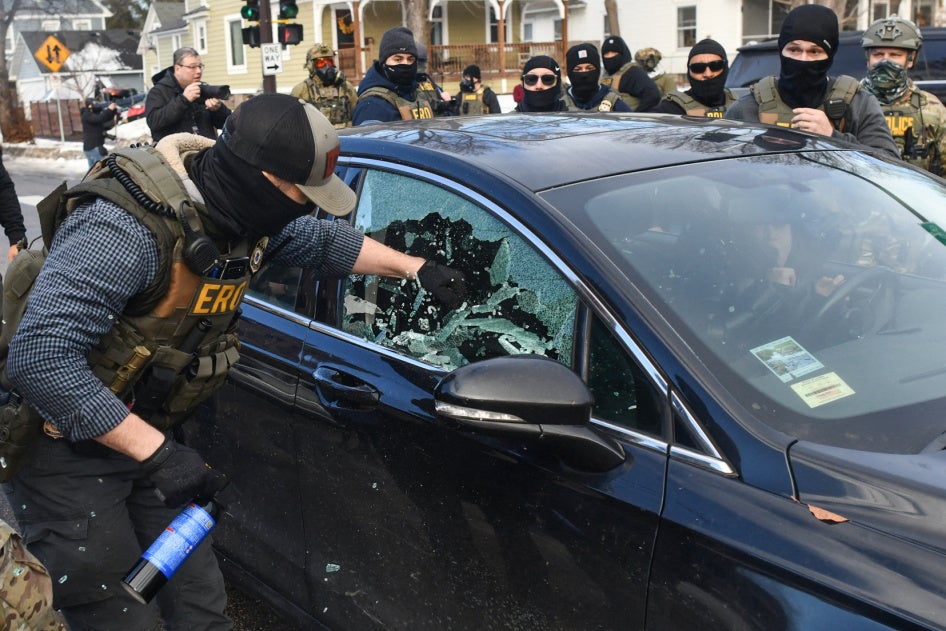
In one incident in late January, C.S. observed masked Border Patrol agents approach a man in his car. C.S. and other observers started honking and whistling, and one agent told C.S. to stop following them. C.S. followed a few more blocks until the agents stopped again, blocking the road so that C.S. could not pass, before getting out, approaching C.S.’s vehicle, and smashing their window. Human Rights Watch analyzed four videos shared with researchers of the incident.
One video shows five agents surround C.S.’s window. One agent knocked on the window and C.S. told them, “I am a constitutional observer; I have a legal right to observe.” The video shows agents then immediately smashed in the vehicle’s driver side window in with a glass-breaking baton. C.S. said that glass spilled into the car, getting into C.S.’s ear and mouth and cutting their face.
Video then shows the same agent reaching into the vehicle and opening the door. He appears to unbuckle C.S.’s seatbelt and yanks their left arm while another agent grabs their legs. The first agent then puts his hand around C.S.’s neck and pulls them by it. The second agent also then pulls C.S. by the neck. A crowd starts to form, filming and approaching the agents, prompting them to leave C.S. alone. As the agents returned to their vehicle, one of the people that showed up smashes the agents' back windshield.
After the incident, C.S. said they sought help in a nearby church, where a member of the clergy with street medic training cleaned the glass from their face, flushed their eye, and put antibiotic ointment on them. C.S. also went to the emergency room that evening for neck and back pain, they said.
Physically Trapping Observer Vehicles
Agents repeatedly maneuvered their vehicles to “box in” or otherwise physically trap observers, often before approaching them to threaten them with arrest, typically also threatening to smash their windows and pull them out of their vehicles.
In one case, Shelly and her wife were driving about 300 feet behind an ICE vehicle in St. Paul in late January, when the ICE agents suddenly slammed on their brakes.[203] Two other vehicles then pulled up behind Shelly so that she was trapped between them. Multiple masked agents got out of the vehicles and approached her car. Shelly said that one of the agents was holding a gun. The agents were wearing a mix of plain clothes and vests, one that said “ICE,” others that said “police.” “I was instantly shaking,” Shelly said. The agents told her if she followed them, she and her wife would be arrested. Shelly had a legal tip sheet on her dashboard on ICE documentation. An agent reached through the passenger side window and grabbed it, ripped it up, and threw it on the ground. Before leaving, one of the agents pointed to the empty car seats in the back seat and said, “you guys got a car seat in the back, real smart, good parenting.” Shelly caught this comment on video. “It felt threatening, referencing our children,” Shelly said.
Another observer, Misko, described an incident in mid-January where she followed an ICE vehicle for a few minutes through her neighborhood before it stopped in the middle of the street, forcing her to stop behind it, unable to safely go around. Another unmarked vehicle then pulled up behind her so she also could not back up. Four agents got out of the vehicle in front of her, with one carrying a long, big gun, she said. An agent wearing an ICE badge approached her driver’s side window and yelled at her while the agent carrying the gun approached her passenger side and pounded on the window. The agent at the driver’s side told her it was her “last warning” and that she was interfering with an investigation and would be pulled out of her car and detained if she continued. After hitting her window for a bit, the other agent took out his phone and appeared to photograph or film Misko while walking around her car. The agents then got back in their car and Misko left. “I was pretty scared,” Misko said. “I’ve never been boxed in before, and I knew they were starting to do that. I was thankful that nothing happened, but I couldn’t help but think, ‘what if’?”[204]
Use of Less Lethal Weapons
Federal agents repeatedly deployed less lethal weapons against Minnesota residents, including tear gas, pepper balls, pepper aerosol spray, smoke grenades, and flash-bang grenades. In a number of incidents investigated by Human Rights Watch, these munitions and chemical irritants, especially pepper spray, were used at close range, including directly in people’s faces and eyes, and without justification. At least some of these actions constituted excessive use of force.
According to the Minnesota observer database reviewed by Human Rights Watch, observers reported at least 25 incidents of federal agents deploying chemical irritants on residents in the Twin Cities and surrounding areas from mid-December 2025 to early February 2026.[205] This number does not include incidents on three of the dates on which federal agents deployed chemical irritants described below, and documented by Human Rights Watch, suggesting the actual number of incidents is likely much higher.
Human Rights Watch also documented the use of chemical irritants, including tear gas, pepper balls, and pepper spray by local law enforcement responding to demonstrations related to the presence or actions of immigration agents.
Below is a selection of incidents in which federal agents or local law enforcement deployed less lethal weapons.
Raid on Rose Avenue in St. Paul, November 25
On November 25, just over a week before the Trump administration officially announced Operation Metro Surge, an ICE raid on a home in St. Paul drew a crowd of protesters.[206] The St. Paul Police Department (SPPD) and federal agents used chemical irritants against the crowd. Human Rights Watch documented two incidents of excessive force by SPPD officers and an incident of excessive force by federal agents. Local media also reported the use of chemical irritants against journalists.[207]
A legal observer said he heard one or two warnings before SPPD officers began deploying chemical irritants at the crowd, telling people to move and that an ambulance needed to get through, suggesting some use of chemical irritants by officers may have been lawful.[208]
However, one protester, Annie May, saw an SPPD officer spray a person who was using a cane with pepper spray from close range and then shove them to the ground. Human Rights Watch also verified a video of the incident. In the video, the person is standing in front of a police van, talking to and appearing to film an SPPD officer. The officer briefly grabs and releases the person by the arm and then deploys pepper spray at the person for several seconds, first in their face, and then moving the large cannister to spray the person’s entire torso.[209] A second officer then attempted to push the person toward the sidewalk, causing them to fall. “Their whole body was covered in pepper spray,” Annie May said. She said she rushed to help the person while the officer got in his car and drove away.[210] Mac, a volunteer street medic who also witnessed the incident, said that the person was standing in front of a vehicle before the officer sprayed them directly in the face for several seconds.[211] Mac does not know if the officer told the person to move. “Whatever happened, it didn’t warrant the force,” Mac said. “It happened so fast. They just went ballistic so fast.”
Two other videos verified by Human Rights Watch show federal agents violently detain a person before using chemical irritants. One video uploaded to X on November 25, 2025, shows two agents standing in front of two protesters along a sidewalk before one of the agents suddenly yanks one of the protesters forward by his collar and then pushes him to the ground by the back of his neck.[212] Another video shows three agents detain the protester on the ground, while two other agents try to detain another protester from the road, and another agent deploys pepper balls toward other protesters in the road.[213]
A man eventually exited the house in ICE custody. After agents put him in a vehicle, Annie May said a crowd started to follow. She said the crowd was upset and yelling, and when the vehicle got to an intersection, "all hell broke loose.” Annie May said she saw a water bottle fly in the air and soon after heard a series of “pops” that sounded like pepper balls.[214] Another witness said he saw some people throw water bottles, but nothing else.[215] Video footage posted to social media by WCCO & CBS News shows a broken back window on a vehicle with police lights, but it is not clear who or what caused it.[216]
At least three journalists documenting the scene were hit with less lethal munitions while covering the incident. According to reporting by the Minnesota Reformer:
Kerem Yücel, with MPR News, was hit in the shoulder and was transported to a hospital by ambulance; he was released and is recovering. Tim Evans, a freelance photojournalist with Reuters, was hit in the stomach with a pepper ball round. Aaron Nesheim, a photojournalist with Sahan Journal, was struck in the head with a pepper ball round. Evans and Nesheim did not require hospitalization. The three journalists told SPJ that they believe they were targeted by law enforcement.[217]
“There are people there with ‘PRESS’ on and they’re getting pepper sprayed, and shoved, and shot at too,” Emily, another protester at the scene, said. “Those are things you hear of in war-torn countries, but it’s not supposed to happen here.”[218]
Park Avenue Confrontation, January 13
On January 13, ICE responded to protesters and observers in South Minneapolis with force, including chemical irritants.[219] People had apparently gathered in response to ICE activity, including a raid on at least one house in the area.[220] Agents detained at least six people, including two who appeared to be targeted in the raid.[221] Human Rights Watch documented two incidents of excessive force against residents in the area.
In one of the incidents, ICE agents confronted resident Aliya Rahman in her car at the intersection of 34th Street and Park Avenue at around 10 a.m. She later testified during a congressional public forum, “I encountered a traffic jam caused by ICE vehicles and no signs indicating how to get around it. I had not wanted to pull into a blocked, chaotic intersection, but verbally agreed to do so and rolled down my window after an agent yelled: ‘Move, I will break your f’ing window.’”[222] A video published by Freedomnews TV and analyzed by Human Rights Watch shows Rahman, in her car with her window down, telling ICE agents “that’s not how you ask someone to move.”[223] One agent approaches the car, shouts, and points to right, seemingly directing Rahman to drive forward.[224] The same agent simultaneously tries to open Rahman’s car door, then reaches for her seatbelt. Rahman attempts to drive a few meters forward before coming to a halt. Agents again surround her car and appear to direct Rahman to drive forward. As she tries to respond, another agent runs up and smashes in her passenger side window. Rahman again drives a few meters forward before coming to a stop, before two agents open her driver’s side door and violently pull her out of the vehicle. Rahman later stated that she then yelled “I’m disabled,” and said an agent responded, “too late.”[225] Additional video footage published by media outlets show four agents then carry Rahman handcuffed and in a hogtied position down the street, before putting her in the back of an SUV.[226] Rahman was taken to Whipple and then released without charge.[227] She said during the congressional public forum that she hit the ground face first when agents detained her.[228]
Another woman, Olivia, told Human Rights Watch how she was pepper sprayed directly in the face, without any justification. She arrived at the scene to observe just before 10:30 a.m., after learning that ICE agents were there. She was standing at the intersection of 34th Street and Oakland Avenue when a car of agents approached her. The agent in the passenger seat waved his arm to his right twice, which Olivia interpreted as signaling her to move out of the way. She moved toward the sidewalk, but as the car drove by her, the agent in the passenger seat rolled the window down and pepper sprayed her face. “I was blinded and in immense pain,” she said. Someone took her into the nearby Methodist church so she could wipe her face and flush her eyes until she could see well enough to walk home. Olivia said she went to the doctor the next day who told her she had a chemical burn on her face and neck and prescribed her lidocaine. She said the effects lasted for about five days.[229]
The repeated use of chemical irritants by federal agents that morning negatively affected residents who lived or worked in the neighborhood. The Methodist Church that Olivia went into, and which is located at the intersection where Rahman was detained, published a Facebook post stating that the protesters were peaceful and that the church’s pastor and other staff “were affected by the chemical irritants as they aided protesters on church property.”[230]
Bethany, who lives down the street from the intersection where Rahman was detained, ran outside upon hearing loud noises, where she saw what she said looked like tear gas and a big crowd. She then saw her 80-year-old father walking down the street toward her with tears in his eyes. She said he had gone outside after hearing honking and got caught in the tear gas. “That was my first time experiencing tear gas, which is a sentence I never thought I’d say,” Bethany said.[231]
Video footage shows some protesters throwing snowballs at agents or their vehicles and shows one protester bang three times on the back window of two vehicles with their hand. Additional footage shows some protesters standing on the road, potentially preventing an ICE vehicle from leaving the scene; however, the footage also shows the vehicle dangerously driving into the protesters.[232]
Protest after Sosa-Celis Shooting, January 14
After ICE agents shot and wounded Julio Cesar Sosa-Celis on January 14, protesters gathered in the neighborhood where the shooting occurred and faced off with law enforcement for several hours, during which law enforcement deployed tear gas, pepper balls, and flash-bang grenades.
Local media reported that hundreds of people had gathered in the neighborhood by 10 p.m.[233] Videos and photos published by media outlets and analyzed by Human Rights Watch show HSI agents, ERO agents, Border Patrol, Federal Bureau of Prisons (BOP) officers, Minnesota state troopers, and Minneapolis Police Department (MPD) officers in the neighborhood at various points that evening.[234] Two witnesses, including a journalist who took a photograph and another witness interviewed by Human Rights Watch, also identified Border Patrol commander Gregory Bovino at the protest that evening.[235]
Human Rights Watch analyzed three videos of the protest documenting the apparent use of tear gas as well as pepper balls and flash-bang grenades by federal agents whose agencies are not clearly identifiable in the footage.[236] In other instances where less lethal munitions were deployed, it is unclear in the videos, due to the incidents taking place at night and the sheer amount of tear gas or smoke deployed, who deployed them - federal agents, MPD, or state troopers.[237]
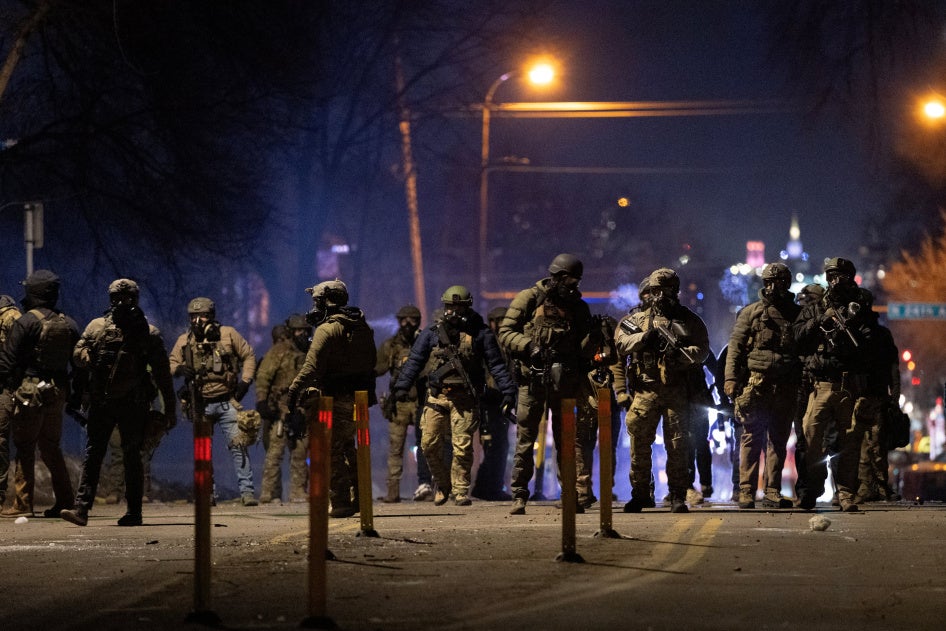
In one incident, video footage shows more than 20 law enforcement officers advancing north up Lyndale Avenue toward 25th Avenue where a large group of protesters had gathered.[238] As the officers approached the intersection, they began deploying flash-bang grenades and either chemical irritants or smoke at protesters in the intersection.[239] M.S., who went to the protest wearing a neon vest and carrying a first aid kit to act as a “marshal” and keep people calm, said he was one of the closest people to the agents, but he never heard them say that the protesters needed to leave or give any kind of warning. “There was nothing violent happening,” he said. M.S. said that protesters had followed ICE instructions to clear a path for vehicles to pass through at one point, but otherwise agents would intermittently tell them to “get back,” without clear instructions on where to go.[240]
Karla, who was present for part of the evening, described federal agents’ behavior, saying “they do these weird tactics where they confuse people, they’ll engage you in a little conversation to come closer and then throw a tear gas can.” She heard one agent say, “I love my job,” after throwing a tear gas canister, she said. Karla said that at one point a group of agents led by Bovino started to leave, saying “we’re moving out,” and directing protesters to move back, before starting to push anyone in reach and shooting pepper balls at the ground toward the protesters. “They were shooting at us as we were running away,” she said.[241]
During the evening, some protesters threw fireworks, water bottles, snowballs or ice chunks, and a traffic delineator post toward law enforcement or their vehicles.[242] Some protesters also tore down police tape.[243] At around 10 p.m., some protesters vandalized and broke into two federal vehicles.[244]
The New York Times reported that “[t]he scene became so tense that investigators [of the ICE shooting of Sosa-Celis] left before they had finished collecting evidence.”[245] Protecting the scene of a shooting until investigators can conclude their work is a legitimate law enforcement objective. However, even with a legitimate objective, law enforcement officers should only use force if strictly necessary and in accordance with international human rights standards.[246]
Blaisdell Avenue Confrontation, January 21
On January 21, as Border Patrol agents were detaining a boy and a girl on Blaisdell Avenue near W 28th Street, residents began to gather and film the arrests.[247] Agents responded aggressively, deploying tear gas or smoke canisters and violently detaining observers.
When one of the observers, C.S., arrived, they saw several cars stopped and at least a dozen people standing on Blaisdell Avenue, several of them filming, as masked Border Patrol agents detained a boy from a vehicle in the middle of the street.[248] Media reports, photographs, and a video also show a girl being detained from the same vehicle, reportedly the boy’s sister.[249]
Human Rights Watch analyzed five videos and a photo taken by C.S. and shared with researchers of the Border Patrol agents at the scene, which included at least two agents from the Border Patrol Tactical Unit (BORTAC), a special operations unit focused on “high-risk” law enforcement operations. A video also shows one of the Border Patrol agents photographing or filming the observers with a professional camera at close range.
As C.S. approached, they said they saw an unmarked Border Patrol vehicle bumper to bumper with the girl and boy’s vehicle. Just in front of that vehicle, agents were handcuffing an observer holding an orange vest on the ground.[250] A photo published online shows the observer on the ground, bleeding from his nose or face as three agents detain him.[251]
C.S. said that agents yelled at the other observers to “get back,” and that as one person was backing up, an agent used their shoulder to shove the person so hard they hit the ground. One of the BORTAC agents then started telling the other agents to “roll out,” C.S. said. Some agents got in their vehicles and drove less than a block before getting out again at the intersection of Blaisdell and 29th Street, C.S. said.
A video reposted by the New York Times shows agents at that intersection detaining a woman and a man on the ground.[252] Three agents are detaining the man when a fourth agent approaches and pepper sprays him directly in the face, with the canister inches from the man’s eyes.[253] The video also shows agents deploying canisters releasing a chemical irritant or smoke and yelling at people to get back. As C.S. caught up with the agents at the intersection, they observed them throwing canisters and then getting back in their cars and leaving.
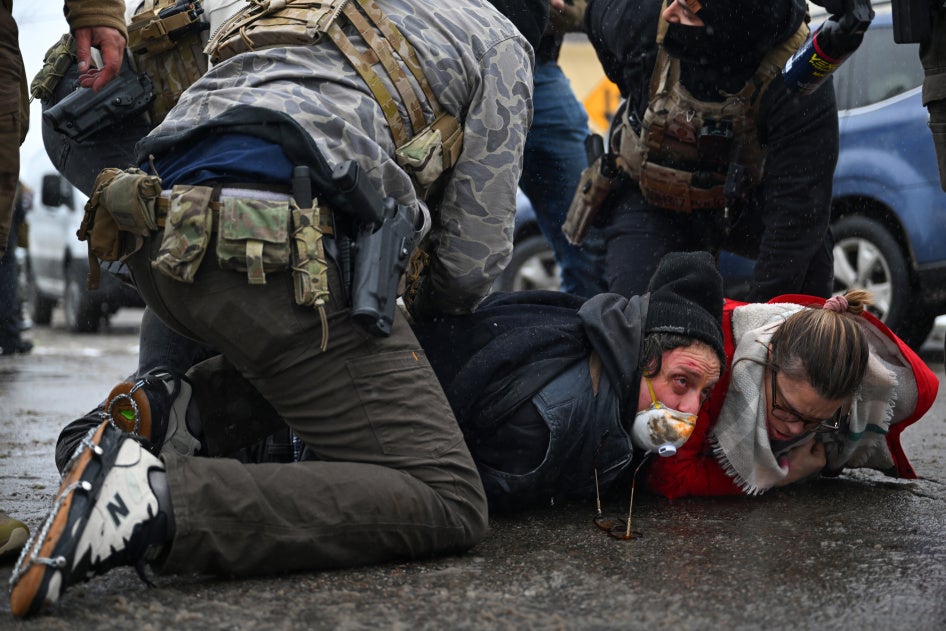
Angela was on her way to work when she stumbled upon the incident, she told Human Rights Watch, and an observer told her they needed people on the other side of the block. As Angela pulled around the block, two masked Border Patrol agents yelled at her to move, terrifying her. “I had agents on either side, I was thinking, this is exactly how Renee Good was killed,” she said. Within 30 seconds, the agents smashed Angela’s driver’s side window, pulled her out of the car, laid her on the ground, tightly bound her wrists with zip ties, and then put her into one of their vehicles and drove her to Whipple, where she was detained for a few hours.[254]
During the car ride to Whipple, Angela heard one of the agents compliment the others on the footage they had captured, saying “great content back there.”
“I wish people could understand what is happening here,” Angela said. “The federal government has turned on its people.”
Protest after Alex Pretti was Killed, January 24
After Border Patrol agents shot and killed Alex Pretti in Minneapolis on the morning of January 24, residents began to gather near the scene. Minneapolis police (MPD) initially cordoned off an area on Nicollet Avenue between 26th Street and 27th Street, where the shooting occurred.[255] Then federal agents and MPD officers set up a perimeter around the intersection of 27th Street and Nicollet Avenue, to prevent protesters from getting closer to the scene. Dozens of people eventually surrounded the intersection that morning, including several journalists and photographers. A photo taken from a nearby rooftop by a ProPublica photojournalist shows over 90 agents and MPD officers inside the cordoned off intersection.[256]
As noted above, protecting the scene of a shooting until investigators can conclude their work is a legitimate law enforcement objective. However, even with a legitimate objective, law enforcement officers should only use force if strictly necessary, and should provide clear warnings, exercise restraint, and act proportionately to the circumstances.[257]
Human Rights Watch analyzed a video of the protest confirming the presence of HSI agents, ERO officers, Border Patrol agents (including BORTAC agents), BOP officers, and MPD officers, and later, Minnesota state troopers and Minnesota conservation officers.[258] The footage shows how federal agents deployed tear gas, pepper spray, and pepper balls at protesters, at least sometimes without warning.[259] Federal agents also detained at least eight protesters, according to Human Rights Watch analysis of three videos.[260]
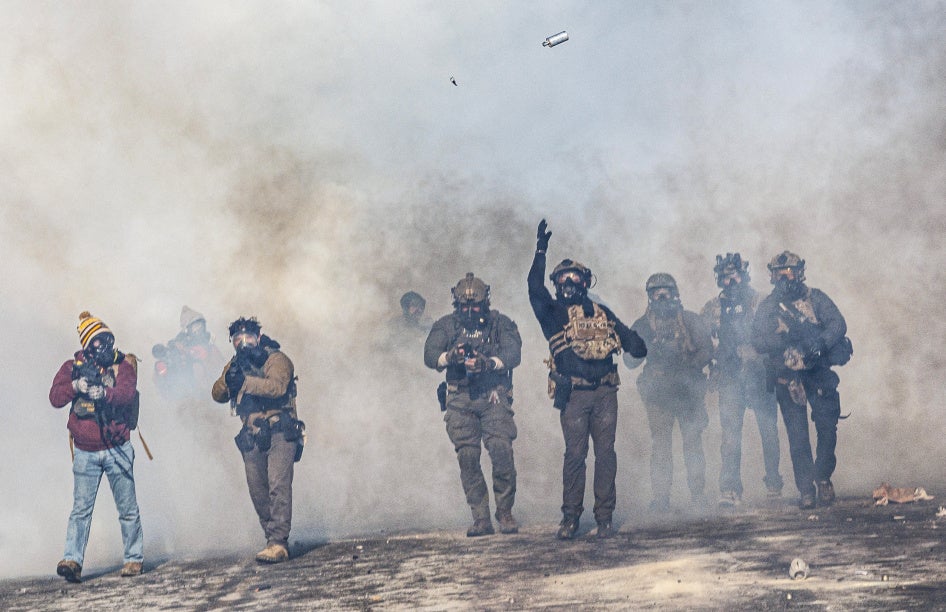
A group of Minnesota state troopers, Minnesota conservation officers, and MPD officers also deployed what appeared to be tear gas.[261] Minnesota state troopers also tackled protesters.[262]
On at least two occasions, federals agents appeared to target journalists. One analyzed video shows an agent shoot either a chemical irritant or smoke at a group of journalists.[263] And photographs show an agent appear to push and then pepper spray another journalist directly in the face.[264]
Video footage and testimonies indicate that protesters were largely peaceful, though some protesters tossed cannisters back in the direction of the officers who deployed them, and two women were later criminally charged for allegedly biting agents’ fingers; in one of the cases, the woman allegedly bit the tip of the agent’s finger off. Some protesters also laid out trash cans, wooden pallets, dumpsters, and other items in the street as a makeshift barricade ahead of intermittently advancing federal agents and a photograph shows one dumpster on fire.[265]
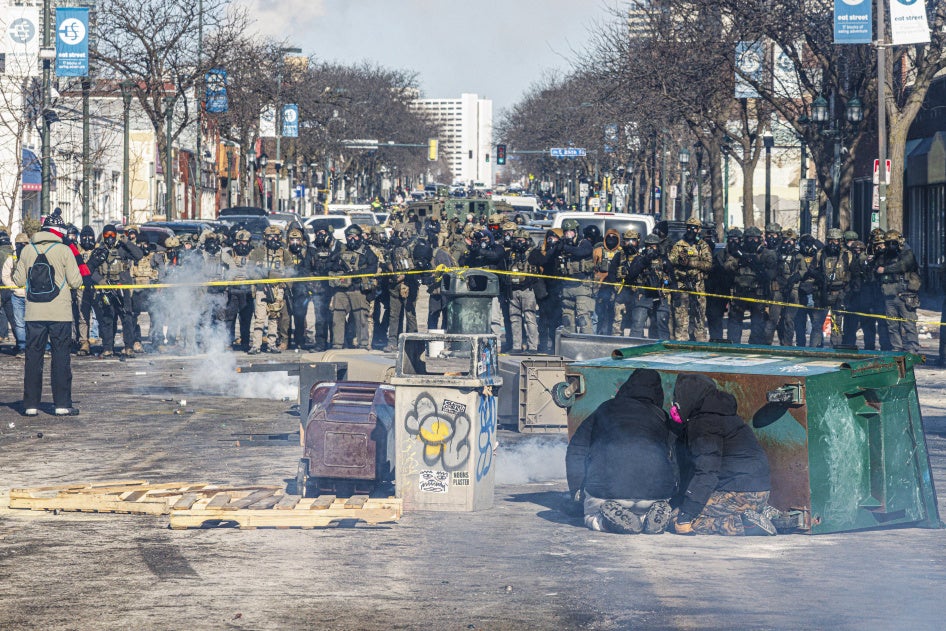
Mac, a volunteer street medic, said she arrived at the cordoned off intersection at Nicollet and 27th within an hour of the shooting.[266] Mac said she heard officers say that the crowd constituted an unlawful assembly and that they needed to move, after which they started to throw tear gas cannisters and shoot pepper balls, Mac said. Mac was on scene for a few hours, and at one point she delivered first aid to someone whose hand had been hit by a less lethal munition, though she could not identify the precise munition. Mac said the person’s hand was bleeding and their fingers were “destroyed.”
Jackson saw state troopers and federal agents when he arrived at the protest. He said he did not hear any warnings about the use of force before one of the officers fired a canister that hit him on his left arm. He stumbled back in surprise and then felt the pain. Other protesters helped Jackson evacuate the scene, and someone who lived nearby let him inside to recover. He later went to an urgent care facility, concerned his arm was broken, where a doctor told him he had a bruised bone.[267]
Use of Force Outside the Whipple Federal Building
From January to March, residents held regular demonstrations outside the Bishop Henry Whipple Federal Building, where ICE detains both US citizens and noncitizens. Federal agents repeatedly deployed chemical irritants and flash-bang grenades and used physical force against protesters outside the Whipple building.[268] Protesters yelled at federal agents arriving, leaving, and stationed outside the federal building, with some throwing snowballs or objects at them or their vehicles.[269] On at least one occasion, someone deployed fireworks toward federal agents.[270]
Federal and local authorities also arrested protesters on several occasions, including two incidents of mass arrests by Hennepin County Sheriff officers, Minnesota state troopers, and Minnesota conservation officers on February 7 and March 1.[271]
In one incident, Diane, who uses a cane, described being shoved by an agent while participating in a protest on January 8.[272] “They were predominantly aggressive with women,” she said. According to Diane, before agents began deploying chemical irritants and shoving people, the protesters were blocking a vehicle from entering one of the gates to Whipple. However, Diane said she did not hear a warning before agents deployed chemical irritants.
Another protester present that day also said that agents began deploying tear gas without any warning. “They almost immediately assaulted protesters,” he said.[273]
In a sworn declaration, a Border Patrol agent stated that CBP officers used pepper balls and pepper spray at different points on January 8, but denied the use of tear gas by CBP.[274] However, media reports suggest tear gas was deployed, and footage analyzed by Human Rights Watch shows canisters releasing white smoke, though it is unclear whether the canisters are emitting tear gas or smoke.[275]
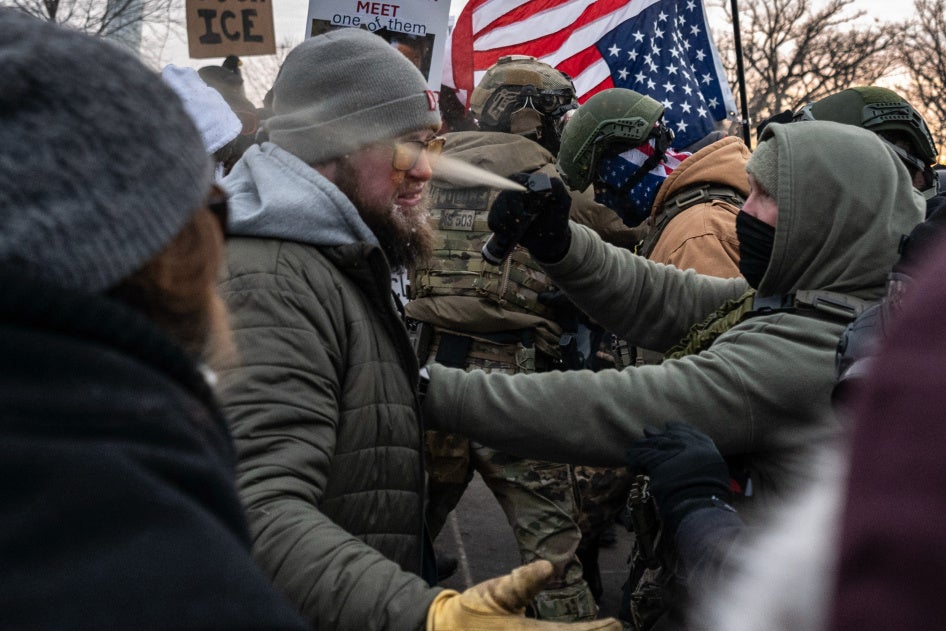
Diane described agents pushing the crowd back in one direction toward a light rail station. “That’s where the shoving began,” she said. “It was an intentional escalation…Women would be turning around and walking back, and they would come up behind them and push them.” Diane said one agent shoved her in the back as she was moving toward the sidewalk. If not for her cane, “I would have been literally pushed to the ground,” she said.[276]
Surveillance of Observers and Protesters
Protesters and observers described to Human Rights Watch instances where agents surveilled them in circumstances that suggest this was done as a form of retaliation or intimidation rather than for any legitimate law enforcement purpose. Many residents have been photographed or filmed by agents without explanation while protesting or observing enforcement activity. Others have been led back to their own homes by federal agents, suggesting agents are surveilling them and gathering their personal information.
Surveillance Tools
ICE and CBP have been using a DHS mobile application called “Mobile Fortify” to identify people by scanning their face and/or fingerprints, and comparing these with records in DHS databases.[277] According to the DHS 2025 AI Use Case Inventory, the application “helps officers establish the identity of individuals to determine legal status and check for prior immigration or criminal history,”[278] and relies on “relevant DHS records and law enforcement databases” to identify individuals.[279] Journalists at 404 Media published a leaked DHS Privacy Threshold Analysis for Mobile Fortify and reportedly reviewed other ICE documents indicating the application checks photographs and fingerprints against a number of government databases managed by CBP, the FBI, the State Department, and state government databases.[280]
The Privacy Threshold Analysis reveals that ICE does not ask for consent or permit people to decline to have their biometric data captured by the application.[281] The document also states that “[a]lthough the intended purpose of the Mobile Fortify Application is to identify aliens who are removable from the United States, users may use Mobile Fortify to collect information in identifiable form about individuals regardless of citizenship or immigration status.”[282] According to the document, photographs and fingerprint data captured through the application, including “non-match” photographs of US citizens or others, will be retained for 15 years, with seemingly no way for even US citizens to remove themselves from this database. The document also acknowledges that “ICE agents do not know an individual’s citizenship at the time of initial encounter,” and need the application to verify identity.[283] In practice, this could allow ICE agents to use the app as a fishing tool to cast a wide net in the hopes of identifying non-citizens without reasonable suspicion of criminal activity.
Human Rights Watch interviewed many residents who have been photographed or filmed by agents while engaging in protest or observation activities. Journalists in Minnesota captured photographs of agents seemingly scanning people’s faces using what appears to be a facial recognition application, likely Mobile Fortify, with the agents’ phones showing a circle centered around the person’s face. One photograph shows a message above the face framing circle that reads, “searching face,” while another photograph of the application shows a message beneath the person’s face that says “processing.”[284]
DHS’s 2025 AI Use Case Inventory also describes an “AI-enabled license plate recognition system” that allows ICE to scan license plates to identify a car’s past movements using data from “ICE-owned and commercial license plate recognition cameras.”[285] The inventory listing claims that the system does not “automatically link license plate records to driver or vehicle registration databases,” but ICE may conduct these searches separately “in accordance with applicable laws and policies.”[286]
ICE has wide-ranging access to license plate records through commercial data,[287] support from local law enforcement agencies,[288] and reportedly, sometimes by accessing local law enforcement data even where such information sharing is prohibited by local governments.[289]
Surveillance of Minnesota Residents
Human Rights Watch documented several cases of agents driving, with observers following them, to the observer’s own home, raising serious concerns about intimidation and further data collection, including potentially addresses, of observers. In these cases, agents also sometimes stopped to visibly film or photograph the resident’s house:
In late December, one observer, Jordan, was following a suspected ICE vehicle when it drove to her house, where the federal agent got out to “theatrically” take photos, Jordan said. Jordan responded by taking photos of the agents, prompting one to roll down his window and say, “yeah, that’s really going to do something,” before taking photos of Jordan. The agents also drove down an alley to take photos of the back of Jordan’s house. Jordan said that the agent who photographed her house was wearing jeans and a black sweatshirt with a vest over it and that all three agents had their faces covered. “I felt a little scared the next few days,” she said. “I would definitely check out my window to see if there were any suspicious vehicles outside my house.”[290]
Also in late December, another observer, Francesca, filmed an incident where an unmarked vehicle she was following in her neighborhood drove to her house and stopped out front.[291] The video, reviewed by Human Rights Watch, shows a man in plainclothes with his face covered getting out of the driver’s side and holding his phone up to apparently film or photograph the house. The man briefly gets back in the vehicle, before getting out again to film or photograph Francesca in her car.
In mid-January, C.S. was driving behind an ICE vehicle when it pulled onto a residential street near where C.S. lived. An agent got out of the car and appeared to take a photo of C.S. The agents then drove to C.S.’s home. Two agents got out of the car and started pointing at C.S.’s housing, saying, “this is where you live,” before taking a photo of the house and then of C.S.[292]
Agents have also identified residents by name when approaching them or made comments suggesting that they are surveilling or tracking their information:
In one case, an observer stated that she had been driving behind agents to observe their activity when they stopped, got out of their vehicle, and approached her car.[293] One agent identified himself as Border Patrol and addressed the observer by name, indicating he knew already who she was.[294] She stated he then told her that the agents had “facial recognition” and his body camera was recording. The observer reported that her Global Entry/TSA-Pre Check status (a CBP program enabling “expedited entrance” to the United States when traveling) was revoked three days later.[295]
In another incident, a video reviewed by Human Rights Watch shows two ICE agents knocking on an observer’s car window and yelling. One of the agents, wearing an ERO vest, appears to film or photograph the observer and says, “you're now in an FBI database, remember that.”
Another observer, Emily, told Human Rights Watch that she had never been detained by ICE, yet agents on multiple occasions called her by name over their vehicle PA systems when they spotted her observing them, sometimes repeating her name numerous times within a couple of minutes. She has felt scared, frustrated, and angry at different times while observing or protesting agents’ activity, she said.[296]
In another case, an unmarked ICE vehicle that Sage was following stopped in front of him, and another unmarked vehicle stopped behind him. Masked agents wearing vests that said “police,” and one with a badge that said “ICE,” got out of the vehicles and appeared to take photos of Sage’s car and of Sage and his passenger’s faces. Sage heard an agent say that he would face scrutiny when traveling in the future.[297]
Another observer, Dalton, said he was following behind ICE agents for about half a block in late January when one unmarked ICE vehicle stopped in front of him, and another vehicle stopped behind him, trapping him between them. ICE agents approached either side of his car and one threatened to break his windows, telling him this was his only and final warning and that it was “being recorded.” Dalton was too frightened to keep observing ICE that day.[298]
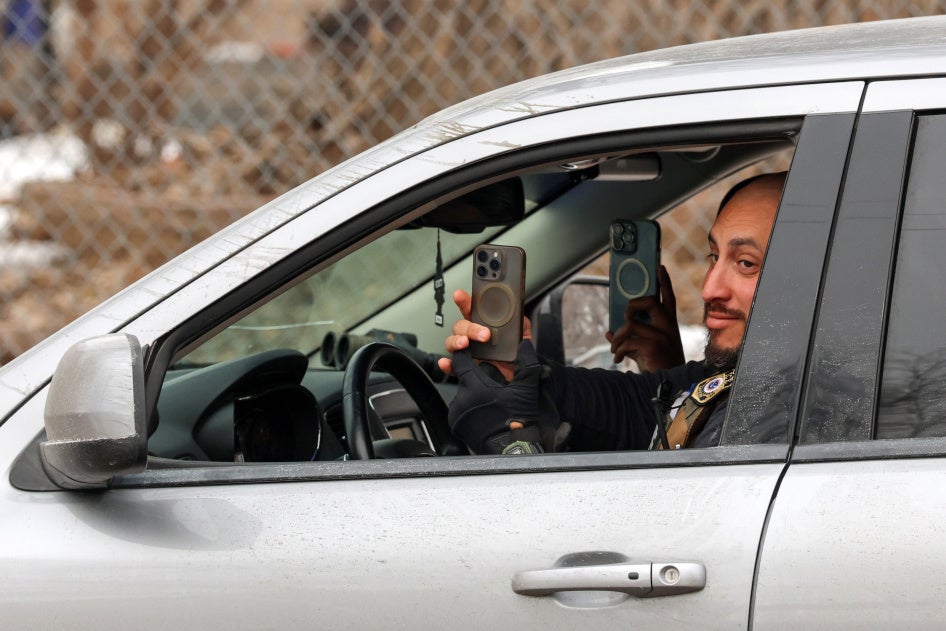
Denial of Access to Counsel
“It appears that the primary deciding factor, between whether an unlawfully detained noncitizen in federal immigration custody is able to achieve a fair hearing and ultimately release, is whether that individual has access to an attorney.”
Attorney Kira Kelley, discussing detention of clients by federal immigration agents during
Operation Metro Surge[299]
Individuals arrested by federal agents during Operation Metro Surge were typically taken to the Whipple Federal Building,[300] where the Department of Homeland Security engaged in a range of practices that made it difficult or impossible for people detained to seek or receive assistance from counsel.[301] Human Rights Watch interviewed formerly detained individuals and lawyers and reviewed 19 sworn declarations as well as relevant legal briefs and judicial decisions. Documented concerns included DHS: failing to respond to detainee requests to make a phone call; preventing lawyers from conducting in-person visits and consultations with their clients at Whipple; failing to confirm the location of a detained person; and failing to ensure privacy and confidentiality for detained people having phone calls or visits with their lawyers. Concerns also include the DHS practice of moving detained immigrants quickly—including within twenty-four hours—out of Minnesota (including to distant locations, such as Texas) and failing to keep the DHS Online Detainee Locator System updated and accurate. These practices obstruct lawyers’ ability to find and counsel their clients. Further, immigrant detainees also reported being pressured to sign “self-deportation” papers without access to counsel,[302] a practice Human Rights Watch has repeatedly documented.[303]
During Operation Metro Surge, almost all immigrants (97 percent) arrested in Minnesota by ICE were initially detained at the Whipple Federal Building. However, ICE then quickly transferred detainees out of state, in a significant change from prior practice. During the last year of the Biden administration, about 34 percent of those arrested in Minnesota were transferred to a detention facility in another state; this occurred on average about 36 days after the arrest. Under the second Trump Administration, from January to November 2025, this jumped to 76 percent of all people arrested being moved out of state within 18 days on average. Then, between January and February, during Operation Metro Surge, 85 percent of those arrested in Minnesota were transferred out of state within three days on average.[304]
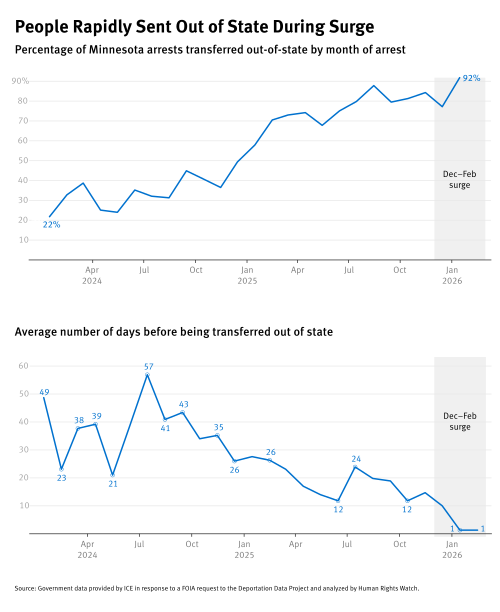
Habeas corpus petitions challenging a detention must generally be filed in the federal district where a person is detained; rapid transfers of detained individuals out of state thus significantly impede the ability to file habeas petitions.
The experience of Kira Kelley, an attorney who visited the Whipple building nearly daily in January 2026 and filed dozens of habeas petitions between January and March for individuals detained there, is illustrative of the obstacles immigrants faced in accessing counsel. Kelley said that lawyers had “just hours to file” habeas petitions before detainees were rapidly flown to Texas.[305] Most of Kelley‘s clients were “sent out of state…within a day or even a few hours of being detained at Whipple,” impeding Kelley’s ability to represent them.[306] Kelley also had numerous clients who they could not find in the ICE detainee locator system, and many of Kelley’s attempts to call the St. Paul ICE field office to obtain information about clients went unanswered.[307] Until mid-February 2026, Kelley and other lawyers were regularly denied the ability to visit their clients. [308] Except for one case in which a judge ordered ICE to allow Kelley to visit a client, Kelley said that “every time I have attempted to visit a client … ICE refuses to allow me to visit.”[309]
In response to a lawsuit by The Advocates for Human Rights, District Court Judge Nancy Brasel found that “Plaintiffs’ evidence suggests that since Operation Metro Surge began, Defendants’ policies and practices at Whipple all but extinguish a detainee’s access to counsel.”[310] ICE “isolated thousands of people... from their attorneys,” said Brasel, and “the obstacles the government has put in place at Whipple rise to the level of an unconstitutional infringement of noncitizen detainees’ right to access counsel.”[311]
US citizens also faced obstacles. Anna Hall, a criminal defense attorney, told Human Rights Watch that most citizens did not get to make phone calls until several hours into detention, if at all.[312] One US citizen detained at Whipple for four hours told Human Rights Watch that each time he interacted with an agent during his detention, he asked for a phone call or attorney, but his request was never followed up on.[313] Individuals volunteering with the National Lawyers Guild (NLG) of Minnesota’s legal support hotline told Human Rights Watch that citizens were systematically denied phone calls at Whipple. “We just didn’t get hotline calls from Whipple,” one hotline volunteer said.[314] Instead, the hotline typically learned of a citizen’s detention at Whipple via a call after the person was released, from concerned relatives who could not reach the detained person, or from people reporting empty cars with smashed windows, indicating someone had been arrested by ICE.[315]
The NLG Minnesota volunteers also told Human Rights Watch that even when they were alerted of an arrest while an individual was still in detention at Whipple, attorneys often could not access the building, and when they could, it often took three or four hours, and the visit was held in a room with an open door, lacking adequate privacy.[316]
Conditions of Detention
Individuals were subjected to abusive conditions in detention and during transfer to other detention facilities, and were released into unsafe conditions, including potentially life-threatening, sub-freezing weather, often without their identifying documents or means of communication or transportation.
In prior eras of immigration enforcement, ICE did not incarcerate everyone they arrested. During the last year of the Biden administration, nearly a third of those arrested by ICE ERO in Minnesota were not placed in detention. Since the Trump administration took over, however, 99 percent of people arrested in Minnesota by ICE ERO have been held in immigration detention.[317]
People detained during Operation Metro Surge, lawyers, and others who work with detained individuals described detention conditions that amount to violations of international human rights law. Human Rights Watch interviewed eight people who were detained at Whipple, reviewed sworn declarations describing detention conditions, and interviewed volunteers who had worked with over 100 people when they were released from Whipple and who collected their accounts of detention.
At Whipple, many individuals were subjected to overcrowded dirty cells, continuous shackling and bright lights, and they had to sleep on cold floors without beds or bedding. They faced unhygienic conditions and lack of privacy when using the toilet, and evidence raises serious concerns about whether those detained were consistently provided with adequate food, clean water, and health care, including access to medicine. After hours or days held at Whipple, many immigrants were subsequently sent to other detention centers in Texas or other states, where they continued to face inhuman and degrading conditions.
Like conditions at other immigration detention facilities recently investigated by Human Rights Watch in the United States,[318] the conditions Human Rights Watch documented at Whipple violated the prohibition against cruel, inhuman, or degrading treatment in Article 7 of the ICCPR and Article 16 of the Convention Against Torture (CAT), as well as the guarantee of humane treatment for people deprived of liberty in Article 10(1) of the ICCPR.
The conditions further did not meet the minimum standards for detention set out in The United Nations Standard Minimum Rules for the Treatment of Prisoners (the “Mandela Rules”), including Rule 13 (cell conditions), Rule 21 (bed and bedding), Rule 22 (water and food), Rules 24-27, 30 (health care), and Rule 58 (contact with the outside world).
Sleeping on Cold Floors, Overcrowding, Continuous Lights
Whipple reportedly has 17 rooms for holding ICE detainees,[319] and before December 2025 was used for holding people for short periods of time, typically 12 hours or less.[320] As noted above, many people were detained at Whipple for less than a day before being moved out of state, complicating the efforts of their families or lawyers to locate, contact, or represent them. However, some people were kept in Whipple overnight, or in some cases, for two or three days,[321] despite the facility lacking the infrastructure and supplies to hold people for longer periods of time.[322]
The rooms for detention at Whipple only have concrete floors and benches around the edges, and do not have beds or bedding.[323] Individuals are forced to sleep on cold, hard surfaces.[324] Amidst the increase in detentions during Operation Metro Surge, Whipple became overcrowded, exacerbating sleeping difficulties.
One individual who had worked with many formerly detained people stated that they were “kept like cattle” and “packed in” rooms with 40, or even 100 people.[325] A 20-year-old Minneapolis resident with refugee status who was detained at Whipple stated in a sworn declaration that ICE took him to a room that he estimated was for 20 people.[326] But over “the next two hours, the room filled up with about 100 people. The conditions in the room were inhumane.” Due to the overcrowding, he said they “had to sleep in handcuffs and standing up.”[327] One man shared with Haven Watch volunteers that met him when he was released that he was detained for three days at Whipple but could not sleep due to the conditions: “It is not human, we were treated like animals,” he told them.[328] An individual with a pending asylum case and employment authorization detained by ICE and held in Whipple stated in a sworn declaration that he “tried to sleep” in the overcrowded cell, “but there was no space to sit down. When some people got up from the floor, I would sit down but it was painful to be on the cement floor. Sometimes there was even no space on the floor to sit or lie down.”[329] A US citizen who was detained at Whipple for several hours said in a sworn declaration, “As I went past different cells, I saw a lot of really sad people. There was no room for people to lie down.”[330] A lawyer who represented many clients held at Whipple similarly told Human Rights Watch that people held there had to take turns lying down due to overcrowding.[331] Haven Watch volunteers told Human Rights Watch that people released from Whipple also reportedly described that bright lights were kept on continuously, making sleep more difficult.[332]
Shackles and Handcuffs
Some individuals detained at Whipple described being kept in handcuffs and/or shackles on their ankles for lengthy periods of time.[333] In one extreme case, a 20-year-old refugee said in a sworn declaration that he was cuffed at his ankles for his entire three-day detention:
My ankles hurt because the cuffs were meant for wrists and were too small for my feet. I asked them to loosen the cuffs a little, but they refused... On the third day, ICE chained my stomach and handcuffed my wrists. My feet had been cuffed the whole time I was there ... I still have marks on my ankles from them.[334]
Sawyer, a US citizen detained while observing ICE, told Human Rights Watch that he was shackled at his ankles for nearly the entire four hours he was at Whipple and handcuffed for part of the time.[335] He observed around 15 to 20 people who he said looked Latino lined up along the wall in the large garage-like intake room, all of whom were shackled at the ankles.
Access to Adequate Food, Water, and Health Care
Some individuals held at Whipple said that DHS did not provide adequate amounts and quality of food and water to those detained. Individuals reported seeing cockroaches crawling out of their food,[336] being provided expired food,[337] and not being provided adequate amounts of food during the day,[338] particularly if they were transferred out of state and held for extended periods in transit.[339] Due to transfers, one woman first detained at Whipple and then moved to Wisconsin and back to Whipple, stated that she “went approximately 24 hours without food.”[340] Some formerly detained people also told legal and other assistance providers who spoke with Human Rights Watch that the drinking water provided to them at Whipple seemed dirty or unsafe, and they refrained from drinking it.[341] In one case, a US citizen repeatedly asked for water over several hours, but was not provided it.[342]
Individuals who work with recently released detained people reported multiple cases of individuals with serious, chronic health conditions—such as diabetes or a heart condition—who were not provided access to the medications they use to manage or treat these conditions.[343]
Others described how authorities at Whipple denied their requests for access to health care, including for potentially serious injuries sustained during their arrest and detention. A US citizen detained at Whipple who had been injured during arrest said he “asked for medical assistance, [but] they did not provide it.”[344] A woman similarly stated in a sworn declaration that she had “asked for medical attention on approximately five occasions” because her head hurt from being “slammed” into a wall by an immigration officer, but the agents at Whipple told her there was no Tylenol.[345] After her release, doctors who examined her told her she “likely had a concussion.”[346] Aliya Rahman, a US citizen violently detained by ICE from her car in mid-January, also reported that her requests for medical care at Whipple were denied for more than an hour until she lost consciousness and was taken to the emergency room.[347]
Jenna, another US citizen, was detained by ICE in late January. She told Human Rights Watch that the ICE agent who detained her threw her to the ground, which caused her to sustain several injuries that were later diagnosed by a doctor to include a concussion, a contusion on her right elbow, and a sprained right knee. She explained how, while detained at Whipple, she received meager medical care for these injuries. After requesting first aid for her knee, she was only given a small bandage and band aids, which she used to secure the bandage onto her injured knee, and when she requested an ice-pack for the pain, an agent gave her a small frozen sandwich from a freezer.[348]
Sawyer, also a US citizen, was injured when an ICE agent smashed his car window before detaining him, casting shards of glass onto his head and face. He was experiencing eye irritation when he arrived at Whipple. He told an agent about his irritation and said that the agent just “brushed” around his eye with her hand, which did not improve the irritation. About 15 minutes after initially arriving, he said he brought it up again to an agent and was finally allowed to use an eye rinse station, but he had to use it while handcuffed. He also noticed blood and a piece of glass embedded in his forehead after he was released. He noticed bruising near his eye that had experienced irritation the next day. Sawyer also observed another detained man while at Whipple who he said appeared bruised, bloodied, and dazed. He overheard agents talking about waiting on an ambulance and laughing about how long it was taking. He did not see anyone assist the man.[349]
Toilets and Hygiene
The rooms for detainees at Whipple include one or two toilets in the corner which, according to people formerly detained there, were unsanitary and did not provide adequate privacy, forcing people to use the toilet in front of each other.[350] A 20-year-old with refugee status who was held at Whipple stated:
The room had a dirty toilet and there was no door for privacy. The excrement was overflowing. There was no toilet paper so I had to ask the officers for it, but sometimes they refused to give it to me and often they would just ignore my requests. ICE cuffed my feet, and I had to go to the bathroom with the handcuffs still on.[351]
Other individuals held at Whipple described similar conditions, including a lack of privacy,[352] and “filthy” bathrooms without soap.[353] Detainees also described “dirty” cells. One detainee noted that there “was food scattered on the floor, the floor was sticky with mud... There were two benches that fit four to five people. The rest of us had to stand or sit on the floor that was covered in garbage.”[354] People detained for longer periods also reportedly described no access to showers or any provisions for brushing their teeth.[355]
In one case, a family of four, including a toddler and another young child, were detained for over 10 hours. No diapers were provided in detention, and when they were released, the toddler was covered in urine.[356] An individual who met them outside Whipple stated that the family was “literally shaking” in response to the harms they had faced.[357]
Conditions of Transfer and Other Detention Centers
Many immigrants were rapidly moved from Whipple to county jails or other federal detention centers across the United States, especially in Texas and New Mexico. They were subjected to harmful conditions of transfer and faced continued harmful conditions of detention outside Minnesota.
More than two out of three people arrested during Operation Metro Surge were transferred to Camp East Montana at Fort Bliss in El Paso, Texas.[358] Camp East Montana is currently the largest immigration detention facility in the United States. It has the capacity to imprison up to 5,000 people and is located inside Fort Bliss, a US military base with headquarters in El Paso, Texas.[359] Within weeks of its opening, ICE’s own internal investigations revealed over 60 violations of federal standards at the immigration detention camp.[360] In December, Human Rights Watch issued a public, joint letter detailing cruel, inhuman and degrading conditions of confinement at the immigration facility, including indiscriminate beatings, forced idleness, coercive third country deportations, and rampant medical neglect at the facility.[361] The ACLU and other legal organizations filed a lawsuit in May challenging the facility’s conditions.[362]
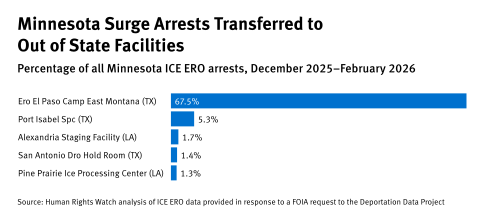
Those taken from Minnesota to other detention centers described being shackled at the wrists, ankles, and/or around the waist during their transfer.[363] Some described the shackling as very tight, including one person who reported having seen red welt-like wounds on the skin of a pregnant woman who was shackled around her stomach area.[364]
Another woman showed Human Rights Watch the marks she still had on her wrists from being handcuffed on a plane to Texas nearly a month prior.[365] She said that no one could use the bathroom on the plane because they were shackled. When she got to Texas, she was detained for nine days at the Camp East Montana facility in El Paso, where she said there sometimes was not soap or water available, and women who were menstruating were not given anything to wash themselves with. She also explained that when detainees were able to wash their clothes, they were not given a second set of clothes to wear but had cover up with a sheet while the clothes washed.[366]
In a sworn declaration, another individual also described being kept in chains during their transfer from Minnesota to Texas: “I was very hungry. No food or water were offered for a while. I was finally given a snack and water on the plane, about 12 hours since I had last eaten, and had to eat with handcuffs on.”[367] He was then held in detention centers in El Paso, Texas and Torrance, New Mexico, and said he faced cold and cramped cells, sleeping on cement floors, pressure from officials to self-deport, inadequate food, and mocking from officers. In total he was held for 19 days, despite the filing of a habeas petition and a judicial order for his release on day five of his detention.[368] His attorney Kira Kelley highlighted that his lengthy detention was “in violation of multiple court orders.”[369]
An asylum applicant with a work permit who was detained in Minnesota told Human Rights Watch that he spent 14 days in three centers across Texas.[370] He was shackled at his hands, waist, and feet on the plane ride to Texas and was not able to use the toilet. The conditions he experienced across detention facilities in Texas included being detained in cold rooms with concrete benches, continuous lights, little food (a sandwich and cookie for each meal), and a lack of privacy when using the toilet.[371]
Luisa Doe, a 48-year-old Latina woman with a pending asylum application who has diabetes, was detained on her way to work in St. Paul. She stated in a sworn declaration that after being detained for several hours at a nearby facility, she was transferred to Douglas County Jail in Wisconsin, where she said ICE agents refused to give her medication she uses to manage her health condition.[372] “I’ve told them how horrible I am feeling and the only thing they have done is isolated me in a cold, dark room with hard surfaces,” she declared.[373]
Unsafe Release
Immigration authorities released many individuals from Whipple in dangerous and potentially life-threatening conditions. Individuals were released into freezing weather without their identity documents, money, or cell phones, and the federal government provided no support for them to get home or to call someone to assist.[374] Attorney Kira Kelley told Human Rights Watch that federal agents “just release people, without anything, onto the streets.”[375] Kelley stated that “many” of her clients were “dropped off without a hat or phone or wallet on the side of the road.”[376] In one illustrative case, a detained US citizen and Iraq war veteran was “released out of the front door of the Whipple building into the January cold wearing only his sweatshirt and without his cell phone or any way to contact his wife,” said his attorney in a sworn declaration.[377] If it was not for the work of Haven Watch volunteers waiting at the Whipple exit to support released individuals, they would have been left out in often below-freezing temperatures without any way to return home.
In another case, an individual sent from Minnesota to Texas was released in Houston with their phone, but no money, and ICE had retained his identity documents and did not issue him any papers. When a refugee resettlement agency tried to support him to get back to Minnesota, the airlines would not let him fly without identity documents; he was only able to return after intervention by a Congressional representative.[378]
Another immigrant said that ICE kept all his documents, including his passport, driver’s license, social security card, and work permit. After being released, he was able to get a new standard driver’s license but could not get a replacement Real ID (a higher security level of identification) without any of his other documents.[379]
“This is grounded in flat out cruelty,” a refugee resettlement worker said, describing the practice of not returning documents.[380] “They want people to feel they have nothing and are nothing.”
These release conditions violate the minimum standards in the Mandela Rules, which require that on release, “articles and money shall be returned” (Rule 67), and that released individuals “are provided with appropriate documents and identification papers,” “are suitably and adequately clothed having regard to the climate and season,” and “have sufficient means to reach their destination” (Rule 108).[381]
Wider Community Impacts of Operation Metro Surge
“You might not be living in a cage, but that’s the feeling of it.”
–An immigrant who temporarily left Minneapolis out of fear[382]
The conduct of ICE and CBP in Minnesota spread terror and fear.[383] Immigrants–including naturalized US citizens, refugees, and asylum seekers–and people of color were particularly impacted and faced heightened and grave risks. ICE and CBP’s terrorizing conduct caused significant numbers of individuals and families, including citizens and those lawfully residing in the United States, to restrict their movements or stay at home entirely. Residents sheltered at home for periods ranging from weeks to multiple months, according to Human Rights Watch interviews with directly impacted people as well as those who have worked closely with them providing services such as health care, education, or food aid. The impacts were so significant that some families left the Twin Cities temporarily or relocated out of state.[384]
The impacts on everyday life were exacerbated by federal agents operating near sensitive locations, such as schools and hospitals. Prior policy to restrict immigration enforcement at such locations was rescinded by the Trump Administration in January 2025.[385] The impacts for Minnesota were dramatic. The 2026 survey by the US Immigration Policy Center at the University of California San Diego reported that 52.6 percent of Minneapolis respondents who had an interaction with federal agents during Operation Metro Surge had encountered them “at or near a school, healthcare facility, childcare facility, courthouse, or place of worship.”[386] Fears of encountering agents at these locations drove residents to stay away from public and private facilities that provide essential services.
Interviewees described how ICE’s conduct impacted nearly every aspect of daily life. Children stayed home from school, moved to lower-quality online education, or had trouble concentrating when they did attend school. Individuals were afraid to physically access healthcare facilities and delayed or went without care, including scheduled appointments and procedures, with potentially serious acute and long-term health consequences. ICE and CBP’s abusive conduct harmed the mental health of residents, causing widespread fear, stress, and trauma. Many people and especially people of color felt unsafe to attend religious services.[387] Many people were too afraid to go to work, and businesses saw significantly reduced profits as customers stayed at home. This caused significant disruption to families’ incomes, undermining their ability to meet housing expenses and other bills. Some people who spoke with Human Rights Watch were also too afraid to exercise their rights to observe or protest the actions of immigration officials.
Chilling of Protest and Observation
Federal agents’ significant abuses, including unlawful arrests and detentions and excessive force, chilled some Minnesotans’ exercise of their rights to protest or observe federal immigration agents.
The killings of Renee Good and Alex Pretti in particular heightened fear among Minnesota residents. Several interviewees expressed to Human Rights Watch their reluctance to protest or even observe federal agents’ activity in the aftermath of the killings. The deaths sent a clear message to Minnesota residents that objecting to the federal government’s campaign could cost them their lives.
One resident, Soloman, a US citizen who immigrated from East Africa 30 years ago, said that Good and Pretti’s death created “a big cloud of fear.” The use of ten bullets was “beyond our comprehension,” he said, describing the number of times that Border Patrol agents shot Pretti. Soloman said that he understood Pretti was out to protest and help, because “that is what Minneapolis is,” but also said that he himself does not participate in protests out of fear. “We don’t want to be a target,” he said. His identity as an immigrant, even though he is a citizen, adds to his fear that he would face violence. “If Renee and Alex were killed, then who wouldn’t be killed?” he said. “It’s created a lot of fear.” He expressed deep sorrow at the fact that Pretti was helping a woman who had been shoved by agents just before he was shot. “We can never forget that,” Soloman said.[388]
A teacher described driving by someone getting pulled out of their car by agents and said he thought about stopping but had just seen the video of an ICE agent shooting Renee Good. “I just thought I should shut up and drive,” he said.[389]
Mac, a volunteer street medic who attends protests to render aid and at other times volunteers as a rapid response observer—quickly responding to observe after receiving notifications of ICE activity—described an incident before Good was killed. He said he was driving behind an ICE vehicle that suddenly turned around and maneuvered to get behind him in a way that frightened him. “They are so unpredictable,” he said. His fear of what they might do only escalated after Good was killed. “They are going to hurt someone again, it could be any of us at any time,” he said. “It could be me.”[390]
Another resident and leader among his community, Ibrahim, said, “seeing that brutalization and execution [of Pretti], I had my PTSD from 2020 triggered,” referencing the trauma he experienced in 2020 after the high profile killing of George Floyd, a Black Minneapolis resident, by a Minneapolis police officer. Ibrahim, who is also Black, said the news of Pretti’s killing triggered a migraine and more physical pain the next day. But he also described finding comfort in his fellow residents in the aftermath: “What I saw was a community that came together.”[391]
Some people explained that if they participated in protests or observation activities, they were careful not to take on other tasks that were core to the defense of human rights in Minnesota, like driving people to work who were afraid to drive alone for fear of encountering ICE, delivering groceries to people sheltering at home, or volunteering with school patrols, and vice versa. They said they worried that doing this type of work while also protesting or observing posed too high a risk that ICE or Border Patrol agents could identify residents through their observation or protest activities and then follow them to disrupt these community support efforts or to target the people that were receiving this support.[392]
The many people who continued to observe or protest described an acute awareness of the unwarranted risks they faced in doing so. “At this point, having ICE beat on your windows and threaten to hurt you is so common,” one observer said.[393] Another observer, describing her efforts to document and protest ICE’s actions, said, “I know at any point they could kill me for this.”[394]
Notably, many people were too afraid to have their names included in this report due to concerns of potential retaliation by the US government for having protested, documented, or spoken publicly about its abuses. “Normally I wouldn’t be so scared to share my information, but [I am] just because other people have been targeted,” one interviewee said.[395] Frustrated by the risk of retaliation they might face from the US government, another interviewee said: “you’re punishing me for doing something completely legal, why should I hide that?,” but they nonetheless felt they had to remain anonymous given the current climate.[396]
Health
The federal government’s violent operations inflicted extensive and serious harm to mental health. Operation Metro Surge also made physically accessing healthcare facilities, goods, and services—an essential element of the right to health—unsafe by subjecting individuals in the community to harassment and violence. The operation sowed fear among residents, and made it dangerous for many residents to leave their homes, attend medical appointments and procedures, or pick up medicine, and created major disruptions to the healthcare system.
Human Rights Watch interviewed 12 healthcare experts and leaders, including providers from numerous healthcare specialties and across clinics and hospitals in the Twin Cities and leaders of healthcare organizations, as well as individuals who experienced or witnessed health harms due to ICE or CBP conduct.[397] Researchers also examined peer-reviewed medical literature, legal filings, news sources,[398] government reports,[399] health policy research and surveys,[400] and the statements of government officials[401] and leading health and mental health associations.[402]
A healthcare provider who works with many immigrant patients told Human Rights Watch that she started noticing health changes for her patients months before Operation Metro Surge began, when there was a “trickle” of her patients being detained or deported. When the operation stated, “all hell broke loose,” she said. Many people “self-isolated because of very reasonable fears of violence, separation from family, detention, and deportation.”[403]
Mental Health Harms
“This is an assault on our psyche and our nervous systems.”
– Katy Armendariz, Founder, Roots Wellness Center[404]
Operation Metro Surge caused severe fear, stress, anxiety, and exhaustion for many people. Medical experts told Human Right Watch that Operation Metro Surge likely contributed to symptoms of depression and post-traumatic stress (PTSD) among residents.[405] Public health and mental health experts described the foreseeable nature of the mental health impacts of experiencing or witnessing abuses committed during Operation Metro Surge, especially for children, based on extensive medical research on chronic exposure to stress, and exposure to acute traumatic events, such as being subjected to or witnessing violence, detention, or family separation.[406] This section examines the scope, vectors, and differentiated impacts of these harms.
Scope of Mental Health Harm
“It was a manufactured crisis—with a very real, lasting, and traumatic impact.”
–Marcus Schmit, Executive Director, National Alliance on Mental Illness (NAMI) Minnesota[407]
Leaders of community mental health organizations, community organizers, residents harmed by ICE violence, and medical professionals in Minnesota interviewed by Human Rights Watch emphasized the breadth, depth, and likely long-term nature of the harms to mental health they felt were likely caused by Operation Metro Surge. They were united in describing the mental health impacts as “significant,”[408] “long-lasting,”[409] and among “the biggest” impacts of the operation.[410] The City of Minneapolis’ preliminary impact assessment concluded that Operation Metro Surge caused “elevated stress, anxiety, and unresolved trauma” and assessed mental health as “one of the most important needs to address.”[411]
The mental health impact is evident in the increased demand for mental health services. The City of Minneapolis assessment concluded that 8,713 children “are estimated to be in need of services due to the Surge.”[412] NAMI Minnesota reported in February 2026 that Operation Metro Surge created “intense fear,” and a “significant uptick” in calls to their mental health hotline as well as people registering for their trainings on the effects of trauma and how to address it. [413] NAMI Executive Director Marcus Schmit told Human Rights Watch that it normally takes two weeks to fill the 60-70 seats available in their trauma trainings. However, during the peak of the operation, “we were seeing the classes fill up in hours,” Schmit said. “Everything was spiked,” in terms of demand for mental health education and support, he said.[414] NAMI’s mental health hotline received 180 calls related to ICE in January, representing a 120 percent increase over normal volume.[415]
The founder of Roots Wellness Center in St Paul, Katy Armendariz, likewise reported significant demand for their mental health services, including a rapid response hotline the organization set up specifically to respond to Operation Metro Surge; the demand outstripped the capacity to respond, Armendariz said, with approximately 100 calls in just its first few weeks of operation.[416] She also noted the racialized impacts, with the majority of rapid response hotline calls coming from Spanish speaking patients.[417]
Mental Health Impacts and Pathways of Harm
Operation Metro Surge produced significant anxiety, stress, and fear, and likely contributed to depression, suicidality, and post-traumatic stress, according to affected individuals, medical experts, and leading mental health organizations interviewed by Human Rights Watch. Mental harms resulted from experiencing or witnessing ICE abuses, fearing future harm, needing to shelter at home, and the stressful and exhausting labor of responding to ICE’s harms.
One woman shared the terror she felt when ICE arrested her. She was observing ICE from her car when federal agents approached. “I had agents on either side,” she said. “I was thinking, this is exactly how Renee Good was killed.” “I felt I was going to die,” she said. While she was detained, she recalled that she “spent the rest of the afternoon, thinking, ‘thank god I’m not dead.’”[418] Since the incident, she reported difficulty sleeping and hypervigilance (being constantly alert or anxious about future threats).[419] Another observer described being “deeply traumatized” after directly witnessing ICE violence and arrests, adding that it made her “feel scared, intimidated, and terrorized.”[420] In sworn declarations, residents repeatedly described how witnessing ICE misconduct caused them significant mental health impacts, including difficulty sleeping and concentrating, trembling, trauma, anxiety, fear, and panic attacks.[421]
Healthcare professionals saw these and other impacts on their patients. One medical provider shared that patients were coming into their health clinic “shaking and scared” and that their “mental health is really suffering.”[422] At the Roots Wellness Center, therapists working on the center’s rapid response hotline reported hearing about significant amounts of hypervigilance, as well as anger and difficulties concentrating.[423]
Healthcare providers had seen rising anxiety and fear among their patients through 2025, as ICE activity increased across the country. Before Operation Metro Surge, residents displayed anxiety as they were “waiting” for something to happen, said one medical provider.[424] With Operation Metro Surge, this significantly increased: the medical provider said that this anxiety transitioned in January 2026 to “abject fear.”[425] The provider also noted worsening depression among his patients since the start of Operation Metro Surge.[426] Operation Metro Surge produced a large amount of “stress flooding people’s brains and systems,” assessed Armendariz, the founder of the Roots Wellness Center.[427]
NAMI Minnesota reported a “significant increase” in people contacting them who had suicidal thoughts and increases in calls from people after suicide attempts.[428] A provider described to Human Rights Watch a patient who had no prior history of depression, but who was now “having suicidal thoughts because of the threat” of being detained.[429]
For individuals who experienced or witnessed ICE detention or violence, the mental health harms can be especially acute. After a woman observed a two-hour standoff between ICE agents and a crowd of observers outside a home in her neighborhood, she told Human Rights Watch: “I feel scared and like my nervous system is rattled because at any point there are these tactics that they use to grab people… That is terrorizing, that is not law and order.”[430]
Armendariz of the Roots Wellness Center observed these impacts among people who experienced or witnessed ICE abuse, such as when ICE pulled a gun: “If you are patrolling, seeing agents, it will traumatize you. I’ve seen it,” she said, explaining that people were overcome by fear.[431] Schmit of NAMI Minnesota told Human Rights Watch that observers “saw things that were deeply unjust and they got involved.”[432] But then those people themselves became the target of abuse.[433]
The family members of those abused or taken by immigration authorities shared with Human Rights Watch how the experience had negatively impacted their mental health. A woman was “distraught” after her husband was taken,[434] and another woman who feared that ICE was looking for her family member felt “terrified” just to go to a medical appointment.[435] A staff member for a refugee resettlement agency who has been assisting refugees observed how relatives and friends are “shocked, traumatized” by the detention of their loved ones, especially when ICE rapidly moves people out of Minnesota to other states.[436]
Individuals who sheltered at home—largely people of color and immigrants—also experienced frequent stress and mental harms caused by fear of ICE, concern about how to make rent and get groceries, and social isolation.[437] One woman shared that for her Latino family sheltering at home for safety, it is “really awful for their mental health” and they have “lots of anxiety, worry.”[438] Further, for those sheltering at home, their “social connections and community are frayed” undermining support networks and further harming wellbeing. [439] Armendariz expressed concern about how much Operation Metro Surge set back communities of color and immigrants, and about “the long-term effects, and what that will to do existing racial disparities.”[440]
Fear and stress were felt by people who did not directly experience or witness detention or violence. A local business owner shared that despite not being directly targeted, ICE “creates a big fear for my family and all my customers.”[441] Another resident described feelings of “exhaustion” and “fear, paranoia.”[442] An ICU nurse told Human Rights Watch that ICE is “on everyone’s mind all the time” and that everyone is stressed.”[443] Another resident said, “I don’t know if I’ve had a conversation with anyone in the last three weeks where what’s going on hasn’t come up. You’re constantly living in this state of low-level panic.”[444]
Refugees and asylum seekers who fled violence or civil war are at heightened risk for further mental harm, given “very high rates of PSTD and depression” among that population already, said a medical provider in the Twin Cities who spoke with Human Rights Watch.[445] As a result of Operation Metro Surge, there will be “more recurrence and more severe symptoms,” she predicted. Government agents are “writing a recipe book” for how to get PTSD, she said. Another healthcare provider shared similar concerns, noting that there is “considerable PTSD exacerbation” for people who fled danger and trauma in other countries and came to the US seeking safety, only to now be faced with renewed violence and insecurity.[446]
The Executive Director of NAMI Minnesota reported the “climate of fear” created by ICE “is having a particularly destabilizing impact” on people with psychosocial disabilities, and causing them “disproportionate harm.”[447] People with psychosocial disabilities are experiencing “intensifying fear, trauma, and instability” and “worsening symptoms, and acute crises triggered by sustained stress.”[448] NAMI stated that, “For many, this stress is not temporary—it is destabilizing.”[449]
Healthcare workers themselves are also impacted, due to stress and burnout from high workloads and exposure to ICE’s harms to patients, and because they also feared being stopped or targeted by ICE.[450] Leading physicians’ associations stated that healthcare providers are “facing unprecedented strain—experiencing fear for their patients and themselves—affecting their own well-being and the health of the communities that depend on them.”[451] Doctors described feeling horrified, devastated, and disheartened.[452] Mental health care workers are “very burned out,” said Armendariz. The work is “very heavy,” she said, especially for mental healthcare workers who are also immigrants, and are carrying others’ stress while also managing their own.[453]
Children
“I can’t imagine being nine years old and not only living in fear but being confined, not getting fresh air, not going for a walk.”[454]
–A teacher outside the Twin Cities
Healthcare providers interviewed by Human Rights Watch said they believed the mental health impacts of Operation Metro Surge on children are serious, and carry long-term risks. In addition to experiencing generalized fear and stress from ICE in their neighborhoods, children experienced fear of immigration enforcement near their schools, mental health harms from isolation, and highly adverse or traumatic incidents, such as separation from a loved one.
A union organizer providing support to detained union members and their families shared how “heartbreaking” it is to see the “huge psychological toll” on children separated from their parents. The wife of a worker she supported was detained by immigration agents. The worker told her that his children wouldn’t stop crying and said: “When I go out to throw out the garbage, the kids come with me, because they are terrified that I could disappear.”[455]
Other children experienced similar fear. A 7-year-old girl’s home was raided by ICE, who took her father and the parents of another child who also lives in the home. “This is my room. A guy went in there to hide, but they found him,” she told Human Rights Watch, pointing to the closet in her bedroom.[456] Her father, who has since been released from ICE custody, said that sometimes his daughter begs him not to leave the house, out of fear. “[ICE] shouldn’t do these things, especially when there are children present,” he said. “It's very traumatizing when there are children involved.”[457]
Medical providers reported seeing such anxiety and trauma in their child and adolescent patients during Operation Metro Surge.[458] Among children, one provider reported seeing patients with “a lot of behavioral regression,” such as new onset of sleeping difficulties, which the provider explained as “a younger child’s way to express mental health challenges.” The provider gave an example of a two-year-old patient who had become scared after ICE detentions in their neighborhood and started to wake up in the middle of the night screaming.[459] Another medical provider similarly noted that children were having nightmares, could not sleep, and say that they are “terrified to go anywhere or do anything.”[460] During Operation Metro Surge, parents also struggled with how to support their children. One mother shared: “I have three Latino children, and how to explain to them what’s happening and why? It’s impossible.”[461]
Children staying at home for safety from ICE also faced social isolation, and missed playing outside,[462] going to activities like sports practice,[463] socializing with friends,[464] and crucially, school. It is very emotionally difficult “for older kids not able to go to school,” a pediatrician said.[465]
A medical provider in Minnesota told Human Rights Watch that in one severe case, their adolescent patient had made frequent suicide attempts after their parent was detained.[466] The provider said that at least three adolescents came in for medical care after suicide attempts because their parent was detained or taken.[467]
The Executive Director of NAMI Minnesota, Marcus Schmit, worried about the potential long-lasting impacts of trauma on children, expressing concern about how children will recover from living in neighborhoods “where friends are interrogated, assaulted, or taken away.”[468] Medical experts raised significant concerns about the long-term mental health impacts for children exposed to sustained fear and traumatic incidents. [469] Noting that adolescents “are really struggling, sad, scared,” and “traumatized,” a provider expressed concern that the “trauma will be present for a long time,” and predicted that the impacts of ICE and CBP’s violence and family separations will be felt for decades.[470] “I think we will have an epidemic of PTSD,” they said. A pediatrician explained that “schools going on lockdown, having protectors and observers at corners around their school–this is so terrorizing for children, whether they are an immigrant or not. It is just so terrorizing.” They added that the “trauma is going to be reverberating for years” noting that there is already “so much data on trauma and what it does to developing brains.”[471]
Access to Health Care
“The ongoing crisis in Minnesota and other communities across the U.S. is directly harming patients and families, compromising their health, stripping them of dignity and creating dangerous barriers to essential care.”[472]
– American Academy of Family Physicians, the American Academy of Pediatrics, the American College of Obstetricians and Gynecologists, and the American College of Physicians
Many people were so afraid of federal immigration agents that they did not leave their homes to access health care, with profound consequences for health that were foreseeable and predictable.
Residents’ fears drove large numbers of people to forego or delay medical care, including for primary care and well visits, dental care, emergency room needs, outpatient care, procedures, and follow-up care by medical providers in numerous specialties.[473] One Latina union organizer described the question parents now have to ask themselves when their child is sick: “Are they sick enough that I have to risk my family?”[474]
A body of public health research shows that immigrant enforcement actions–especially near sensitive locations like hospitals–impact access to health care, including for lawful residents.[475] Prior research also demonstrates that when there are barriers to health care, known outcomes include delayed care, reduced preventative care, and greater reliance on emergency room care.[476]
In Minnesota, people were scared to leave home to access health care due to generalized concern about encountering ICE on the streets, exacerbated by sightings of ICE near healthcare facilities.[477] ICE policy that had limited enforcement near sensitive locations including hospitals was rescinded in January 2025.[478] Leading state and national medical, physician, and nursing associations condemned the presence of ICE near emergency rooms and hospitals and called for healthcare facilities to be safe zones for health care.[479] The American Medical Association (AMA) said that deploying ICE near hospitals was “a tactic fueling fear among patients and hospital staff.”[480] The Minnesota Medical Association and other Minnesotan physicians’ groups–representing over 15,000 Minnesota physicians–called for restricting ICE activities near healthcare facilities.[481]
Healthcare providers in Minnesota stressed the importance of in-person care, noting the barriers to and limitations of telehealth care as an alternative.[482]
Volume of Missed or Delayed Care
Multiple healthcare providers at hospitals and clinics across the Twin Cities told Human Rights Watch about dramatically reduced patient volumes. One medical provider told Human Rights Watch that they saw “significant decreases in patient visits” to their emergency room when Operation Metro Surge started.[483] The provider noted that while the winter months are normally the “busiest time of year because of viruses,” Operation Metro Surge had created a “general perception that it is not safe” to leave home.[484] Another healthcare provider from a different emergency room stated that their patient volume was down 30 percent in January from the prior year.[485] A doctor at a community healthcare clinic said that the no show rate had “gone up significantly” with patient appointments down 50 percent in January 2026.[486] When the provider was able to speak with patients during telehealth visits, patients gave immigration operations as the reason they were not coming in person.[487] A provider at a second clinic similarly noted they had seen “a lot of no-shows” and that people “are forgoing care because they are really scared.”[488] A healthcare provider at a third clinic stated that there were more no shows and cancellations, with many patients giving fear as their reason, and the overall volume was 30 to 50 percent of the norm.[489] A pediatrician at a fourth clinic also noted that the number of patients was down, with patients voicing during telehealth appointments that they did not want to come in person. [490] The pediatrician compared what they were experiencing in terms of the numbers of patients not coming for in person care to the Covid-19 pandemic.[491]
The City of Minneapolis reported in February 2026 that “[h]ealthcare providers report drops in attendance rates at clinics in the 25-50% range.”[492] The City assessment also found significant impacts on the ability of residents to access mental health services.[493] The February-March US Immigration Policy Center survey found that 29 percent of respondents in Minneapolis with a scheduled medical appointment missed it because of Operation Metro Surge. Further, 40 percent of those who needed urgent or emergency care stayed at home instead of going to urgent care or a hospital, and 30 percent of those with a scheduled vaccination missed the appointment.[494] The study concluded that “Operation Metro Surge disrupted access to routine care, urgent services, and preventive vaccinations, creating serious risks for both individual and public health.”[495]
Healthcare providers interviewed by Human Rights Watch also reported racial disparities among those delaying or forgoing care. One doctor said that, the day after Renee Good was killed, 9 of their 25 patients did not come to their appointments. They were “mostly minority–Hispanic or Somali,” the doctor said.[496] Another medical provider at an emergency room similarly stated that, after Renee Good was killed, patient visits reduced by approximately 50 percent.[497] The most significant decreases were seen among Latino patients: emergency room patients would typically be 20 to 30 percent Latino, but the provider said this “dwindled” to single digits after Operation Metro Surge began.[498]
Impacts on Health
The consequences of missed or delayed care on human health can be significant. They can include: pain, suffering, and deteriorated health from not treating acute conditions; the exacerbation of chronic conditions; and losing the opportunity to access preventative care that provides earlier detection and diagnosis of medical issues.
Because of the climate of fear caused by Operation Metro Surge, some patients stayed at home and missed getting health care they urgently required. A healthcare provider shared a case of a patient who had a suspected bowel obstruction and an infection, for which the provider would typically recommend emergency room care. But the patient had not left their house for 40 days due to fear of ICE, and the patient and his wife told the provider that he could not come in person. They were too worried he would be taken by ICE and that they would never see each other again.[499] In another case, a teacher who was supporting students and their families staying home shared that a mother she was assisting had recently had surgery and needed stitches taken out. The teacher offered to drive the woman to her medical appointment, but she was “really terrified” to leave her home. So, she did telehealth with her doctor who “walked her through how to take out her stitches herself while she was at home.”[500] Patients’ difficulty in leaving their homes also undermined their ability to obtain necessary medications, according to two interviews with physicians in the Twin Cities.[501]
Healthcare providers who spoke with Human Rights Watch emphasized their concerns about patients with chronic conditions being unable to access care.[502] Existing medical research shows the serious and long-term harms that can result if patients with chronic conditions such as diabetes do not receive required care,[503] which can include “preventable acute service, reduced quality of life, and life-threatening progression of disease.”[504]
Routine visits and follow-up care have also been undermined. These visits are important for preventing problems before they become more serious, and early detection for treatment. Yet routine follow-up was “missing” for many patients too afraid to leave their homes, said a healthcare provider.[505] “We are missing the opportunity to pick things up” and “identify any problems,” they said.
Women and girls also missed prenatal appointments out of fear, increasing risks to their health and their pregnancy.[506] Marta was six months pregnant when her husband, Víctor, was detained by ICE in early December.[507] Víctor was released later that month, but Marta was too afraid to leave the house for doctor appointments prior to giving birth. Women unable to access healthcare would also face disruptions to other essential reproductive health services, including access to contraception, mammograms, and annual gynecological care.
Impacts on Children
Healthcare providers shared a wide range of accounts of delayed or forgone medical care for children and expressed marked concern about the impacts for children's health and development. One doctor shared examples of how Operation Metro Surge impacted medical care for his pediatric patients: one child was not able to get a cochlear implant, another faced obstacles in replacing the batteries for their hearing aid, and a third child was not able to be assessed for surgery on their airway.[508] A pediatrician gave an example of a child with a significant heart condition who was not able to be seen in person due to fear of ICE.[509]
Healthcare professionals also reported families delaying seeking care for children. One provider stated that patients and their families have said they are “really scared to leave the house” and as a result, they come to the hospital at a “much later, urgent point.”[510] This could have grave impacts: for example, a younger child with the flu seen earlier can more readily be treated quickly and sent home, but if they “are coming in really late, kids are really, really sick, then they would more often need hospitalization or even intensive care,” the provider said.[511]
Dr. Asitha Jayawardena, a pediatric Ear, Nose and Throat (ENT) specialist,[512] was seeing delays in preventative pediatric and non-acute pediatric healthcare, which “will have long term consequences.”[513] For example, delaying cochlear implants for a child would mean missing “language development in this critical period” of early childhood, impacting how the brain develops, he said.[514] His patients and their families were “weighing getting hearing fixed versus being picked up by ICE.”[515] He predicted that this would seriously harm hearing and speech outcomes.[516]
Delayed routine well visits or checkups, including for otherwise healthy-seeming children, was also a concern for healthcare providers interviewed. Such visits are important for identifying any illnesses or health concerns early, and for administering vaccinations,[517] with implications for that individual child and the population more broadly.[518] “There are things we often catch early” but “can’t right now,” said one provider.[519] Such visits are also important for monitoring children’s “growth and development”[520] and to share guidance with parents.[521] Another healthcare provider noted that missing such care, “especially in the first year or two of life” could mean that health or development concerns are not picked up or addressed and that for first time parents, missing these appointments could lead to parents being “unsupported and isolated.”[522]
Several providers highlighted concerns about how Operation Metro Surge interrupted healthcare care for newborns, in particular. A medical professional told Human Rights Watch that in their clinic, five newborns had not yet been seen for their newborn visits,[523] which are important visits recommended by the American Academy of Pediatrics.[524] The contacted families told the clinic that they were not comfortable coming in.[525] Another healthcare provider at a different clinic noted that while it is critical for newborn babies “to be seen within 5-6 days of hospital discharge,” they had had a few newborn babies not come in at all, despite it being as long as six weeks since their birth.[526]
Importance but Limitations of Alternative Care
Healthcare professionals adapted, offering alternatives to promote care in the face of widespread fear. Where feasible, providers used telehealth to meet with their patients virtually. This is an important backstop, but many health needs require in-person, physical assessments or procedures. Dr. Jayawardena, an ENT specialist, for example, noted that while they “do offer telehealth,” much of his work cannot be done remotely and he needs to conduct physical examinations “to determine if [patients] need surgery.”[527] In addition, medical providers explained that patients seen through telehealth may still face challenges in accessing required medications, such as antibiotics .[528] For mental health care, providers noted that while they built hotlines for urgent therapy, many clients struggled with purely online treatments, and that some people did not have access to the necessary technology or a private space.[529]
Education
“This is terrorizing our school community. No one feels safer with this presence, and the damage to our most vulnerable students will take years to undo.”
– Fridley Public Schools Superintendent Brenda Lewis[530]
Operation Metro Surge undermined the right to education for thousands of students.[531] First, due to fear of immigration agents’ harmful conduct, thousands of students—particularly immigrant students and students of color—across all levels of education did not feel safe leaving their homes to attend school. These fears were exacerbated by ICE and CBP enforcement activities close to schools, school buses, and bus stops.[532] Second, while schools supported students by offering online learning options, these were not available to all students, and online education typically has poorer learning outcomes for students than in-person education. Third, many students who were able to attend school in person felt unsafe, afraid, and anxious, impacting their wellbeing and their ability to concentrate and learn.
In response to the crisis the federal government caused for education in Minnesota, school communities stepped up to support and protect students and families. They worked long hours in stressful conditions to adjust educational offerings, instituted patrols at schools and bus stops, and increased security on school grounds. Teachers, administrators, and parents arranged food and homework deliveries, and helped students get to school safely. “Schools are having to protect our own families from federal agents,” Fridley Superintendent Brenda Lewis told Human Rights Watch.
Students Missing School
Operation Metro Surge sharply reduced attendance at schools in Minnesota. In light of racial profiling, arbitrary arrests, and violence by ICE and CBP across the state, many students and their families stayed at home to protect themselves from harm.
For decades, the federal government had a policy of restricting immigration enforcement in or near schools and other sensitive locations.[533] However, on January 20, 2025, the Trump Administration rescinded the policy.[534] During Operation Metro Surge, numerous reports detailed ICE or CBP operations near schools, including in school parking lots, as well as along school bus routes.[535]
Lewis, the Fridley superintendent, told Human Rights Watch about ICE staging in Fridley school parking lots and said: “If I told you every time ICE was near a school, you’d stop reading my messages.”[536] In legal filings challenging DHS operations near schools, the plaintiff public school districts of Fridley and Duluth set out at least 14 separate incidents. These include that DHS staged operations in the parking lots of multiple Fridley schools; arrested a teacher as she left a preschool; took a teacher from her car in front of a Spanish immersion school; arrested a special education school staff member in the school parking lot; arrested a parent waiting at a school bus stop; and stopped multiple school vans as they drove to school.[537]
In one high-profile incident outside Roosevelt High School in Minneapolis on January 7, CBP agents deployed chemical irritants, pushed and tackled people, and arrested four people, including a Roosevelt staff member.[538] Video footage shows one agent appear to knee and punch a person as agents detain the person on the ground.[539] A CBP official told a local news outlet that agents were apprehending someone near the school after a vehicle chase when a crowd started to form, and a confrontation between agents and the crowd ensued.[540]
As a result of these types of incidents, many students and their families became terrified to go to school. Parents did not feel safe undertaking routine activities such as walking or driving their children to school, and they were worried that their children could get picked up walking the short distance from their school bus to home.[541] Families of color and immigrant families were especially impacted.
These fears caused a significant decline in student attendance. Fridley, one of the most impacted school districts, reported that attendance “dropped nearly one-third during ‘Metro Surge.’”[542] The US Immigration Policy Center survey found that in Minneapolis, 53 percent of respondents with a school-aged child said they kept their child at home from school due to Operation Metro Surge, and 57 percent said that the operation led to moderate or high disruption to learning.[543]
One school in Richfield stated that student attendance had dropped to just 39 percent in mid-January. As a result, and combined with fears for student safety, the school decided to go fully remote from January 20, with the school closed the prior week so that teachers could prepare.[544] Concerns about safety led other schools to temporarily close as well: for example, after agents killed Renee Good and engaged in violence at Roosevelt High School, Minneapolis Public Schools closed entirely on January 8 and 9, 2026.[545] This “impacted around 100 schools and 30,000 students.”[546]
The impacts on attendance were starkest among people of color. Superintendent Lewis said that 80 percent of students in her district of Fridley are students of color, “and now they are the population most affected.”[547] In St. Paul on January 9, two days after Renee Good was killed, “half of the district’s Spanish-speaking students and a quarter of its Somali students” were absent from school.[548] From December 12 to January 19, over 25 percent of students from Spanish-speaking families were “absent every school day” in St. Paul.[549]
A public high school teacher told Human Rights Watch that the principal of his school had notified staff twice that ICE had been in the parking lot.[550] He said that attendance was down around 5 to 10 percent in December, and by early February was consistently down 20 to 30 percent. Some students enrolled in a temporary online program, but others were just not showing up at all, he said.
Parents and educators described to Human Rights Watch the impact of Operation Metro Surge on their children and students. A parent of an elementary student in the Minneapolis public school district said in February that just in their son’s class, ten students (about a third of the class) were staying at home and doing online school.[551] To protect school staff and students coming in, parents patrolled at drop-off, recess, and pick-up times.[552] “My son is confused. I don’t know what to say,” said the parent.[553]
One teacher shared with Human Rights Watch that some of their students would come in late to school, missing the first few classes, hoping that they could avoid ICE if they arrived “after the regular school drop off” time.[554] He said 20 of his students did not attend school at all for most of the last two weeks of the fall semester, and that about half of them continued to stay home for the first few weeks of the second semester. “They stayed home all day because they were afraid,” the teacher said.[555] The students missed final projects and assessments, and the teacher expressed concern about impacts on student grades. A teacher in another district told Human Rights Watch in February that students had to miss days and even numerous weeks, or over a month of schooling, including missing core units of study, assignments, and final tests.[556]
Minnesota Department of Education Commissioner Willie Jett stated bluntly: “What is happening right now is harming children.” Operation Metro Surge is “eroding [children’s] sense of safety. It’s interrupting the full academic experiences we work so hard to create in every classroom.”[557] A pediatrician told Human Rights Watch that it is very emotionally difficult “for older kids not able to go to school,” emphasizing that the known long-term effects for children of such significant education disruption is “not meeting the achievements they have the potential to meet.”[558] She compared Operation Metro Surge to Covid-19, emphasizing the racialized disparate impacts: “In 2020 [during Covid-19] we had everyone in the same boat. But this is such a targeted population that is feeling the effects of being at home. The rest of school is going on, everyone else is advancing.”[559]
As the surge of federal agents started to withdraw from Minnesota, schools reported improvements from early March 2026: for example, Saint Paul Public Schools stated on March 3 that the “majority” of students who had been enrolled in virtual learning had returned to in-person classes.[560]
Remote Learning
In response to student fears of attending school in person, schools in the Twin Cities began to offer remote learning options from mid and late January 2026.[561] The Saint Paul Public School District offered virtual learning from the end of January until March 13, with a peak of nearly 24 percent of all students doing virtual learning in early February, including a “disproportionate number” of immigrants and students of color, according to the district.[562] Lewis, the Fridley superintendent, similarly told Human Rights Watch that approximately 20 percent of their students (500 children) were doing virtual learning during Operation Metro Surge.[563]
While online learning is an important back-up option, research from Covid-19 indicates the harms of online schooling for educational outcomes.[564] Superintendent Lewis told Human Rights Watch of its drawbacks, including lack of social experiences for students, and the lack of “in-person side-by-side support.”[565] Fridley schools, based on their experience with falling test scores during Covid-19, predicted that remote learning during Operation Metro Surge would “undoubtedly result in academic and social setbacks that will impact Fridley students into the future.”[566]
One teacher expressed concern that teachers do not necessarily have special skills in online teaching. “I don’t think they are super high quality,” he said of the virtual classes.[567] Kathy Lombardi Kimani, director of the Office of School Support for Saint Paul Public Schools, also noted the harms of online school for learning and expressed concern that Operation Metro Surge could worsen existing racial disparities in education.[568]
Online school was not offered in all school districts–Human Rights Watch spoke with teachers at one school outside the Twin Cities where there was no online school option available.[569] Further, where online options were available, not all families had access to laptops or hot spots.[570] One of the teachers interviewed by Human Rights Watch assessed that the “learning loss” would be “substantial.”[571]
Fear, Stress, and Difficulty Concentrating
“I can't imagine studying for a final exam while worrying about whether your door will be knocked down.”[572]
–A public school teacher near Minneapolis
The widespread abusive tactics used in Operation Metro Surge also undermined education for students who were able to attend classes in person. Students experienced anxiety, stress, and fear for themselves, their families, and their fellow students. A teacher explained to Human Rights Watch that his students were “terrified, angry, helpless,” including US citizen children who were also “terrified” of what could happen.[573]
Kathy Lombardi Kimani, director of Saint Paul Public Schools’ office of school support, explained that the constant “fear, anxiety or stress...impacts children's learning.”[574] “Trauma compounds the educational issues,” said Armendariz, a mental health expert. If students are “hypervigilant, it impacts the ability to concentrate and remember.”[575] One teacher gave an example of a student who was distracted on his phone all day because ICE was active in his neighborhood.[576] Another person who works at a school said a student told her he is not sleeping because he is watching the news constantly.[577]
Work, Incomes, Housing, and Economy
The fear that Operation Metro Surge instilled in residents caused many to stay home from work for extended periods. It also left customers too afraid to visit restaurants and other businesses, and many businesses had to reduce hours or in some cases close.[578] The operation thus massively disrupted many Minnesotans’ work and incomes, negatively impacting their ability to pay for rent and essential goods and services.
The scale of the impact was massive. A February—March study by the US Immigration Policy Center found that 36 percent of respondents in in the workforce in Minneapolis said they missed work due to Operation Metro Surge.[579] Among the reasons given were: the workplace closed (63 percent), concerns about personal safety due to federal agents (66 percent), and lack of childcare because their provider could not show up due to Operation Metro Surge (35 percent), with some respondents citing multiple concerns.
The loss of income for many residents produced significant economic insecurity. Multiple people described to Human Rights Watch the economic strain and stress that Operation Metro Surge created for themselves or neighbors:
Edwin, an asylum seeker from Central America with a valid work permit, was detained in early January and taken to Texas. Edwin was released after two weeks but told Human Rights Watch in early February that he had since been too terrified to go to work, which would require driving 40 minutes and spending the day outside, as he works in construction. He worried that driving or being outside would put him at a high risk of being grabbed by ICE again. His daughter also went three weeks without working due to fear but then had to return to work due to financial hardship. They received some financial support from Edwin’s union, and a trusted friend has been bringing them groceries, but Edwin said that he was not sure what they would do in the long term.[580]
One couple from Mexico, David and Carmen, lived in terror when Operation Metro Surge began.[581] They are raising two young daughters, who, after living in Minnesota for the past year, were learning English and making friends at school. “We were happy,” David said. “Minnesota is a state that we greatly appreciate.” But after a few days of increasing immigration detentions, David was too scared to continue going to work, where he installed HVAC systems. David and Carmen also stopped going to the grocery store and stopped sending their daughters to school. Without income, they were not going to be able to buy food or pay rent. As the weeks went on, David began to worry that his daughters would suffer trauma if they stayed in Minnesota, and so they left at the end of January to move back to Mexico. “Our options for living a better life were closing,” he said.
Tara had been assisting a family of five, including two teenagers and a two-year-old. Tara helped drive and organize rides for the mother, Ana, to get to work because she was scared to go alone. Tara did this for a few weeks, but then federal agents came to Ana’s workplace. Ana hid in the walk-in freezer from fear, Tara said, and eventually stopped going to work altogether after that. Tara then started driving the father, Oscar, to work, who asked if he could start riding in the back seat to reduce his risk. Ana and her children considered moving out of state, but it would be too difficult for Oscar to give up his job and find new work, so the family would have to separate, Tara said.[582]
Holly, a woman in St. Paul, provided support to a severely affected family, all of whom were seeking asylum, she said. Holly told Human Rights Watch that the family’s 18-year-old son was detained in early January and taken to New Mexico and that the family generally did not feel safe leaving the house. The mother had left a couple of times to go to work, but the family struggled to meet expenses, including those associated with legal representation, Holly said. Holly helped gather financial support to cover the family’s rent and food, but this took a financial toll on her as well. She supported three families in total and said she spent $2,000 on groceries for them in January.[583]
Quantitative data from the city of Minneapolis reveals the extent of harm to workers and the economy. A February 2026 assessment by the city estimated that the economic impact of Operation Metro Surge in just one month was at least $203.1 million, of which $171.1 million was livelihood impact: “financial loss to workers and businesses.”[584] The city estimated that foreign-born workers with limited English proficiency were losing at least $47 million in wages per month. The city also estimated that small businesses could lose $81 million a month in revenue, that hotels had lost $4.7 million due to cancellations, and that construction had declined to a loss of about $37.9 million.[585] The city surveyed restaurants and other consumer-facing small businesses, finding “dramatic foot traffic and revenue declines,” with many businesses reporting $10,000 of losses per week.[586] One third of those businesses were forced to reduce hours and one third temporarily closed.[587] Forty-nine percent of small business respondents overall stated that they had to reduce their employees’ hours or fire staff.[588] The assessment noted that the financial losses “will continue to grow even after the conclusion of the operation.”[589]
Reduced hours, job losses, and the millions of dollars in lost wages undermine workers’ income security, with cascading consequences. Lost wages and reduced purchases at businesses can also translate to lower tax revenue for the city and for the state, which depend on those revenues to deliver essential services.[590]
Immigrant workers and business-owners were particularly harmed. Immigrants are central to Minnesota’s economy, producing an estimated $41 billion of economic output per year, according to the Economic Policy Institute.[591] Around 12 percent of business owners (approximately 9,000 people) in the Minneapolis metro area are immigrants.[592] This includes 2,000 “Main Street” business owners, who were especially hard-hit by Operation Metro Surge. Reports suggested 50 to 100 percent revenue loss to immigrant-run businesses in some areas of the Twin cities.[593]
Human Rights Watch interviewed a US citizen local business owner in Minneapolis who migrated from East Africa to the United States decades ago. He said that his business was down “40 to 50 percent” since Operation Metro Surge started, and that a “lot of immigrant customers are not coming” to his business anymore due to fear.[594] A cafe near his business had to close down.[595]
Assessments focused exclusively on Minneapolis likely underestimate the toll, as other areas were impacted as well. One resident of a suburb outside the Twin Cities interviewed by Human Rights Watch noted the closure of numerous Mexican restaurants in her area.[596] The resident also shared how a Guatemalan restaurant closed for weeks after the manager was detained just outside the restaurant. He had documents and was released, but “it was so traumatic for him, so they closed,” she said.[597]
A local grocery store owner in Minneapolis, Ammar, told Human Rights Watch that he lost a lot of revenue when Operation Metro Surge started.[598] “A few years ago, we had the riots in Minneapolis. We had Covid,” he said. “All these things were very hard for all businesses. [But] this has been the worst.” With Covid-19, Ammar said, “people, they put on a mask, they go to the grocery store, and they're okay–but now they're scared of their own government. And sometimes they are American citizens. Sometimes they're legal permanent residents, sometimes they're legal here, and sometimes they are not legal. But because they know they might end up taken for a couple days, couple weeks, or just for good, they decide to stay home. Then this is hurting small businesses a lot.” To stay open, Ammar said he has shifted to doing a lot of deliveries, something the store was not prepared to do, and that cost him time and money as he did not charge customers a delivery fee, “out of fairness,” he said.
The significant income insecurity caused by Operation Metro Surge undermined the security of housing for some people. With many residents unable to work for extended periods or facing financial losses, rent and bills became increasingly difficult to meet as the operation continued.[599] HOME Line, a nonprofit serving tenants in Minnesota, noted that many renters faced a “crisis,” and by early February the organization saw a nearly 85 percent increase in people seeking assistance to pay rent compared to the same time last year.[600] HOME Line stated that financial aid “has never placed this high in a monthly list of reasons for calls.”[601] The nonprofit also reported that in March “[s]tatewide [eviction] filings jumped 18.7 [percent] compared to March 2025.”[602] According to the impact assessment published by the city of Minneapolis in February, a city housing program reported a 47 percent increase in housing assistance needs compared to the same time last year.[603] Also as of February, the city of Minneapolis estimated the need for rent assistance due to Operation Metro Surge as $15.7 million per month.[604]
Food
Operation Metro Surge severely impeded the physical accessibly of food as many individuals sheltering at home for safety were unable to go out to purchase groceries.[605] Existing programs providing food for certain populations in Minnesota were also disrupted by the operation’s impact on freedom of movement. And, as described above, as Operation Metro Surge continued and people lost income, economic insecurity also made it more difficult to pay for food.
A food assistance specialist in Minnesota told Human Rights Watch that because people “are terrified and not leaving their houses,” their food security was threatened.[606] One medical provider emphasized the significant impact of Operation Metro Surge and said that people were “very hungry.”[607] A refugee resettlement expert told Human Rights Watch that many refugees “can’t go to the store” amid the government’s operations.[608]
Data from government agencies and food assistance services demonstrate the wide scope of the harm. An assessment by the Minneapolis city government reported that Operation Metro Surge “dramatically” increased the need for food assistance and may have caused up to 76,200 people to experience food insecurity.[609] The assessment reported a 127 percent increase in requests for food assistance to one call center, a roughly five-fold increase in the provision of food assistance, and an estimated $9.75 million in new food assistance needs.[610] Effects were felt across the population, but disproportionately harmed immigrants and people of color.[611]
While Operation Metro Surge increased food assistance needs, it also interrupted the operation of existing food assistance organizations.[612] Food shelves (community-based providers of food, also known as food pantries) reported significant drops in people coming to their centers. A non-profit leader in the hunger relief space told Human Rights Watch that while the prior five years had seen food shelves as over-burdened with demand, they saw numbers of patrons down “significantly” with the onset of Operation Metro Surge.[613] Some areas saw 20 percent drops, while others saw 40 percent drops in a week, she said.[614] Food shelves in some areas were even more disrupted: Twin Cities Food Justice saw a 50-80 percent decrease in patrons, while the Greater Friendship Missionary Baptist Church reported a 84 percent drop.[615] “It’s not that suddenly food access was solved,” the non-profit leader told Human Rights Watch. Rather, people were too afraid to leave their homes. She noted that food shelves serving Latino populations saw particularly “dramatic changes.”[616]
The non-profit leader and another food assistance specialist also expressed concern about ICE showing up near food distribution centers or food shelves.[617] With many residents unable to pick up food themselves, organizations moved to delivery models and had to institute safety measures to mitigate the risk that ICE would follow the delivery vehicles and identify potential immigrants.[618] The reliance on deliveries impacted the adequacy of food quality and cultural appropriateness for families. The need to store and deliver food meant that volunteers and food assistance providers had to rely more on shelf-stable items, with reduced ability to distribute perishable items and those requiring refrigeration.[619] “Ideally, I’d provide fresh and nutritious food, vegetables, fruits—but right now it's just getting food to people, the shelf stable items,” a food assistance specialist said.[620] Trying to deliver large amounts of perishable foods would create food safety problems, especially since so many families were relying on mutual aid partners without the infrastructure for cold storage on a large scale.[621]
Many families sheltering at home also could not choose the food delivered to them. While the hunger relief system in Minnesota places a high value on ensuring food choice for families, the need to deliver pre-packed boxes necessarily limited choice.[622] The non-profit leader told Human Rights Watch that they could not “offer as much fresh food as we like.”[623] An individual who works with refugees noted that the grocery deliveries are incredibly important, but also said: “Imagine for a month if you couldn’t choose what you eat?”[624]
Community groups, neighbors, and existing food assistance programs joined forces to respond.[625] Human Rights Watch interviewed several people who have been delivering groceries, including baby formula, to families who were staying at home from fear, and in need of food and other essentials.[626] One interviewee was coordinating support for approximately 20 families within her small suburb.[627] A Minneapolis sex shop became a mutual aid hub, helping distribute financial support and donations of food and other essentials.[628] Anne, who manages the store’s mutual aid distribution, described her motivation to do this work: “I feel extremely connected and responsible for my community, because through all of those horrible incidents, it made me realize, if you want something to get done, you've got to go do it.”[629] At the same time, she noted the need for the local government to step up and reduce people’s financial burdens by waiving fees for those who need to obtain new identification cards that were confiscated by federal agents, helping people pay bills, and establishing an eviction moratorium.
Who is Responsible
Accountability for the abuses of Operation Metro Surge is essential to remedy past rights violations and prevent future abuse. As part of that accountability, senior officials in leadership roles in the agencies that directed and implemented Operation Metro Surge should be investigated for the responsibility they bear for the patterns of abuse and impunity documented in this report.
Individuals with senior leadership responsibilities related to DHS and oversight of the agencies responsible for Operation Metro Surge include:
Kristi Noem, Former Secretary of the US Department of Homeland Security: Noem led DHS during Operation Metro Surge, until March 2026, and had oversight responsibility of ICE and CBP.[630]
Gregory Bovino, Former Chief Patrol Agent of CBP’s El Centro Sector and Former “Commander-at-Large,” US Border Patrol: Bovino led Border Patrol agents in Minnesota starting in early January 2026 through to on or around January 26.[631] He was present during law enforcement response to protesters in North Minneapolis near Lyndale Avenue and 25th Avenue the night of January 14.[632] He was also present outside Roosevelt High School in Minneapolis when agents deployed chemical irritants on January 7.[633]
Todd M Lyons, Acting Director of US Immigration and Customs Enforcement: Lyons led ICE during the entire period of Operation Metro Surge.[634]
Marcos Charles, Acting Executive Associate Director, Enforcement and Removal Operations, US Immigration and Customs Enforcement: Charles leads ERO, the key agency responsible for arrests and removals. He described himself as leading “troops” in the “Surge effort.”[635] Tom Homan, the White House Border Czar, described Charles as “running ICE operations here” and “leading the enforcement effort here right now.”[636]
- John Condon, Acting Executive Associate Director of HSI: Condon administers HSI’s budget and oversees its workforce of more than 10,000 employees, including HSI special agents.[637]
Rodney Scott, Commissioner of US Customs and Border Protection: Scott is responsible for CBP employees, budget, and daily operations.[638]
David Easterwood, Acting Field Office Director, ERO St. Paul Field Office, U.S. Immigration and Customs Enforcement: Easterwood stated in a sworn declaration in January 2026: “I direct and oversee ICE’s enforcement of federal immigration law in the states of Minnesota, Iowa, Nebraska, North Dakota, and South Dakota” and that “ERO manages and oversees all aspects of the removal process within ICE, including domestic transportation, detention… and removal to more than 170 countries around the world.”[639]
Sam Olson, Field Office Director, ERO St. Paul Field Office, U.S. Immigration and Customs Enforcement: In February, Olson stated in a sworn declaration that he had held the position of the St. Paul Field Office Director with ICE ERO since October 2025.[640]
Kyle C Harvick, Former Deputy Incident Commander, Border Patrol Incident Command Post, Operation Metro Surge: Harvick stated in a sworn declaration that he had “operational oversight and am responsible for all U.S. Border Patrol assets and operations in the greater Minneapolis area... I oversee personnel, logistics, referrals for criminal prosecutions, the execution the of the Agency’s use of force policy, and tactical information gathering. I report to the Incident Commander or act as the Incident Commander in his absence. The ICP is the lowest level operational headquarters for CBP personnel in support of Operation Metro Surge in Minnesota.”[641]
Other individual agents and officers reasonably alleged to be responsible for abuses should also be investigated, including by the DOJ for violations of federal law, by relevant oversight offices for violations of applicable DHS or DOJ policies, and to the extent possible, by local prosecutors for violations of state criminal law.
Impunity for Violations
The many abuses committed by federal agencies during Operation Metro Surge have so far been met with near-total impunity. At the time of writing, one ICE officer was facing assault charges for pulling a gun on residents, and one was facing assault charges for shooting Julio Sosa-Celis.[642] These charges have only been brought by local authorities and no other ICE or CBP officer has been prosecuted for engaging in arbitrary arrest, excessive force, or unlawful killings in Minnesota; nor has DHS faced meaningful accountability for terrorizing residents of Minnesota and violating their rights. Such pervasive impunity is itself a violation of human rights law—which requires investigation of alleged violations and effective remedies—and encourages continued misconduct by ICE and CBP across the country.
The causes of impunity are numerous. They include high-level political support for ICE and CBP conduct and federal agent impunity, including by the president of the United States, as well as lying about incidents from senior officials; ICE and CBP practices of hiding their identity; the dismantling of internal oversight at DHS; the failure of federal agencies to meaningfully investigate alleged abuse; and federal agent’s actions to block or impede state-level investigations.
State and local agencies in Minnesota have launched efforts to fill the accountability gaps, including a lawsuit by the state attorney general challenging the lawfulness of Operation Metro Surge and investigations by the Hennepin County prosecutor into potential criminal liability of federal officers.[643] These important initiatives were ongoing as of May 2026.
High-Level Support for ICE, Rhetorical Support for Abuse, and Lying
Senior federal officials have repeatedly defended federal immigration agents’ abusive actions, lied about the facts of incidents, and set a national tone for impunity.[644]
For example, in January, days after an ICE officer killed Renee Good, DHS reshared on X a months old interview clip of Stephen Miller, White House deputy chief of staff for policy and homeland security, saying:
To all ICE officers: You have federal immunity in the conduct of your duties and anybody who lays a hand on you or tries to stop you or tries to obstruct you is committing a felony. You have immunity to perform your duties, and no one—no city official, no state official, no illegal alien, no leftist agitator or domestic insurrectionist—can prevent you from fulfilling your legal obligations and duties.[645]
Meanwhile, the day Good was killed, then DHS Secretary Kristi Noem claimed that Good “attempted to run a law enforcement officer over... an act of domestic terrorism.”[646] Then DHS spokesperson Tricia McLaughlin called Good a “violent rioter” who “weaponized her vehicle” in “an act of domestic terrorism.”[647] President Trump claimed that Good “violently, willfully, and viciously ran over the ICE Officer.”[648] The following day, Vice President JD Vance said “the reason this woman is dead is because she tried to ram somebody with her car and that guy acted in self-defense.”[649] He also claimed that Jonathan Ross, the officer who shot Renee Good, was “doing his job” and that he was “protected by absolute immunity,” a legally inaccurate claim, as law enforcement officers can face civil liability in certain circumstances and may also be prosecuted for criminal conduct.[650]
Similarly, just hours after the shooting of Alex Pretti, then DHS Secretary Noem stated that Pretti approached officers with a handgun and “reacted violently” when they tried to disarm him, even though video evidence contradicted this account.[651] She falsely claimed that it “looks like a situation where an individual arrived at the scene to inflict maximum damage on individuals and kill law enforcement.”[652] Likewise, then US Border Patrol commander Gregory Bovino stated that Pretti “violently resisted,” when agents attempted to disarm him and that he had and “wanted to do maximum damage and massacre law enforcement.”[653] Stephen Miller called Pretti, an ICU nurse, a “domestic terrorist.”[654] Such statements from numerous senior officials prejudge and undermine ongoing investigations, and contribute to a culture of impunity.
DHS Agents Obscuring Identity
ICE and CBP have contributed to impunity by making it difficult for victims, witnesses, or independent investigators to identify them. Federal immigration agents now commonly cover their faces with masks while conducting operations on the streets and often do not wear identifying badges. Reports also suggest they change, obscure, or use fake license plates on their vehicles.[655] These actions obstruct residents’ ability to identify who violated their rights in individual cases. It also undercuts efforts to investigate any patterns of abuse by specific individuals or DHS units operating in Minnesota.
Federal Agency Failures to Properly Investigate and Obstruction of State-level Efforts to Investigate
Federal agencies have failed to properly investigate alleged abuses in Minnesota.
Investigation into the Killing of Renee Good
The Minnesota Bureau of Criminal Apprehension (BCA), a criminal investigation agency within the Minnesota Department of Public Safety, announced two days after Renee Good’s killing that it was not conducting a full investigation because the FBI would not allow the BCA access to evidence and would instead be leading the investigation alone.[656]
However, the federal government does not seem to have proceeded with an investigation.
On January 18, Deputy Attorney-General Todd Blanche stated that the Department of Justice was not investigating the shooting of Good and that he would not “bow to pressure” to initiate an investigation where “an officer is forced to defend himself against somebody putting his life in danger.”[657]
In February, the New York Times reported that FBI agents were directed by senior officials, including FBI Director Kash Patel, to stop investigating Good’s killing over concerns that pursuing a civil rights investigation would undermine President Trump’s claims that Good tried to kill an officer.[658] Instead of investigating officer Jonathan Ross, senior officials reportedly pressured prosecutors to investigate Renee Good’s wife, Becca Good, including “her possible ties to activist groups.”[659] The Justice Department also launched investigations into Tim Walz, the Governor of Minnesota, and Jacob Frey, the Mayor of Minneapolis, for allegedly “impeding” DHS activity in Minnesota.[660]
The FBI once again informed the BCA on March 18 that the federal government would not share evidence, including access to Good’s car, which is in FBI custody, despite a BCA search warrant.[661]
Investigation into the Killing of Alex Pretti
After Border Patrol agents shot and killed Alex Pretti on January 24, the superintendent of the BCA declared in a court filing that DHS agents “blocked” the BCA “from accessing the scene,” though they had a signed search warrant.[662] The superintendent expressed concern about whether federal officials were properly protecting evidence. Referencing photos circulated online by DHS of a gun, the superintendent expressed particular concern that the gun “does not appear” to have been “protected according to normal law enforcement processes.”[663]
CBP’s Office of Professional Responsibility presented a preliminary report on the shooting to Congress on January 27 that reportedly stated that Pretti had resisted arrest and that a Border Patrol agent and a CBP officer fired shots at him.[664] The report also apparently indicated that DHS Homeland Security investigations would lead the full federal investigation into the killing.[665] Federal prosecutors had reportedly raised concerns the day before about DHS leading an investigation into a shooting by its own officers.[666] It was reported later that week that the FBI would take the lead on the investigation, with support from the Department of Justice Civil Rights Division.[667]
The State of Minnesota, Hennepin County, and the BCA sued the administration in March for withholding evidence relating to the shootings of both Good and Pretti. According to the complaint, after Pretti was killed, “federal authorities took exclusive control of evidence and refused state and local authorities access to even the most basic information related to the incident–such as the identities of the involved officers.”[668] The FBI formally informed the state on February 13 that the federal government would not be sharing information or evidence related to the shooting with the BCA.[669]
The BCA superintendent called the FBI’s decision “concerning and unprecedented” and stated it would continue to investigate, even though it was “hampered by a lack of access to key information and evidence.”[670] A judicial ruling indicated that while federal agencies collected evidence from the site where Pretti was shot, they had not shared it with BCA or the Hennepin County Attorney’s Office.[671] The BCA and FBI investigations were reportedly ongoing at the time of writing.[672]
Dismantling of DHS Internal Oversight Mechanisms
Internal oversight mechanisms at DHS have been severely diminished since early 2025, and the DHS Office of Inspector General has reported on obstruction of its investigative work.[673] These mechanisms are an important piece of the accountability ecosystem, yet they have been stymied by staffing and budget cuts, and refusals to cooperate from DHS officials and components.
In March 2025, DHS reportedly notified affected staff of the “dissolution” of the Civil Rights and Civil Liberties Office (CRCL) within DHS, an office with responsibility for investigating discrimination, physical abuse, and other potential civil rights violations in connection with DHS conduct.[674] Hundreds of ongoing investigations into civil rights complaints were frozen,[675] and most of its 150 staff were fired.[676] DHS also announced it was cutting back the Office of Citizenship and Immigration Services Ombudsman (CIS Ombudsman).[677] Former DHS spokesperson Tricia McLaughlin claimed that the offices “obstructed immigration enforcement” and were “internal adversaries that slow down operations.”[678] DHS likewise announced that it would cut back the Office of the Immigration Detention Ombudsman (OIDO),[679] with McLaughlin asserting that it had been “facilitating complaints that encourage illegal immigration.”[680]
In May 2025, DHS posted notices to the websites of these offices noting that each one “continues to exist,”[681] after human rights and civil rights groups filed a lawsuit challenging their dismantling.[682] However, DHS also stated that it would continue “reductions in force” for the three offices, because it “must streamline oversight to remove roadblocks to enforcement.”[683] A former adviser at CRCL expressed concern last year that the office’s loss of expertise would translate to a loss of “meaningful oversight.”[684] The offices now rely on a “skeleton crew,” which human rights and civil rights groups asserted in court has left core functions “unperformed.”[685] DHS’s 2026 fiscal year budget justification to Congress showed that positions within CRCL were reduced from 135 to 4; positions with the CIS Ombudsman were reduced from 42 to 2; and OIDO positions were reduced from 86 to zero.[686] The budgets for CRCL and the CIS Ombudsman were slashed by nearly 90 percent, and the budget for OIDO was cut entirely, with the justification explicitly stating "OIDO has been eliminated in its entirety.”[687] The government then stated in a May 2026 legal filing that OIDO was “winding down” and its website was no longer active at time of writing.[688]
The White House’s 2027 fiscal year budget proposal state plans to “reorganize” DHS Headquarters, including through the elimination of CRCL, OIDO, and the CIS Ombudsman.[689]
In addition, while DHS has an Office of Inspector General with responsibility for conducting investigations and audits of DHS operations, the Inspector General Joseph Cuffari stated in a March 2, 2026 letter to Congress that DHS had “systemically obstructed” the office’s investigations and described 11 instances in which DHS denied access to records, including revoking the Office’s access to databases important for investigations.[690]
III. Legal Obligations and Violations
The United States is party to several legally binding international human rights treaties, including the International Covenant on Civil and Political Rights (ICCPR), the International Convention on the Elimination of All Forms of Racial Discrimination (CERD), and the Convention Against Torture and Other Cruel, Inhuman or Degrading Treatment or Punishment (CAT).
US obligations under these covenants extend to authorities at every level of government: federal, state, and local. The United States is obligated to ensure that all law enforcement personnel respect human rights.
Right to Life
The ICCPR guarantees the right to life (Article 6). States may not arbitrarily deprive anyone of their life.[691] This entails strict limitations on the permissible use of lethal force. Law enforcement should only use potentially lethal force when strictly necessary to protect life or to prevent serious injury from an imminent threat. The deliberate, lethal use of force (i.e., the use of force with intent to kill) is only appropriate in even narrower circumstances, where when strictly unavoidable to protect life from an imminent threat.[692]
The unwarranted use of lethal force against Renée Good and Alex Pretti by federal agents in Minneapolis were unlawful, arbitrary deprivations of the right to life.
Right to Non-discrimination
Racial profiling by law enforcement, including in the context of immigration-related operations, violates the right to non-discrimination.
The ICCPR (Article 26) prohibits discrimination “on any ground such as race, colour, sex, language, religion, political or other opinion, national or social origin, property, birth or other status.” The UN Human Rights Committee has emphasized that “[N]on-discrimination, together with equality before the law and equal protection of the law without any discrimination, constitute a basic and general principle relating to the protection of human rights.”.[693]
Article 2 of the International Convention on the Elimination of All Forms of Racial Discrimination (ICERD), to which the United States is a party, obliges States to pursue a policy of eliminating racial discrimination including amending, rescinding or nullifying any laws and regulations which have the effect of creating or perpetuating racial discrimination wherever it exists.[694]
In its 2009 decision in Williams Lecraft v. Spain, the UN Human Rights Committee found that identity checks carried out by police on the basis of ethnic characteristics constituted discrimination in violation of articles 2(1) and 26 of the ICCPR.[695]
General Recommendation No. 36 of the Committee on the Elimination of Racial Discrimination (hereinafter the “CERD Committee”) defines racial profiling as the practice of law enforcement relying, to any degree, on race, color, descent, or national or ethnic origin as the basis for subjecting persons to investigatory activities or for determining whether an individual is engaged in criminal activity (emphasis added).[696] The Committee clarified that racial profiling might take place in the context of “raids, border and customs checks, home searches, targeting for surveillance…and immigration decisions.”[697]
The criminal law enforcement context is distinct from that of immigration enforcement. However, the CERD Committee’s General Recommendation No. 30 also advises States to ensure that measures taken in immigration enforcement do not discriminate, in purpose or effect, on the grounds of race, color, descent, or national or ethnic origin, and that non-citizens are not subjected to racial or ethnic profiling or stereotyping.[698]
As noted above, a federal court in Minnesota found that DHS had unlawfully and repeatedly stopped residents “based solely on their race or ethnicity” and conducted warrantless arrests without cause.[699] These findings and the additional cases documented by Human Rights Watch seem, especially in the absence of any US government effort to present evidence to the contrary, to demonstrate violations of the right to non-discrimination.
Rights to Freedom of Expression and Peaceful Assembly
The ICCPR protects the rights to freedom of expression (Article 19) and peaceful assembly (Article 21).
The ICCPR allows only for limited restrictions on the right to peaceful assembly that are “necessary in a democratic society” to protect a narrow range of important interests including public order, public safety, and the rights of others.[700] Restrictions on the right should be carefully tailored.[701] More specifically, they should both be necessary for and proportionate to a permissible ground for restriction.[702] Restrictions justified on grounds of public safety require the authorities to demonstrate “a real and significant risk to the safety of persons (to life and security of person) or a similar risk of serious damage to property.”
Under international human rights standards, law enforcement should only use force if other means to address a genuine threat have proved ineffective or have no likelihood of achieving the intended result.[703] When using force, law enforcement should provide clear warnings, exercise restraint, and act proportionately, taking into account both the seriousness of the offense and the legitimate objective to be achieved.[704]
The widespread efforts of federal agents in Minnesota to intimidate and harass residents for observing or protesting had—and was apparently intended to have—a chilling effect on the exercise of the rights to freedom of expression and peaceful assembly. Additionally, the use of excessive force against observers or protesters to stop, punish, or deter their documentation or protest directly violated these rights.
Right to Liberty and Security of Person
The ICCPR guarantees the right to liberty and security of person and prohibits arbitrary arrest or detention (Article 9). Deprivations of liberty must have a basis in law. However, arrests based on domestic law may still be arbitrary, including if they are effectuated “as punishment for the legitimate exercise of the rights as guaranteed by the Covenant,” including the rights to freedom of expression, assembly, and association.[705]
The ICCPR provides that “[a]nyone who has been the victim of unlawful arrest or detention shall have an enforceable right to compensation” (Article 9).
The UN Human Rights Committee’s General Comment No. 35 provides the authoritative interpretation of Article 9 and confirmed that “arbitrary” detention includes detention that is discriminatory in purpose or effect. Specifically, the Committee stated that arrest or detention on discriminatory grounds in violation of article 2(1) or article 26 of the Covenant is in principle arbitrary.[706]
General Comment No. 35 also clarified the broader concept of “security of person.” This right extends beyond physical detention to encompass protection against intentional infliction of bodily or mental injury. States parties should respond appropriately to patterns of violence against categories of victims and protect populations against unjustifiable use of force in law enforcement.[707]
ICE and CBP operations documented in this report involved deprivations of liberty within the meaning of article 9, even though brief stops for questioning do not necessarily rise to that level. Agents stopped individuals at their places of work and in public spaces, questioned them about their immigration status, and in many cases physically detained them. Others were detained even without being asked their immigration status and had their attempts to show their documents or proof of legal status denied by officers.
The right to security of person is also implicated. The pattern of armed enforcement raids at workplaces and in community spaces has created an environment of pervasive intimidation for individuals who share the racial and ethnic profile being targeted. This environment of threat and insecurity, maintained through systematic state action directed at a population defined by protected characteristics, implicates the right to security of person as a freestanding guarantee independent of any particular deprivation of physical liberty.
Federal agents’ repeated use of excessive force against residents during detentions and in retaliation for observation and protest activity at times resulted in bodily or mental injury, violating the right to security of person.[708]
Right to Freedom from Cruel, Inhuman and Degrading Treatment
Both the ICCPR (Article 7) and the Convention Against Torture and Other Cruel, Inhuman or Degrading Treatment or Punishment (CAT) (Articles 1 and 16), to which the United States is also party, prohibits torture and all forms of cruel, inhuman, or degrading treatment or punishment (Article 16). The ICCPR also establishes that “all persons deprived of their liberty shall be treated with humanity and with respect for the inherent dignity of the human person” (Article 10(1)).
The UN Standard Minimum Rules for the Treatment of Prisoners, also known as the “Mandela Rules,” are generally recognized as the most authoritative global benchmark for the humane treatment of detainees.[709]
The conditions interviewees described to Human Rights Watch at the Bishop Henry Whipple Federal Building in Minnesota, where many citizens and noncitizens were detained during Operation Metro Surge, violated the prohibition against cruel, inhuman, or degrading treatment in Article 7 of the ICCPR, and the guarantee of humane treatment for people deprived of liberty in Article 10(1) of the ICCPR. The conditions also violate Article 16 of the Convention Against Torture.
These conditions also fail to meet several standards laid out in the Mandela Rules, including around cell conditions (Rule 13), bedding (Rule 21), food and water (Rule 22), hygiene (Rule 18), health care (Rules 24-27, 30), contact with the outside world (Rule 58), and returning the property of detained persons upon release (Rule 67).[710]
Rights to Health, Education, Work, Food, and Housing
The United States is not a party to the International Covenant on Economic, Social and Cultural Rights (ICESCR), but it is nonetheless important to highlight the profound impacts of Operation Metro Surge on the rights described under that Convention.
ICESCR guarantees the right to “the highest attainable standard of physical and mental health”—which requires that healthcare facilities be physically and economically accessible (Article 12); the right to education—which must at the primary school level be available to all and at all levels be accessible to all (Articles 13 and 14); the right to earn a living through freely chosen work (Article 6); and the right to an adequate standard of living, "including adequate food, clothing and housing” (Article 11).[711]
The rights to education and health are also guaranteed under the Convention on the Rights of the Child (CRC),[712] another treaty to which the United States is a signatory but which it has not ratified.
The US government’s rampant infliction of abuses in Minnesota directly and indirectly impeded the ability of residents to access health care, education, food, and work.
As this report documents, federal agents directly undermined residents’ right to health by inflicting physical abuse and mental harm. The government also directly undermined the right to health for individuals in detention by failing to provide medical care and by subjecting them to inhuman and degrading conditions.
Additionally, widespread fear of immigration agents led many residents—particularly immigrants and people of color—to shelter at home or restrict their movements, impeding their access to healthcare facilities, goods, and services; schools; food; and their workplaces.
ICERD prohibits intentional discrimination as well as facially neutral measures that produce a disparate negative impact on people based on race, color, descent, or national or ethnic origin (article 1(1)).[713]
Article 5(e) of the Convention applies this prohibition specifically to economic, social, and cultural rights. States parties undertake to guarantee the right of everyone, without distinction as to race, color, or national or ethnic origin, to equality before the law in the enjoyment of these rights, including in particular the right to public health, medical care, social security, and social services, and the right to education and training.[714]
The UN Committee on the Elimination of Racial Discrimination’s General Recommendation No. 36 recognized that the full enjoyment of the rights to health, education, and work could be affected by racial profiling by law enforcement officials.[715]
IV. The Way Forward
Operation Metro Surge caused widespread harm to human rights in Minnesota. During the Operation, federal agents unlawfully killed two individuals, used excessive force against scores of others, engaged in widespread unlawful arrests and detentions, intimidated and harassed residents, and detained individuals in abusive conditions. Individuals were targeted for their perceived race or ethnicity, grabbed on the streets by masked agents, and whisked off in shackles to other states; families were ripped apart; and residents became terrified even to leave their homes. Operation Metro Surge, designed and authorized at the highest levels of federal government, terrorized many people in Minnesota, leading to significant harms to health, education, work, housing, food, and the economy. For months, the operation disrupted all aspects of everyday life for Minnesotans, and normal activities, such as taking the bus to school or visiting the grocery store, became fraught with risk to physical safety and liberty. Children missed school, patients with critical needs could not access health care, and workers were too afraid to drive to their jobs. Fear, anxiety, and hardship spread across communities.
Responding to the crisis created by the federal government, Minnesotans joined together to protest, bear witness to human rights violations, and support each other. Thousands of people acted to protest abuses and protect people from racial profiling and violence. Minnesotans delivered food to families sheltering at home, raised funds for rent assistance, and built systems to support access to education and health care. The public pressure this all created contributed to ending Operation Metro Surge.
However, while Operation Metro Surge has officially concluded, federal agents continue to detain people in the state and across the country, sometimes violently and arbitrarily, often targeting people of color. Many continue to feel afraid, and the impacts on health, education, and work will take significant effort and time to heal. Importantly, there is yet to be proper legal and political accountability for these harms.
Urgent action is needed at all levels of the US government to stop abuse and provide immediate relief; investigate and prosecute abuse; and dismantle the causes of abuse to prevent future harm. Other states and intergovernmental organizations such as the United Nations also have a role to play in upholding human rights in the United States.
Stop Abuse and Provide Immediate Relief
DHS should immediately release all individuals unlawfully detained, and ensure that detention is used only as a measure of last resort when effective alternatives are not feasible, for the shortest possible duration.
Federal prosecutors should refrain from filing arbitrary criminal charges against individuals for exercising their rights to freedom of expression and peaceful assembly and monitoring, documenting, and/or protesting the actions of federal agents against themselves and their neighbors.
Where the federal government fails to remedy its abuses, local authorities, including the Governor of Minnesota and the Minnesota state legislature, should work together to provide support for residents who have had their access to health care, education, work, and food negatively impacted by the activities of Operation Metro Surge. Local activists, organizers, and social service providers are well-positioned to advise on these gaps and measures to address them.
Investigate and Prosecute Abuse
Federal officials and immigration agents have enjoyed widespread impunity. Serious, far-reaching, and well-resourced efforts are necessary to investigate all those with responsibility for abuse and to prosecute where appropriate. This is essential to account for past abuse, and to send the message that future abuse will not be tolerated.
Federal investigations: Department of Homeland Security internal oversight mechanisms, and the Department of Justice, have responsibility for investigating abuse by federal agents. If the current administration does not undertake meaningful investigations, a future administration should immediately launch comprehensive investigations into federal abuse in the context of purported immigration enforcement in Minnesota and elsewhere.
Congressional action: At the same time, Congress should take strong action now to rein in abuse by the executive branch. Since the peak of Operation Metro Surge, Congress debated and withheld DHS funding, with disagreements over provisions related to immigration operations leading to a partial government shutdown.[716] Kristi Noem, the Secretary of Homeland Security, was removed from her position in March.[717] Ranking members of the Senate and House judiciary committees referred Noem to the Department of Justice for potential criminal investigation for making false statements under oath to Congress about DHS operations.[718] These are steps in the right direction, but much more should be done. Congress should hold comprehensive oversight hearings to investigate the conduct of all federal agents in Minnesota.
Minnesota state efforts: Minnesota state agencies have a critical role to play. They have sought to fill the accountability gap left by the federal government and initiated various efforts to investigate abuse. These include a portal launched by the Minnesota Attorney General to collect evidence from the public,[719] efforts by the Hennepin County Attorney to collect evidence and criminally investigate federal agents,[720] and efforts to investigate the shootings of Renee Good, Julio Sosa-Celis, and Alex Pretti.[721]
On March 2, Hennepin County Attorney Mary Moriarty announced that her office was launching a new evidence portal for receiving evidence of abuse by federal agents and a Transparency and Accountability Project (TAP).[722] Moriarty said that Minnesota state prosecutors were investigating 17 cases, including an incident related to the use of force by Border Patrol commander Gregory Bovino.[723] Moriarty stated that Operation Metro Surge caused “immeasurable harm” and her office was committed to seeking accountability. In response, DHS stated: “What states are trying to do is unlawful...Federal officials acting in the course of their duties are immune from liability under state law.”[724] On March 24, Moriarty and the State of Minnesota sued DHS and DOJ for access to evidence related to the shootings of Good, Sosa-Celis, and Pretti.[725]
On April 13, prosecutors for Ramsey County (where St. Paul is located) announced two active investigations and three preliminary investigations into conduct by federal agents during Operation Metro Surge, including the detention of a US citizen by ICE in January, noting that case could lead to charges of kidnapping and unlawful detention.[726] On April 16, Hennepin County prosecutors charged an ICE ERO agent assigned to Operation Metro Surge with assault for reportedly pointing a firearm at two motorists on the highway in Minneapolis,[727] and on May 18, Hennepin County prosecutors charged the ICE officer who shot Julio Sosa-Celis with assault.[728]
On March 25, Minnesota Governor Tim Walz issued an executive order to create a council to document the harms of Operation Metro Surge and Operation PARRIS, comprising up to 15 members, including representatives of civil society organizations.[729] The council is set to deliver a report with its findings to the Governor’s office, Minnesota state legislators, and members of Congress from Minnesota by December 1, 2026.
The Minnesota state government should ensure that the council is adequately resourced and has subpoena powers and the ability to hold hearings. In addition to local civil society, the council could seek support from the UN Office of the High Commissioner for Human Rights or other international or regional human rights mechanisms to ensure best practices informed by past initiatives in other countries to document and memorialize human rights abuses.
Structural Reform: Legal, Policy, and Institutional Transformation
The human rights crisis manufactured by Operation Metro Surge shined a spotlight on the structures, policies, and actors that enable abuse, especially in the context of immigration enforcement. Profound structural reforms are necessary to ensure these abuses end, and do not happen again at any scale.
Transform DHS: DHS—including ICE and CBP—requires serious overhaul. It has engaged in widespread and systematic abuse, sanctioned by the highest levels of its leadership. If the current administration fails to undertake the needed reforms, the next one should initiate a major effort to root out abusive agents and transform the culture of impunity and the policies and practices that cause harm, and make promoting and protecting human rights central to its operations. Congress should also not wait for any administration to make reforms but legislate certain reforms as in their power to do so. Key elements of the transformation should include: a full and public accounting of prior abuses and transparency about operations, including the numbers of people detained and released and on what grounds, and internal records of use of force incidents; policy change to only detain individuals as a last resort; strict policies and procedures to prevent racial profiling and excessive force; full release of all previous policies and memos related to Operation Metro Surge and similar operations; strict limitations on officers concealing their identity and on enforcement activity near sensitive locations; ensuring that anyone detained can be readily located by their lawyers and family; and restoring and strengthening internal oversight mechanisms.
Law reform: Legal reform efforts at state and federal levels are needed to promote accountability and improve federal agent conduct. Congress should pass legislation to prohibit most or all immigration enforcement at sensitive locations, restrict the use of masks and unmarked vehicles, and eliminate mandatory immigration detention. At the Minnesota state level, laws should be passed to ban 287(g) agreements between local law enforcement agencies and ICE.
International Action
Other states and international institutions play an important role in the ecosystem of human rights protection and accountability.
UN Special Rapporteurs—including those on racism, rights of migrants, extrajudicial executions, right to food, right to education, freedom of opinion and expression, freedom of peaceful assembly, right to health, and human rights defenders—can send communications, request country visits, and address developments in their upcoming reports. They can also offer their legal and policy expertise to state officials seeking to uphold human rights.
The UN Universal Periodic Review of the United States should incorporate specific recommendations on racial profiling, excessive force, accountability, and the impact of Operation Metro Surge in its next cycle on the United States, which was postponed until November 2026 after the United States failed to participate in November 2025.
The UN Human Rights Committee and the UN Committee Against Torture should write letters requesting information from the United States on racial profiling in immigration enforcement and issue statements addressing the situation. The UN Committee on the Elimination of Racial Discrimination should monitor implementation of recommendations made to ICE and CBP in its March 2026 decision on the United States, including measures to eliminate racial profiling, and consider a follow-up letter based on US actions regarding these recommendations.
Foreign states can also play a role in protecting human rights in the United States and preventing impunity. They should raise concerns about Operation Metro Surge and similar actions at the inter-state level, and through intergovernmental institutions such as the UN Human Rights Council.
Acknowledgments
Human Rights Watch is deeply grateful to all the people in Minnesota who shared their expertise and stories with us, many of whom expressed hope that doing so might help protect other communities around the country from similar abuse, and lead to accountability.
This report was researched and written by Reagan Williams, researcher in the Crisis, Conflict and Arms division, and other members of the Crisis, Conflict and Arms division. Brian Root, senior advisor, Technology, Rights and Investigations division, conducted and wrote quantitative analysis for the report. Ida Sawyer, Crisis, Conflict and Arms division director, Nicole Widdersheim, Deputy Washington Director, Laura Prieto Uribe, Senior Producer, and Skye Wheeler, senior advisor in the Women’s Rights division contributed research to the report. Sophia Jones, Technology, Rights and Investigations open-source researcher led video analysis of the second fatal shooting. Research support was also provided by Kobe Spells, open-source research consultant. Akshaya Kumar, crisis advocacy and special projects director, contributed research and writing to the report’s legal standards and analysis.
Ida Sawyer edited the report. Chris Albin-Lackey, senior legal advisor, provided legal review. Sarah Jackson, deputy program director, provided programmatic review. Specialist reviews were provided by Nicole Widdersheim; Tanya Greene, US Program director; Angelica Sedgwick Oun, US Program senior immigration researcher; Bill Frelick, Refugee and Migrant Rights director; Michael Garcia Bochenek, senior counsel; Heather Barr, Women’s Rights associate director; Matt McConnell, Economic Justice and Rights’ Global Health Initiative researcher; Robin Taylor, Crisis, Conflict and Arms senior research assistant; Mark Hiznay, Crisis, Conflict and Arms associate director; Michelle Reyes Milk, International Justice senior counsel; Samer Muscati, Disability Rights deputy director; Anna Bacciarelli, Technology, Rights and Investigations senior researcher; and Lucy McKernan, UN deputy director.
The report was prepared for publication by Nīa Knighton, senior Crisis, Conflict and Arms division associate; Travis Carr, publications manager; and Fitzroy Hepkins, senior administrative manager.