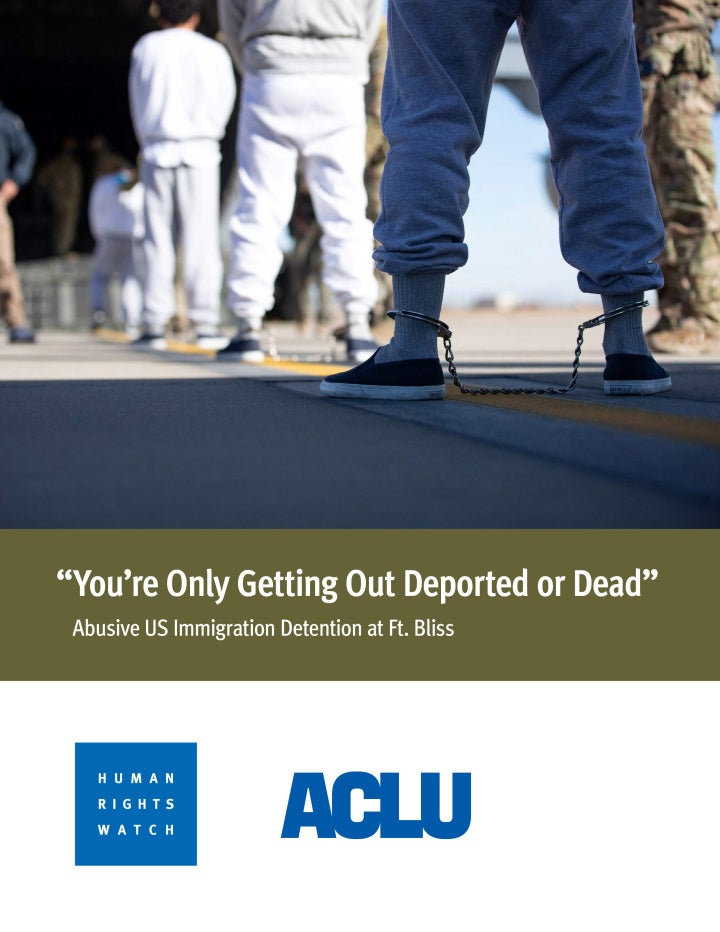
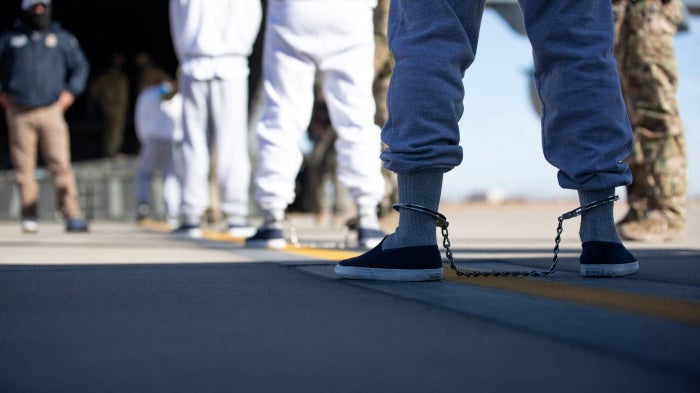
The 84-page report, “‘You’re Only Getting Out Deported or Dead’: Abusive US Immigration Detention at Ft. Bliss,” documents conditions at the largest immigration detention facility in the United States. The detention camp has the capacity to hold up to 5,000 people and consists of five “soft-sided” tent-like structures that house detained people in penned enclosures. Inside, detainees said they were forced to live in filthy and cramped conditions with up to 72 people housed in each pod. Human Rights Watch found evidence of punitive immigration enforcement practices, including cruel, degrading, and inhumane detention conditions; excessive force by guards; failures to provide medical and mental health care; coercive deportation practices; and systemic barriers to legal representation.
This briefing paper describes the current humanitarian and security conditions faced by hundreds of thousands of Iraqi residents, refugees, and displaced persons, and examines priority concerns and potential humanitarian consequences in the event of war.
Many refugees who come uninvited to Australia are compelled to do so because they cannot find effective protection anywhere else, Human Rights Watch said in a new report released to mark International Human Rights Day.
China must end the forcible return of North Korean asylum-seekers and the arrest and harassment of aid workers who assist them, Human Rights Watch said in a new report released today.
Why the International Community Should Reject Australia's Refugee Policies
The government of Australia has taken increasingly aggressive measures in recent years to prevent unauthorized asylum seekers from reaching its shores. One year ago, on September 26, 2001, it enacted new legislation that extended the legal basis for its policies, which are among the most restrictive in the developed world.
The Arbitrary Application of Spanish Immigration Law
The Human Rights Watch report, "Discretion Without Bounds: The Arbitrary Implementation of Spanish Immigration Law," criticizes the Spanish authorities' uncoordinated and ad hoc application of Spanish Law 8/2000.
We recognize the many challenges presented by the pressures of increased migration and the government's commitment to honor international protection obligations. We believe that efficient immigration management and potential national security concerns can be reconciled with the protection of fundamental human rights guarantees for migrants and asylum seekers.
Rights Violations Against Migrants and Asylum Seekers
The government of Spain is violating the rights of migrants and asylum seekers who arrive illegally on Spanish shores, Human Rights Watch said in a new report released today.
The Impact of the September 11 Attacks on Refugees, Asylum Seekers and Migrants in the Afghanistan Region and Worldwide
The backlash against refugees, asylum seekers and migrants throughout the world is a serious side effect of the September 11 attacks. While governments have legitimate security concerns, there must be a balance with human rights and refugee protection standards.
Backgrounder for the World Conference against Racism, Racial Discrimination, Xenophobia and Related Intolerance
Throughout the world, refugees, asylum seekers, migrants and internally displaced persons are the victims of racial discrimination, racist attacks, xenophobia and ethnic intolerance. Racism is both a cause and a product of forced displacement, and an obstacle to its solution.
The Greek Government should as a matter of urgency take measures to alleviate the extreme overcrowding and otherappalling conditions of detention for foreigners held in police facilities in Greece.
How countries treat those who have been forced to flee persecution and human rights abuse elsewhere is a litmus test of their commitment to defending human rights and upholding humanitarian values.
The November 24-25 summit in Zagreb, with the participation of fifteen European Union (E.U.) states and Albania, Bosnia and Herzegovina, Croatia, Federal Republic of Yugoslavia, the former Yugoslav Republic of Macedonia and Slovenia, provides a unique opportunity for the E.U.
At almost no time since Burmese asylum seekers started arriving on Thai soil in 1984 has the need for protection of this group been greater. Human rights violations inside Burma continue almost a decade after the State Law and Order Restoration Council (SLORC) seized power in Burma in September 1988
Abuse of Undocumented Migrants, Asylum Seekers, and Refugees in South Africa
Unpunished attacks on foreigners in South Africa are disturbingly common; and foreigners are regularly victimized by the South African police,the army, and by guards at detention facilities. Detention conditions for migrants awaiting deportation are substandard and overcrowded. South Africa's treatment of refugees is also troubling, and fails to conform with international standards.